1.) Interstellar
I've already called this one my pick for the year's best movie. The reception otherwise seems to be lukewarm (the lack of Golden Globe nominations just one recent reminder), but that's the fickle public for you, after three huge blockbusters (The Dark Knight and Inception especially, and The Dark Knight Rises to a lesser extent, and perhaps now clearly the beginning of the cooling process). This is Christopher Nolan's opus, in a career that seems already full of them. What makes this so special is that it's the first time that the director has grounded his story less in flashy concept than the human drama that roots it. All around it's Nolan pushing all of his instincts to the next level. he was already among the elite. Now he's making a bid for something greater.
2.) Winter's Tale
Based on the Mark Helprin novel, this is the second of three high concept movies that converged to make 2014 truly exceptional in that degree, movies that didn't merely suggest but demand their ideas take center stage. Out of the three, it's no surprise that Winter's Tale ultimately proved the hardest to swallow. This was Akiva Goldsman's directorial debut. He's previously been known for his screenwriting, where no doubt opinions might rightly be split on his efforts (Batman Forever and Batman & Robin on one side, A Beautiful Mind and Cinderella Man on the other, say). I think his true apprenticeship for this movie came from his time working on Fringe, a TV series that sought to challenge audiences with the same mix of intimate character work and the baffling events that surrounded them. Obviously, the fact that it stars Colin Farrell made me interested to begin with, but Winter's Tale itself continues to fascinate me.
3.) Noah
Darren Aronofsky's sixth movie may be his best. This is a bold statement, in that his previous movies have a great deal of critical approval behind them (starting with Pi and continued through Requiem for a Dream, The Wrestler, and Black Swan). Only The Fountain has stymied the critics to the extent Noah has, and that one fell through so many cracks I bet most people still haven't even heard of it. Noah was always going to have an unavoidable profile, given that it's a biblical epic. Sixty years ago this would have been an acceptable part of the mainstream. Only this year have critics begun to speak of the controversial Passion of the Christ positively, and that one was released a decade ago to famously spectacular box office success. The thing about Noah is that it's not "acceptable" by either mainstream or religious standards. Aronofsky made an Aronofsky movie. Anyone who saw Requiem will recognize its DNA in Noah. Like Winter's Tale, Russell Crowe and Jennifer Connelly are featured. Crowe does some of his best work in a career filled with exceptional acting, portraying a man tortured by what he believed has been asked of him. I've experienced many different versions of this story, and I've been fortunate to experience several good ones. This is definitely one of them.
4.) Locke
The only actor to appear in the whole movie is Tom Hardy. Released early in the year, it received a little bit of attention given that fact, but it's been forgotten largely overlooked, and that's unfortunate. After everyone discovered Hardy in Christopher Nolan's Inception, it became harder to overlook the actor's incredible ability to reinvent himself in each new role, which is to say, acknowledge his considerable talent. He's not the first person to be the only actor in a major motion picture (a recent example would be Robert Redford in All is Lost, a kind of more subdued Castaway), but this is literally a whole movie of watching Hardy drive. He takes a series of phone calls, and as they continue, the drama escalates, because the pressure of the situation builds. This is a life that has already come undone, but over the course of the movie, it becomes obvious how. It's quite remarkable.
5.) The Amazing Spider-Man 2
In a year filled with excellent superhero movies, it's the one that the fewest truly seemed to enjoy that is arguably the best. Maybe I was biased, given how much I enjoyed director Marc Webb's earlier (500) Days of Summer, but this is the best Spider-Man movie yet, one that truly appreciates the complexities of Peter Parker's life and explores it in ways many comic books have tried over the years, but never to this emotional degree. The villains are the one concession Amazing Spider-Man 2 makes to what most other superhero movies have done. The rest of it is what it proves can still be done, if only filmmakers make the effort.
6.) Sin City: A Dame to Kill For
I liked the first one, but the second one is better. Oh, it's better. Critics have gotten audiences to agree with them that Robert Rodriguez and Frank Miller have been collaborating on a glorified novelty act, one that is relentlessly misogynistic, but if that were the case, I wouldn't expect Eva Green and Jessica Alba to have been the best parts of A Dame to Kill For. Green has been a bombshell of a different kind for nearly a decade at this point, blazing new ground in the mainstream since Casino Royale, and only recently has she begun to find roles worthy of her. I suspect the best is yet to come. Alba wouldn't get anywhere close to this kind of material from anyone but Rodriguez, which makes me anticipate the next time they work together. Throw in Joseph Gordon-Levitt, Josh Brolin, and of course Mickey Rourke, and it's not just the way this one's presented that makes it so riveting, but what the characters in it are doing, which has less to do with shock value this time, with more emphasis on storytelling.
7.) The Hobbit: The Battle of the Five Armies
Peter Jackson's likely last visit to Tolkien's Middle-earth is less compelling than its immediate predecessor, The Desolation of Smaug, but by the time it finds echoes from the first of the six-volume saga, The Fellowship of the Ring, it's clear the director made an effort to encompass the whole experience in more ways than one as he says goodbye. Until Smaug, Fellowship was my favorite of the series, with its strong character work, anchored by the death of Boromir. When Jackson first introduced Thorin Oakenshield, I thought he was a big to be a surrogate Aragorn. But as it turns out, he was Boromir all along. I haven't read the book since I was in elementary school, so had forgotten that Thorin's arc exists in it. The changes Jackson did make in his three films, including the creation of Evangeline Lilly's Tauriel, are all welcome decisions as far as I'm concerned.
Showing posts with label Seven Reasons To Love. Show all posts
Showing posts with label Seven Reasons To Love. Show all posts
Sunday, December 28, 2014

Thursday, July 17, 2014
#759. Seven Reasons - Earth: Final Conflict
In the late '90s, a decade flush in Star Trek, Majel Roddenberry helped bring a few of her late husband Gene's aborted projects to television. The first of these efforts was Earth: Final Conflict, sort of V without lizards.
Kevin Kilner, as William Boone, was the original series lead, replaced by Robert Leeshock, as Liam Kinkaid, in the second season, succeeded by Jayne Heitmeyer, as Renee Palmer (who debuted in the third season), in the fifth season. Others who appeared as series regulars throughout the five-year run from 1997 to 2002 included Lisa Howard (Lili Marquette), Richard Chevolleau (Augur), Leni Parker (Da'an), David Hemblen (Jonathan Doors), Anita La Selva (Zo'or), Melinda Deines (Street), Guylaine St-Onge (Juda), and Alan Van Sprang (Howlyn). This constantly shifting cast line-up was a source of frustration for fans, but realistically reflected the volatile nature of the Resistance's efforts to thwart to an alien invasion that seemed on the surface to be totally benevolent. Fortunes changed all the time.
My favorite character was Ronald Sandoval (Von Flores), who appeared throughout the series. He dies a punk, but embodies the best of Earth: Final Conflict's instincts. A few of the following episodes unabashedly feature Sandoval's unexpectedly nuanced role at its most dynamic, plus a few key developments otherwise:
1. "Sandoval's Run" (1x12)
Prior to this episode, as with most of the series, you may be forgiven to assume Sandoval is merely a stooge for the Taelons, the so-called Companions, helping to carry out their secret agenda. Except he's as much victim as anyone. Thanks to the CVI implant all Protectors receive (along with the Skrill weapon!), he's the opposite of what he'd otherwise be like (a parallel dimension seen in the second season episode "Dimensions" helps confirm this, where Sandoval is definitely one of the good guys). Turns out his is a tragic story, worse than Boone's experiences from the pilot.
2. "Gauntlet" (2x11)
Expanding the mythology of the series by explaining who the Jaridians are and their relationship to the Taelons, this one hints at how the series ends.
3. "Crossfire" (2x22)
The end of the second season sees Jonathan Doors' bid to become President explode in his face as he clashes with his son and the Resistance seems to come to a tragic end.
4. "Thicker than Blood" (3x6)
Liam Kinkaid's surprising link to Sandoval is exposed to his allies, who find it difficult to reconcile, especially when it means they probably ought to save the dude's life, too.
5. "Atonement" (4x17)
Sandoval's great bid for redemption on his own terms is probably his greatest moment as a character. Unfortunately it's all downhill from here.
6. "Boone's Awakening" (5x5)
As the title suggests, Boone returns, appearing for the first time since the first season finale, in a moment that helps explain the strange new circumstances for the final season, in which the Taelons and Jaridians have merged back together and become something worse.
7. "Final Conflict" (5x22)
The final episode of the series, in which Renee Palmer and Liam Kinkaid finally get to embrace humanity's destiny in space.
Classic opening theme (one of the best ever):
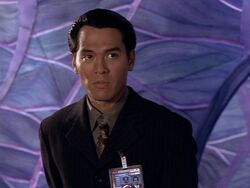
Kevin Kilner, as William Boone, was the original series lead, replaced by Robert Leeshock, as Liam Kinkaid, in the second season, succeeded by Jayne Heitmeyer, as Renee Palmer (who debuted in the third season), in the fifth season. Others who appeared as series regulars throughout the five-year run from 1997 to 2002 included Lisa Howard (Lili Marquette), Richard Chevolleau (Augur), Leni Parker (Da'an), David Hemblen (Jonathan Doors), Anita La Selva (Zo'or), Melinda Deines (Street), Guylaine St-Onge (Juda), and Alan Van Sprang (Howlyn). This constantly shifting cast line-up was a source of frustration for fans, but realistically reflected the volatile nature of the Resistance's efforts to thwart to an alien invasion that seemed on the surface to be totally benevolent. Fortunes changed all the time.
 |
| via Earth: Final Conflict Wikia |
My favorite character was Ronald Sandoval (Von Flores), who appeared throughout the series. He dies a punk, but embodies the best of Earth: Final Conflict's instincts. A few of the following episodes unabashedly feature Sandoval's unexpectedly nuanced role at its most dynamic, plus a few key developments otherwise:
1. "Sandoval's Run" (1x12)
Prior to this episode, as with most of the series, you may be forgiven to assume Sandoval is merely a stooge for the Taelons, the so-called Companions, helping to carry out their secret agenda. Except he's as much victim as anyone. Thanks to the CVI implant all Protectors receive (along with the Skrill weapon!), he's the opposite of what he'd otherwise be like (a parallel dimension seen in the second season episode "Dimensions" helps confirm this, where Sandoval is definitely one of the good guys). Turns out his is a tragic story, worse than Boone's experiences from the pilot.
2. "Gauntlet" (2x11)
Expanding the mythology of the series by explaining who the Jaridians are and their relationship to the Taelons, this one hints at how the series ends.
3. "Crossfire" (2x22)
The end of the second season sees Jonathan Doors' bid to become President explode in his face as he clashes with his son and the Resistance seems to come to a tragic end.
4. "Thicker than Blood" (3x6)
Liam Kinkaid's surprising link to Sandoval is exposed to his allies, who find it difficult to reconcile, especially when it means they probably ought to save the dude's life, too.
5. "Atonement" (4x17)
Sandoval's great bid for redemption on his own terms is probably his greatest moment as a character. Unfortunately it's all downhill from here.
6. "Boone's Awakening" (5x5)
As the title suggests, Boone returns, appearing for the first time since the first season finale, in a moment that helps explain the strange new circumstances for the final season, in which the Taelons and Jaridians have merged back together and become something worse.
7. "Final Conflict" (5x22)
The final episode of the series, in which Renee Palmer and Liam Kinkaid finally get to embrace humanity's destiny in space.
Classic opening theme (one of the best ever):
Thursday, July 10, 2014
#757. Seven Reasons - Gene Roddenberry's Andromeda
In the late '90s, probably flush in what was a decade saturated in Star Trek, Majel Roddenberry helped bring two of her late husband Gene's other projects to television. The first was Earth: Final Conflict, which was very similar to V. The second was Andromeda, which was part of a TV space opera boom that decade that included Babylon 5 and Farscape. Come to think of it, Andromeda was kind of a mix between those two. It was an attempt to create an alternative to Star Trek saturated with wild sci-fi concepts heavily steeped in an ambitious mythology.
Fans tended to think of Andromeda in two ways: 1) it was developed by Star Trek: Deep Space Nine writer Robert Hewitt Wolfe and 2) it starred Kevin Sorbo. A few years after the launch of Andromeda, another Star Trek alumni, Ron Moore, launched a very different kind of space opera in Battlestar Galactica. Wolfe left Andromeda, famously, partway through the second season, taking with him any sense of creative integrity, at least as far as the fans were concerned. Left behind was Sorbo, who had made his name previously in Hercules: The Legendary Journeys, which at some point had become better known as the series where Xena: Warrior Princess came from.
Long story short, Andromeda grew to have a poor reputation. It's another thing I love that very few others do. Here are seven episodes that showcase the series at its best:
1. "Under the Night" (first season)
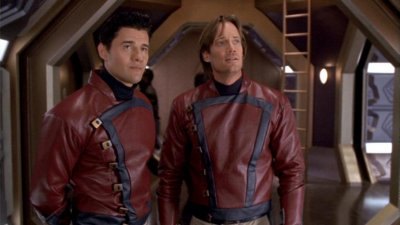
First episode of the series, establishes the Systems Commonwealth and its fall from betrayal by the Nietzscheans as represented by Dylan Hunt (Sorbo) and his first officer and best friend, Rhade (Steve Bacic, who was far from done with Andromeda despite his character dying this episode). The second hour, "An Affirming Flame," sets up the salvage crew who round out the rest of the cast and how Dylan hopes to revive the Commonwealth after being stuck in a black hole for three hundred years.
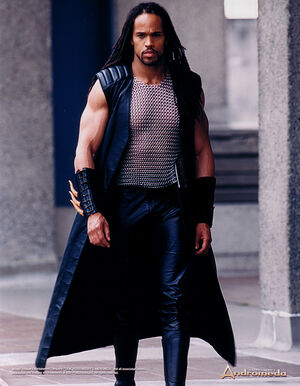
Probably the favorite character of just about every fan was Tyr Anasazi (Keith Hamilton Cobb, whom Jason Momoa can probably thank for his whole career). Tyr was Dylan Hunt's constant rival, the consummate Nietzschean, incredibly cool, you name it. When the decision was made to switch focus more heavily on Dylan, every fan assumed this would be at the expense of Tyr most of all. His great arc begins with this episode, however, after the switch, as he conceives a son destined to be the messiah of his people (and genetic reincarnation of Drago Museveni , a name so awesome I could not pass up the opportunity to put in this series recap) and suddenly his loyalties, always reluctantly in Dylan's favor, shift. The best character in his best episode.
The great Tony Todd guest-stars in this episode that features the Andromeda version of Star Trek.
Is that Rhade, the dead Nietzschean, again? Indeed! This is before his genetic reincarnation, introduced in "Home Fires" a season earlier, becomes a regular in the fourth season. That means this is the original, in an alternate life where he's the one, not Dylan, who survived the fight in "Under the Night." Andromeda frequently meditated on fate, but this is certainly one of its more interesting efforts in that regard.
Although he returns for a handful of appearances in the fourth season (to be killed off), Tyr's farewell must be considered the highlight of Andromeda's stream of ambitious season finales. This is the man bowing out on his own terms, switching allegiances but getting fond farewells from everyone anyway.
The series finale, in which everything is resolved, including the Seefra System tangle, Trance's true nature and ultimate role, the fate of the Commonwealth. Typically, Andromeda goes out big.
Fans tended to think of Andromeda in two ways: 1) it was developed by Star Trek: Deep Space Nine writer Robert Hewitt Wolfe and 2) it starred Kevin Sorbo. A few years after the launch of Andromeda, another Star Trek alumni, Ron Moore, launched a very different kind of space opera in Battlestar Galactica. Wolfe left Andromeda, famously, partway through the second season, taking with him any sense of creative integrity, at least as far as the fans were concerned. Left behind was Sorbo, who had made his name previously in Hercules: The Legendary Journeys, which at some point had become better known as the series where Xena: Warrior Princess came from.
Long story short, Andromeda grew to have a poor reputation. It's another thing I love that very few others do. Here are seven episodes that showcase the series at its best:
1. "Under the Night" (first season)
 |
| via DVD Talk |
2. "Ouroboros" (second season)
The episode where everything changes. Wolfe's final episode. Rev Bem (Brent Stait) departs as a series regular. Harper (Gordon Michael Woolvett) finally loses the nasty Magog larvae he picked up at the start of the season. Trance (Laura Bertram) switches from purple to gold, loses tail. The prime example of just how wild the series could be with its science fiction.
 |
| via Andromeda Wikia |
3. "Immaculate Perception" (second season)
 |
| via Andromeda Wikia |
4. "The Lone and Level Sands" (third season)
 |
| via Veehd |
5. "The Unconquerable Man" (third season)
 |
| via Veehd |
6. "Shadows Cast by a Final Salute" (third season)
 |
| via Sidereel |
7. "The Heart of the Journey, Parts One and Two" (fifth season)
 |
| via OV Guide |
I haven't even mentioned Beka (Lisa Ryder), Rommie! (Lexa Doig), or Doyle (Brandy Ledford), three more strong ladies, or Beka's Uncle Sid (John de Lancie), or any number of exceptional elements or moments from the series. If anyone ever made a movie out of Andromeda, I think more people would understand how awesome it really was.
Monday, July 07, 2014
#756. Seven Reasons - Star Trek: Enterprise
I'm always among the select few among people who love what I love. It should be no big surprise that I love Star Trek: Enterprise, unabashedly. Here are seven episodes of the series at its finest, and then seven more from the character who helped make the series its finest:
1. "Fortunate Son"
Travis Mayweather got a lot of flak for being the least featured main cast member in modern franchise history, although he got two feature episodes during the four seasons of the series (far more than similar characters in the original series). I was fascinated with his backstory, coming from a family of Boomers, humans who lived on ships well before it became the norm in Starfleet. This first season episode is the first time we have a look at what that kind of life was like, and what it's like to see progress pass you by.
Scott Bakula's Quantum Leap co-star Dean Stockwell made a visit in this first season episode that took a different look at the Suliban, from a sympathetic standpoint. The historic reunion was itself worth the price of admission, but the story around it was more than sufficiently weighted to justify it, and completely threw off all expectations. A similar episode from the Xindi arc third season, "The Shipment," explores the matter of reconsidering assumptions.
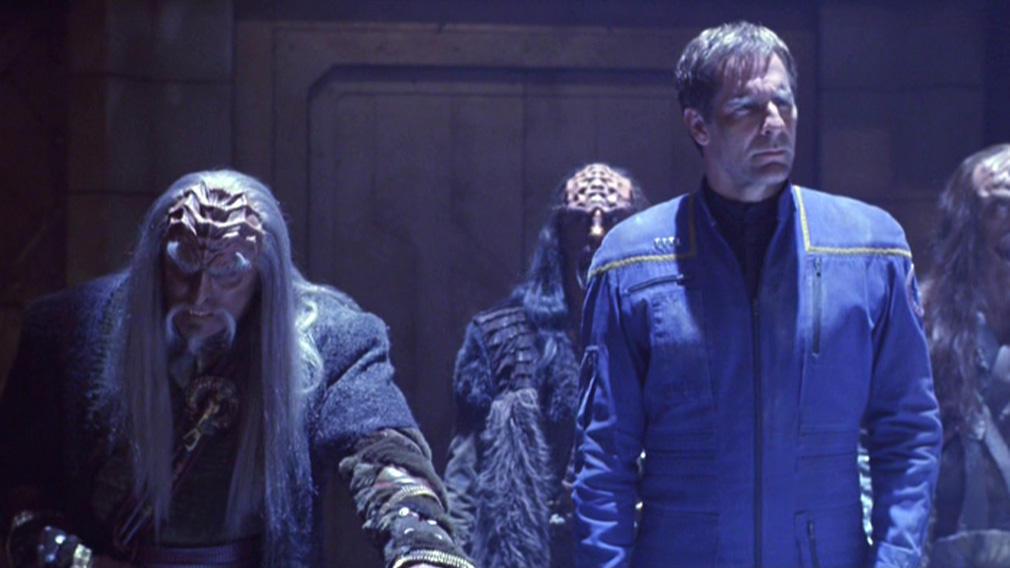
One of two episodes extrapolated from Star Trek VI: The Undiscovered Country (the other is Voyager's "Flashback"), featuring a Klingon trial and sentence to Rura Penthe. Except this is no ode. This is one of Star Trek's periodic Rashomon tales, featuring two very different versions of an encounter between our crew and a Klingon ship. The significant bonus is J.G. Hertzler (best known in the franchise as Martok in Deep Space Nine) helping to broaden our sense of Klingon society, which after DS9 and Next Generation, you probably didn't even think was possible.
Similarities to other reboot episodes are a moot point: this is the best episode of the Xindi arc, one of two standouts (the other is "Similitude") that dramatize the ramifications of the crew's desperate mission that have nothing to do with the mission itself, but rather its human toll. After an accident, Archer can no longer form new memories. T'Pol elects to stay by his side and refresh him on current events, a situation that endures for years.
Besides "Twilight" and "Similitude," this is the finest episode of the third season, and continues the surprisingly contemplative trend of all these episodes. And that's the thing about Enterprise. It's not really merely a prequel or merely another series about space exploration. It took a great deal of time to just think about things. It's like the Next Generation episode "The Drumhead" expanded as an entire series. This one's about the nature of enemies. Degra had already expressed misgivings about what his Xindi brethren expected him to do in creating a weapon capable of destroying Earth, yet he's no closer to switching sides than any other of his kind when confronted directly by Archer.
One of the earliest fourth season episodes looked back at what the series had done rather than attempt to revise its whole approach, as with the rest of the final season. This one deals with the emotional fallout from the Xindi arc, both its toll on Archer and where it left the relationship between Trip and T'Pol (despite what the above image seems to suggest, it's not marriage). Similar to "Family" from Next Generation, which found Picard healing from his Borg experience, "Home" is an episode fans of the series can't help but love, and as such may be ideal to help the uninitiated discover a little love for themselves.
1. "Fortunate Son"
 |
| via Beyond the Farthest Blog |
2. "Cold Front"
The whole concept of the Temporal Cold War baffled fans who thought the series was only going to be a prequel, and then moreso when the conflict only came up occasionally. The only real disservice the arc ever got was when it was jettisoned at the start of the fourth season. Otherwise this episode from the first season will always be a highlight, the introduction of Daniels and the best spotlight for Suliban Cabal agent Silik, who tries to convince Captain Archer that they're not actually on opposing sides. The next most intriguing episode in the arc would be "Future Tense" from the second season. That one features Tholians, rebooted time, arms being cloaked. Good stuff.
 |
| via Star Trek |
3. "Detained"
 |
| via Star Trek |
4. "Judgment"
 |
| via Borg (how awesome is that?) |
5. "Twilight"
 |
| via We Minored in Film |
6. "Stratagem"
 |
| via Angriest |
7. "Home"
 |
| via Cygnus-X1 |
The bonus round is for me a no-brainer. The best character of the series wasn't Captain Archer, but his faithful engineer, Charles "Trip" Tucker III. He might have seemed like a McCoy knockoff at first, the good 'ol country boy, but the wealth of narrative material, and potential, he provided was invaluable, essential, and exactly the subject that infamous series finale really featured.
 |
| via the Green Asterisk |
- "Shuttlepod One" (first season) Trip and stuffy Malcolm Reed don't kill each other, but rather end up bonding. The start of one of Trip's many defining relationships.
- "Desert Crossing" (first season) The best example of Trip and Archer's relationship, which features the always-excellent Clancy Brown, and Trip saying this (while suffering from heat exhaustion and trying to humor Archer's request that he take his mind off the heat by talking through the major components of the warp reactor): "Well, there's the drumsticks, thighs, wings. You got anything to eat around here?"
- "First Flight" (second season) In which we experience how Archer and Trip meet, which takes the form of a story Archer tells T'Pol, a reciprocation of "Carbon Creek" from earlier in the season.
- "The Expanse" (second season) Besides a flood of Trip episodes that season, it became all the more obvious how valuable he was to the series when the Xindi arc was kicked off as affecting Trip most directly with the loss of his sister during the original attack.
- "Similitude" (third season) Trip is mortally wounded, Phlox proposes a solution that leads to medical and ethical dilemmas, and Archer must decide how these matters conclude. The character study of all character studies in this series, with the character of all characters in this series.
- "Demons"/"Terra Prime" (fourth season) Often considered the "real" series finale (and featuring Peter Weller in the franchise years before Star Trek Into Darkness), this is the culmination of the Trip/T'Pol relationship. I dare you to not become emotional at its conclusion.
- "These Are the Voyages..." (fourth season) Often listed as one of the worst episodes of the series, mostly because Next Generation characters "hijacked" the final episode, this is actually a Trip story, stripping away all distractions. And what better way to end the series than with one last rumination on its best character? I don't even mind that it features his death. Why would I? Does death diminish a life? In a way, it was completely appropriate. This was the end of the franchise in some ways, certainly that era. There was a prominent tie-in with another series. There was Archer finally intoning (part of) the famous motto. And there was every character talking about Trip. I couldn't possibly have asked for something better. I think once fans have a more favorable impression of the series, they'll come around and agree with me.
Thursday, July 03, 2014
#755: Seven Reasons - Star Trek: Voyager
Listen, I know all about Star Trek: Voyager's reputation. If Enterprise hadn't come along after it, Voyager would have easily been the least popular Star Trek series ever (at least among the fans who don't fanatically remember Deep Space Nine). Captain Janeway became increasingly polarizing as the series progressed, reaching a crescendo in the sixth season (which itself wasn't...popular; we'll leave it at that) when she and Chakotay clashed over the issue of torture ("Equinox, Part II," one of many episodes in the franchise that would take on far greater significance in later years), and helped define opinions on Voyager as a whole. Yet the most controversial aspect of the series was tied intrinsically into its premise: a Starfleet ship stranded tens of thousands of lightyears away from home, with a crew comprised of a mix between loyal officers and Federation rebels known as the Maquis.
The creators of the series made the choice to keep Voyager similar to the kind of series that had come before it, which meant the characters lived by a set of relatively fixed moral ideals. The ship itself managed to make it through seven seasons intact (with an infamously endless supply of shuttlecrafts), the crew didn't end up killing each other, and the Starfleet code of behavior was upheld. A lot of fans thought these were terrible mistakes.
Surprisingly, Voyager dipped into alternate scenarios about what might have happened on a number of occasions. Here's a list of seven such stories:
1. "The 37's"
Usually understood to be the second season premiere, this was the Amelia Earhart episode, but more significantly this was also the first opportunity the crew had to leave the ship and settle down in the Delta Quadrant. Among all the other scenarios, this one is least often considered because of course it's the least exciting. By the time Janeway figures out what's really going on concerning Earhart and other human abductees, she decides she's found an ideal place for her crew to be able to decide for themselves if they want to stay on the journey home, which will probably take decades and consume the best years of their lives, or simply start over someplace new.
2. "Cold Fire"
The whole reason the ship is in this predicament is because of the eponymous being in the series premiere, "Caretaker," who mentions during the course of that episode that he has a mate somewhere. Among the other chances of finding an easy solution home, this is clearly the most natural one. Except when they find her, she's is far less accommodating. "Cold Fire" occurs during the second season.
3. "Worst Case Scenario"
This is the third season episode that addresses definitively the potential for decisive conflict between the Starfleet and Maquis crews, cleverly extrapolated from a holodeck program created by tactical officer Tuvok. Other episodes ("State of Flux" from the first season, "Repression" from the seventh, and pretty much the entirety of the second season) suggest how things might have developed beyond successful integration (which began with Chakotay becoming first officer and B'Elanna Torres chief engineer early on, and then the rank and file trickling in thanks to efforts like the one in "Learning Curve"), but this one, which also features the one Maquis who did refuse to play along (Seska, whose relationship with Chakotay served to provide the series with some of its best material, culminating in "Maneuvers" and the two-part "Basics"), explains pretty well why things played out the way they did.
4. "Year of Hell, Parts I & II"
Otherwise known as the Battlestar Galactica Option, wherein everything that can go wrong does, with the whole ship disintegrating over time, crew complement dwindling, captain going down with her ship, you name it. This one was one of the earliest two-hour events, from the fourth season, which became a staple for the series. It's worth noting that although Battlestar was a critical darling beloved by its fans, it still had anemic ratings. In fact, until recent times, and with the exception of X-Files, every single genre series fans turned to as alternatives to the Star Trek experience wasn't anymore popular than Star Trek itself, and in most cases in fact fared worse with the public. For fans to say this is how it should have been done still boggles me, because even Battlestar turned less bleak (and arguably less appealing to even its own fans) as it continued.
5. "Message in a Bottle"
Contact with home started becoming a staple in the fourth season thanks to a Hirogen relay network, which enabled Voyager's irrepressible Holographic Doctor to make a house call (or two), starting with this episode. Being far easier to transplant from one place to another, the Doctor was always a secret trump card. Except he couldn't take everyone else with him.
6. "Equinox, Parts I & II"
What if Janeway constantly compromised herself? That's the basis for this cliffhanger that straddled the fifth and sixth seasons, in which a different Starfleet crew in the same predicament is encountered, and that's exactly what Captain Ransom did, throwing away his Starfleet principles in order to gain whatever edge he could. When faced with this ugly counterpart, Janeway is herself pushed to the edge. In other episodes like "Night," fans got to see the incredible strain she was under to remain the stoic idealist she was throughout the series, but this is the one where she nearly crosses the line (to say nothing of the Borg).
7. "Live Fast and Prosper"
Narrowly beating out "Worst Case Scenario" and "Message in a Bottle" as the most fun episode on this list, "Live Fast" is, like "The 37's," an option fans rarely considered for a ship completely cut off from home. Being on their own and still attempting to represent not just itself but all of Starfleet without any actual Starfleet to back them up left the crew vulnerable to a group of con artists to go around pretending they were the crew. A different kind of danger than outright hostile aliens could ever represent (and the crew certainly faced plenty of those), these guys visited numerous worlds, making bargains they never intended to live up to, all while presenting themselves as rough proximities of Janeway, Tuvok, and Chakotay.
And because fans often forget that Voyager could actually be pretty good on its own terms (and beyond), here's a bonus list of seven good episodes:
The creators of the series made the choice to keep Voyager similar to the kind of series that had come before it, which meant the characters lived by a set of relatively fixed moral ideals. The ship itself managed to make it through seven seasons intact (with an infamously endless supply of shuttlecrafts), the crew didn't end up killing each other, and the Starfleet code of behavior was upheld. A lot of fans thought these were terrible mistakes.
Surprisingly, Voyager dipped into alternate scenarios about what might have happened on a number of occasions. Here's a list of seven such stories:
1. "The 37's"
 |
| via Trek Core |
Usually understood to be the second season premiere, this was the Amelia Earhart episode, but more significantly this was also the first opportunity the crew had to leave the ship and settle down in the Delta Quadrant. Among all the other scenarios, this one is least often considered because of course it's the least exciting. By the time Janeway figures out what's really going on concerning Earhart and other human abductees, she decides she's found an ideal place for her crew to be able to decide for themselves if they want to stay on the journey home, which will probably take decades and consume the best years of their lives, or simply start over someplace new.
2. "Cold Fire"
 |
| via Robert Beltran (fansite). Not Soval, but the same actor. |
3. "Worst Case Scenario"
 |
| via Trek Core |
This is the third season episode that addresses definitively the potential for decisive conflict between the Starfleet and Maquis crews, cleverly extrapolated from a holodeck program created by tactical officer Tuvok. Other episodes ("State of Flux" from the first season, "Repression" from the seventh, and pretty much the entirety of the second season) suggest how things might have developed beyond successful integration (which began with Chakotay becoming first officer and B'Elanna Torres chief engineer early on, and then the rank and file trickling in thanks to efforts like the one in "Learning Curve"), but this one, which also features the one Maquis who did refuse to play along (Seska, whose relationship with Chakotay served to provide the series with some of its best material, culminating in "Maneuvers" and the two-part "Basics"), explains pretty well why things played out the way they did.
4. "Year of Hell, Parts I & II"
 |
| via Iain's Blog |
Otherwise known as the Battlestar Galactica Option, wherein everything that can go wrong does, with the whole ship disintegrating over time, crew complement dwindling, captain going down with her ship, you name it. This one was one of the earliest two-hour events, from the fourth season, which became a staple for the series. It's worth noting that although Battlestar was a critical darling beloved by its fans, it still had anemic ratings. In fact, until recent times, and with the exception of X-Files, every single genre series fans turned to as alternatives to the Star Trek experience wasn't anymore popular than Star Trek itself, and in most cases in fact fared worse with the public. For fans to say this is how it should have been done still boggles me, because even Battlestar turned less bleak (and arguably less appealing to even its own fans) as it continued.
5. "Message in a Bottle"
 |
| via My Year of Star Trek. Be quiet, Andy Dick! |
6. "Equinox, Parts I & II"
 |
| via Cinema Blend |
What if Janeway constantly compromised herself? That's the basis for this cliffhanger that straddled the fifth and sixth seasons, in which a different Starfleet crew in the same predicament is encountered, and that's exactly what Captain Ransom did, throwing away his Starfleet principles in order to gain whatever edge he could. When faced with this ugly counterpart, Janeway is herself pushed to the edge. In other episodes like "Night," fans got to see the incredible strain she was under to remain the stoic idealist she was throughout the series, but this is the one where she nearly crosses the line (to say nothing of the Borg).
7. "Live Fast and Prosper"
 |
| via Furious Fan Boys. (Probably wouldn't like this post.) |
Narrowly beating out "Worst Case Scenario" and "Message in a Bottle" as the most fun episode on this list, "Live Fast" is, like "The 37's," an option fans rarely considered for a ship completely cut off from home. Being on their own and still attempting to represent not just itself but all of Starfleet without any actual Starfleet to back them up left the crew vulnerable to a group of con artists to go around pretending they were the crew. A different kind of danger than outright hostile aliens could ever represent (and the crew certainly faced plenty of those), these guys visited numerous worlds, making bargains they never intended to live up to, all while presenting themselves as rough proximities of Janeway, Tuvok, and Chakotay.
And because fans often forget that Voyager could actually be pretty good on its own terms (and beyond), here's a bonus list of seven good episodes:
- "Non Sequitur" (second season) Harry Kim often gets labeled as one of the worst main characters in franchise history. Regardless, he's got at least two of the best episodes of this series under his belt ("Timeless" is the other). This one features one of his alternate lives, in which he never joined the crew. I think the fact that he was the prototypical officer who was never promoted makes Harry emblematic for a lot of frustrations. It bears remembering that Ensign Kim was in fact fresh out of the Academy at the start of the series. In a lot of ways, he's exactly the character the new Star Trek films refashioned Chekov to be, the wunderkind who was instantly fantastic at his job. "Non Sequitur" confirms Harry's potential as he's still a standout even at home. When he meets up with Tom Paris in this reality, who's a bum because he never had his shot at redemption among Janeway's crew, everything Harry accomplished right from the start, his willingness to believe in Starfleet ideals (he's also the one who exhibits the most growing pains throughout the series, perhaps best featured in "Nightingale," in which we see a bit of Sulu Complex in him), is pushed into sharp contrast.
- "Death Wish" (second season) One of the finest Q episodes isn't from Next Generation but rather Voyager, and features the impish figure in rare dramatic form, forced to confront another member of the Continuum who took his most rebellious instincts to their most extreme conclusions. This is probably the most commonly acknowledged standout episode of the series.
- "Distant Origin" (third season) You don't have to be a fan of Voyager to love this one. Told almost entirely from the perspective of the featured aliens, "Distant Origin" is an allegory about government repression, and the scientist who dares to hold true to his ideals. One of the finest episodes of the whole franchise. A similar experience can be found in "Blink of an Eye."
- "Living Witness" (fourth season) I could've listed this one in the above list, except the story is more about the perils of corrupted history (think Richard the 3rd) than specifically our crew itself. A backup program of the Doctor's is activated centuries in the future and is forced to stand trial for an errant interpretation of the ship's visit to that world.
- "Thirty Days" (fifth season) The nature of Tom Paris's conflict with his father as well as his past as a troubled officer booted from Starfleet is revisited in this one. Voyager had a lot of episodes that explored its characters in great depth. This is not even the best one, but it explains Paris so well without deliberately doing so, more as reflection based on a current predicament than what might have been done with flashbacks in any other series, that it answers one of the many complaints about the series, that the setup in "Caretaker" was never properly exploited.
- "The Voyager Conspiracy" (sixth season) The most famous character of the series wasn't introduced until its fourth season. Initially, Seven of Nine was greeted with great fanfare, because, well, she was a hot chick in a catsuit, but as time wore on the fans started to grate on her increasing dominance, and began to consider her a cheap ratings ploy. Yet she was was responsible for some of the best character moments of the series. This is a whole episode that reflects not just on Seven, but Janeway and Chakotay as well, looking at some of the very alternate scenarios explored above but in a still less-obvious manner.
- "Child's Play" (sixth season) Along with Seven came the Borg, of course. A lot of fans had a huge problem with this. It seems the more the Borg appeared the more of their mystique was lost. And apparently a huge part of the Borg's allure was their mystique. Yet there were considerable benefits to their increased exposure, such as exploring their untapped story potential. Earlier there had been "Hope and Fear," in which an alien attempts to take revenge on the ship for the fallout of events from "Scorpion," the two-part episode that started the Borg rolling in Voyager. "Child's Play" concerns Icheb, one of the drone youths introduced a few episodes earlier, a sort of revamped Wesley Crusher whose parents apparently engineered him to be a weapon against the Collective. Yikes!
Wednesday, June 11, 2014
#751: Seven Reasons - Movie Supervillains
In the thirty-plus years of superhero movies, the constant challenge has always been to create supervillains as compelling as the superheros. Without further preamble, here's my list for the seven best to date:
1. Heath Ledger's Joker (The Dark Knight)
I was always a fan of Ledger as an actor, but it took everyone else and one great role to make him immortal, sadly right before his passing. The genius of his Joker is that it went completely against the grain, a villain who was less interested in being obvious (which is what virtually every other supervillain does in these movies) and more understating...pretty much everything. No origin. Slapdash clown makeup. First scene he's introduced seemingly as just another goon. There's nothing I don't like about the performance, the part, how it fits into the rest of The Dark Knight. Instantly the gold standard for movie supervillains.
2. Tom Hiddleston's Loki (Thor, The Avengers, Thor: The Dark World)
I've been lukewarm on the Avengers movies from the start (Iron Man does not have a representation on this list), but one of the elements I loved instantly was also one of the most unexpected ones: a supporting character in Thor. I didn't expect great things from Thor. It was fine. But it just seemed, right from the start, like a kind of pointless excuse to add to the cinematic Avengers cycle. Without the rest of the team, would anyone really care that much about the guy? But his troubled brother Loki? Even with an arc that still hasn't gone anywhere three appearances later, the dude oozes charisma. He's a bad guy who's really easy to love (I mean, even blatantly stealing from Terence Stamp's iconic Zod in Avengers with the whole "kneel before me" thing doesn't hurt him). I would watch a whole movie headlined by Loki. Easily.
3. Thomas Haden Church's Sandman (Spider-Man 3)
Everyone knows Spider-Man 3 is the black sheep of the Sam Raimi Spider-Man films. Yet I've always been a fan, and it's mostly thanks to the reinterpretation of Uncle Ben's death. Turning the story around has a number of intriguing possibilities (arguably Marc Webb's Spider-Man films have benefited greatly from them), but here this means we actually get to sympathize with the villain, which is certainly rare enough. Haden Church had just experienced a career resurgence thanks to Sideways, which had the effect of finally exposing his dramatic potential. He's the rare supervillain actor to have been given the chance to explore that side, and because of all the other things going on in the movie, he's free to focus exclusively on that. He nails it. I would watch a Sandman movie, too.
4. Tom Hardy's Bane (The Dark Knight Rises)
I've long been a fan of Hardy's, so I was already expecting great things from him, although even for me (see above) it was a tall order to follow Heath Ledger. He did it. He knocked it out of the park. There have been various criticisms, such as Bane's hard to hear (he really isn't) or being revealed as Talia's henchman weakens the character (it really doesn't). Like Ledger's Joker, Hardy nails the ability to create a character who clearly doesn't mind calling attention to himself without making a parody of a character, which is what happens far too often with movie supervillains.
5. Anne Hathaway's Catwoman (The Dark Knight Rises)
A real argument could be made for Dark Knight Rises being...a Catwoman movie. Every one of Hathaway's scenes is fantastic and as a whole carry a full story. Her status as a villain fluctuates throughout the movie, although for most of it there's no real question. A lot of people have long praised Michelle Pfeiffer's version of the character, as many who have maligned Halle Berry's. Neither really has a ton of subtlety, which is something Hathaway accomplishes easily despite most of her scenes calling for high emotion or pithy remarks. If any movie supervillain has approached Tom Hiddleston's Loki, it would be Hathaway's Catwoman.
6. Ian McKellen's Magneto (X-Men, X2, X-Men: The Last Stand, X-Men: Days of the Future Past)
The whole reason I couldn't really get into Michael Fassbender as Magneto in X-Men: First Class is because he wasn't nearly as compelling in the role as McKellen. McKellen's Magneto isn't even my favorite role from the actor, but c'mon. The man knows how to act. Aside from Hugh Jackman, he's the actor who helped the X-Men films really take off in the first place. Without him, most of their dramatic weight would be gone, and these are movies that need that. I argue that the Avengers movies are less successful creatively because they don't have a Magneto. If Loki were more prominent, instead of the guy who keeps stealing movies, I'd like them a lot more. I like the X-Men movies more when McKellen's Magneto is around.
7. Jennifer Garner's Elektra (Daredevil, Elektra)
I think the whole reason Daredevil quickly lost mainstream support is because Garner stole the movie. At the time she was best known for the TV series Alias. In a lot of ways, her Elektra is exactly like her Sydney Bristow. Like Hathaway's Catwoman, she's not really a villain. In fact, even less so. But the story often pits Elektra and Daredevil against each other, and every time, Elektra easily holds her own. When she received her own spin-off a few years later, it was a nonevent. Everyone wanted Daredevil to show up. That's a testament to Elektra's appeal, that it wasn't just her alone, but how she fit so well in Daredevil's story, how essential she was to him and he to her. The more people disassociated them, the more they only thought about Ben Affleck, who played Daredevil. At the time he was on the verge of a career decline, and so pretty much everything he did was interpreted unfavorably. But watch this one again. It's great. And Garner's Elektra is a huge reason why. She's a villain who's not really a villain. They say all villains see themselves that way. This is a chance to see that make some sense for a change, cleverly turning classic Hollywood romantic comedy tropes on their head.
I do have a number of runners-up:
Who're your picks?
1. Heath Ledger's Joker (The Dark Knight)
2. Tom Hiddleston's Loki (Thor, The Avengers, Thor: The Dark World)
3. Thomas Haden Church's Sandman (Spider-Man 3)
4. Tom Hardy's Bane (The Dark Knight Rises)
5. Anne Hathaway's Catwoman (The Dark Knight Rises)
6. Ian McKellen's Magneto (X-Men, X2, X-Men: The Last Stand, X-Men: Days of the Future Past)
7. Jennifer Garner's Elektra (Daredevil, Elektra)
I do have a number of runners-up:
- Gene Hackman's Lex Luthor (Superman, Superman II, Superman IV: The Quest for Peace)
- Kevin Spacey's Lex Luthor (Superman Returns)
- Terence Stamp's Zod (Superman II)
- Michael Shannon's Zod (Man of Steel)
- Colin Farrell's Bullseye (Daredevil)
- Jack Nicholson's Joker (Batman)
- Peter Sarsgaard's Hector Hammond (Green Lantern)
- Sam Rockwell's Justin Hammer (Iron Man 2)
- Liam Neeson's Ra's al Ghul (Batman Begins, The Dark Knight Rises)
And all of them I could wax fantastic about.
Who're your picks?
Tuesday, June 03, 2014
#749. Seven Next Generation Episodes to Remember
Last November I wrote about characters from The Next Generation (1987-1994) that Star Trek fans who know Picard's crew only from their movies (Generations, First Contact, Insurrection, Nemesis) would never have met. It recently occurred to me that there are large swathes of the crew's legacy that would be hard to truly appreciate without having seen at least some of the series. Fans who existed at the time Next Generation was on the air wouldn't need a reminder like this, but we're now twenty years past the end of the series (no, really!), which is plenty of time for new fans who may not particularly have the time to sit through a hundred-seventy-odd hours (although, of course, there's binge-watching as a whole thing these days, which I'm not ashamed to admit I helped pioneer) but could easily watch the movies, if the new movies have indeed been making new Star Trek fans.
Here's the list:
1.) "The Measure of a Man"
Anyone who watches the movie will obviously know Data is an android, but by the time Generations comes around he's undergone a dramatic revision of his character. He's lost one of the biggest hurdles in his quest to become more human. "Measure" is the episode that doesn't just spotlight that quest, but threatens to take it away from him. Insurrection is kind of a sequel to the episode, actually, in a lot of ways (another reason to take this particular movie more seriously), the way Admiral Dougherty casually dismisses Data. It's also an early look at Data's relationship with Picard, which really doesn't get picked up again until the movies.
2.) "Sins of the Father"
Surprisingly, one of Next Generation's most distinctive characters, Worf, really only has a fitting spotlight in one of the films (First Contact), which doesn't even address most of what he was all about in the series. Consider "Sins" a primer on everything you need to know about the proud Klingon warrior, from his background to his relationship with other Klingons (don't expect a lot of happiness).
3.) "The Best of Both Worlds, Parts 1 & 2"
First Contact is a sequel to this defining moment from the series, one that is useful in experiencing itself, from how Picard initially confronts the Borg to the process of disconnecting him from it. Riker has a considerable role in the first part, which goes a long way to expanding his characterization.
4.) "Brothers"
The other side of Data's journey in the series is his surprisingly complicated family situation, which includes his creator, his brother, and the pesky emotion chip that he finally receives in Generations. This is probably the most concise exploration of the whole affair.
5.) "The First Duty"
There isn't really a good Dr. Crusher episode worth recommending, but there are plenty of Wesley Crusher episodes to choose from (really!), including this one where he admits to wrongdoing at Starfleet Academy, which sees the cadet confront both his mother and Picard.
6.) "Ship in a Bottle"
Next Generation was famous, some might say infamous, for introducing the holodeck to Star Trek lore. The best use of the holodeck was the underrated character of Moriarty (who debuted in "Elementary, Dear Data"), a truly cerebral villain fit for the character of the series itself.
7.) "Tapestry"
Arguably the best Q episode also explores aspects of Picard suggested in Nemesis, i.e. his surprisingly rebellious youth. Given a chance to revisit those days, the thoughtful older Picard is surprised to discover that he needed to make the mistakes he did in order to become the man he is.
Have any episodes you think deserve consideration? Sound off in the comments!
Thursday, March 27, 2014
#711. Seven best elements from Star Trek: Deep Space Nine's third season
Do I love Star Trek? Is Deep Space Nine my favorite Star Trek? Is the third season my favorite from DS9? The answers to these questions are all "yes." Now let's move on to the list!
- The Defiant - For the first two seasons of the series, anytime the personnel of the space station wanted to go somewhere, they had to take a ride in a runabout, which was DS9's version of the classic Star Trek shuttlecraft. One of the very first things seen in the third season premiere, the two-part "The Search," was Benjamin Sisko arriving at the station in the Defiant, the first Starfleet warship. It was Sisko's baby, something he helped develop thanks to his personal experiences during the Borg invasion that culminated in the Battle of Wolf 359, when he lost his wife Jennifer. The thing about the Defiant, rushed into service thanks to the new Dominion threat that saw a Galaxy-class starship (the same as the Enterprise-D) destroyed by a single Jem'Hadar fighter, was that it was a little overpowered. It was in constant danger of shorting out. Oh, and it had a cloaking device, on loan from the Romulans. The ship, and its successor, remained attached to the station for the remainder of the series, and was even featured in Star Trek: First Contact. It was a "tough little ship." And it remained Sisko's baby. And it was very, very sweet. Great way to kick off the season!
- Michael Eddington - Another addition to the series in "The Search" was the new Starfleet security chief. This was a position that Odo briefly had to contend with in the first season, but Eddington actually worked with the constable, respected him. And he trusted Sisko implicitly. He was a reliable presence in the series, not overly noteworthy, until...well, he revealed himself to be a member of the Maquis, the rogue group of Federation citizens who declared open war on the Cardassians. And how did he do it? By setting up Sisko's girl, Kasidy Yates, for the fall. And that made it personal. And that made a DS9 legend out of Michael Eddington.
- "Past Tense" - The season had a couple of two-hour adventures, but this time-traveling trip to the Bell Riots of the early 21st century featuring Sanctuary Districts for the homeless and unwanted rang most brilliantly. Sisko ends up having to replace Gabriel Bell after the man who would help bring about social reform is killed. And what is the fate of Bell according to the timeline? Oh, death. How is he going to make it out alive? This is sort of like the DS9 version of the original series classic "The City on the Edge of Forever." But I'd say "Past Tense" is better.
- "Explorers" - One of the reasons the third season was so memorable for me was that it was to that point and even for the rest of the series the best season for Sisko material. It found him at his most comfortable, and he couldn't get more comfortable than getting to hang out with his son Jake and working on a personal project, building a replica of an ancient Bajoran solar ship and then making the journey from Bajor to Cardassia just to prove it had actually happened. We learn Jake's plans for the future, his father's estimation of his writing, and generally just spend time with the Siskos. It's a sublime hour.
- Kasidy Yates - The Eddington affair would happen later, but both characters debut this season, so it's only fitting that their fates would intertwine again. Yates is a freighter captain, whose brother actively plays baseball, Sisko's main passion in life. They're positively fated to fall in love. If they can just overcome the problems of building a relationship while both leading demanding lives! Even if Penny Johnson didn't enter pop culture lore in this role, she would later, as the scheming wife of David Palmer in 24.
- Jennifer Sisko - The other woman in Sisko's wife appeared in Prophet-induced vision form in the series pilot, "Emissary," but finally appeared in the present thanks to the Mirror Universe, which saw the first of its two greatest hours in DS9 happen this season, "Through the Looking Glass." In the Mirror Universe, Sisko is dead. In our universe, Jennifer is dead. Their meeting this season is our chance to see them together, in all its awkward glory, given the circumstances. (Is that Tuvok, from Voyager? Well, no. Technically, it's Mirror Tuvok.) And finally, this character enters living DS9 history. Next time, Jennifer Sisko dies again, alas...
- Captain Sisko - Besides gaining a ship, Sisko also finally attains the rank of captain this season. (Wait, did I just fill this entire list with Sisko elements? Yes, yes I did. Also, Bashir and O'Brien singing "Jerusalem." Classic, classic stuff right there.) For the first two seasons, not only was there no starship in a Star Trek series for the first time, but the lead was a commander instead of a captain. This season corrected both of these oversights. In the season finale, "The Adversary," Sisko is not only sporting his goatee (Avery Brooks started out with the original look to distinguish the character from his other notable TV role, which saw him star in A Man Called Hawk for a season, spinning off from Spenser: For Hire), but gets promoted, too. I didn't mention Garak's shenanigans during the season. I'm sure Captain Sisko wouldn't have minded if Garak just stopped trying to meddle in things, and really did stick to being a plain, simple tailor...And Odo finally solving the mystery of his people? Say hello to the Founders. And just try and say goodbye!
Just in sheer terms of being the best series material possible, I'd say this season at least ranks with the best ones throughout the whole Star Trek franchise. But since this is my blog, I will just go ahead and say this is the best season of Star Trek. Ever. Did I mention Quark's Klingon bride? Because that happens, too. And the Rules of Acquisition are revised. And Bareil is turned into a robot. And O'Brien shifts through time. And Kira is tricked into believing she's Cardassian. And Nog decides to enter Starfleet. And Jadzia meets all the previous Dax hosts. And Odo almost ends up remaining one of them. And...and...and...!
Thursday, March 06, 2014
#696. Seven characters who explain Lost
I love Lost. Lost was immensely popular even though it routinely baffled its fans. The only thing that stains its memory now is that in its conclusion, Lost managed to remain true to that trend. More people seem to think that it never really explained everything and therefore ends up being unsatisfying than those who think it did and therefore remains immensely satisfying.
So here I am making another attempt to clarify matters. I've always believed it was the characters and not the elements around them that define Lost. I mean, I thought that was always pretty clear. It was their journeys that gave meaning to anything that happened. But the characters also explain those sticky elements, too, and so here I will try to explain the series by explaining the characters, and how they define those elements better than it sometimes seems.
So here I am making another attempt to clarify matters. I've always believed it was the characters and not the elements around them that define Lost. I mean, I thought that was always pretty clear. It was their journeys that gave meaning to anything that happened. But the characters also explain those sticky elements, too, and so here I will try to explain the series by explaining the characters, and how they define those elements better than it sometimes seems.
- Jack (see also: Hurley, Michael, Mr. Eko, Claire) This is the lead character of the series. He's also someone who believes he's forever defined by a tragic past that he's always interpreted as being his fault, but it really wasn't, and so he's spent his life torturing himself, never forgiving himself, and needing redemption for it. Isn't that the whole series in a nutshell? Jack's father was always hard on him, claimed his son just "didn't have what it takes." As the lead character and most obviously heroic of the series, is that how you would describe Jack? As someone who had no idea what to do? Right from the start, right after the crash, he's the one who sets out to rescue everyone. His mirror opposite, Ana Lucia, ended up with a far different fate for her camp of survivors because she couldn't do the same. And who could? His journey on the island and even off the island, his decision to return to it, are not really about the island itself, but his continuing inability to let go. If his father was right about anything, it's Jack's need to continue pressing the issue when it seems like he should just walk away. He doesn't walk away from the Others, when he becomes their prisoner. He doesn't walk away from Juliet. He doesn't walk away from the island. He doesn't walk away from Jacob. There's always unfinished business, at least in Jack's mind, something to fix. Usually when he tries to hard to fix something, he ends up breaking it again. And that's the whole thing about the island, too, isn't it? The Others were only there to protect it. That's why Jack's father makes such a compelling and early and appropriate manifestation of the island (or the Smoke Monster, if you will). Even though Jack tends to break things he fixes, he's far closer to the final mend than anyone else.
- Kate (see also: Sawyer, Sun) Jack's perfect accomplice also punished herself the most out of anyone. She always believed in herself, but she also constantly punished herself. Every time she had a good thing, she let it slip away. It's the whole reason the island had to wait so long to find another protector, because no one had enough confidence in themselves to just do what had to be done, to stop questioning everything. Kate was pretty heroic. She's one of the few characters who when considered in full would probably make for a pretty easy villain in any other context, but when given her shot at redemption, looks exactly like a hero. She never understood the point of the island, either. She only went back out of a sense of guilt, something she thought she owed someone. If you want a character who represents that disappointment fans have in Lost, Kate's your girl. Her life was constantly disappointing her, but in large part because she kept letting it, kept provoking it, even if she never thought she was. She couldn't let go.
- Locke (see also: Walt, Aaron, Man in Black, Boone) The character, I think, who most ends up disappointed fans is Locke, who early on seemed like the one with the most to gain and who had gained the most. But then he gave us a perfect illustration of what kept happening to prevent a happy ending. He was never satisfied. He always wanted more. Even when he had far more than he could have hoped for, he wanted more. He tempted fate, just like Kate, just like Jack, but the key difference is he was always told he was special. Instead of being happy with that, he kept pushing the envelope. When you push the envelop, you sometimes end up tearing it. That's what happened with Locke, and with everyone else (even the whole Dharma Initiative) who thought they had it all figured out but were constantly surprised to learn they didn't.
- Desmond (see also: Jin, Juliet) Here's the character those frustrated fans ought to value a little more. Desmond's the one whose story ultimately transcended the series, whose defining moment had nothing to do with the mysteries of the island, but a personal triumph that was in no way negated by his further adventures. His was a love story, filled with magic. He's the one that shows what's possible when you don't obsess over what can be done but rather what needs to be done, overcoming every seemingly insurmountable obstacle along the way. Needless to say, but he's always been a favorite character of mine.
- Jacob (see also: Daniel) Even though Jacob is the important figure of the whole story, it's not really about him, and so it's entirely appropriate that it takes so long to meet him. Events eclipse him, even though without him they would never have happened. He's the embodiment of the maguffin, which is not to say he's ultimately pointless, but that if you don't worry so much about the great mysteries of the island, you see that they're really just another of the series of human woes that the series is really about. That dazzling light, those incredible properties, that's just something he protected, which is to say the ability of the island to force people to be honest with themselves, to find peace. The island is not a magical wonderland. It's a horror movie. Peace is far more difficult to find than you'd think, even with an island imbued with everything you need to achieve it. What would happen if the rest of the world had equal access to it? Just ask Jacob. He believes in the island, but he also needs to protect it. What more do you need to know?
- Ben (see also: Sayid, Shannon, Ana Lucia) A character who never asked for trouble, but trouble keeps finding him. Basically, the human condition for all the cynics, the opposite of Desmond (appropriately, they both represent the last vestiges of the Dharma Initiative). After a while, even if Ben is not really a villain, even he begins to see himself that way, believes he deserves all the bad things that happen to him. And so he continues to plot and calculate, thinking there's no point in trying to avoid his fate anymore. Perhaps the greatest beneficiary of the alternate character studies from the final season. Because before that, who would have believed that the erstwhile Henry Gale could actually be redeemed?
- Richard (see also: Charlie, Rousseau) Richard Alpert was one of the more fanciful and therefore instantly charismatic additions to the series, seemingly integral but always peripheral. No doubt he saw all these properties in himself as well. He was, in the end, the embodiment of the human connection we all crave but frequently fail to make, sometimes quite spectacularly, the necessary bonds that formed in the very first episode and remained strong despite every obstacle to the very end, cutting through every other element. Even polar bears.
Sunday, January 26, 2014
#672. Seven epic visions from J.J. Abrams
I've been a fan of J.J. Abrams for a long time. Not as long as some people (the 1998-2002 TV series Felicity was his first project to be heavily touted, but it gained most of its buzz from star Keri Russell's signature hair...and lost most of it when she lost it, although its concept-heavy final season was the first of J.J.'s big creative gambles; the largest impact on his career was the show's focus on emotional character development, which became a signature for every other project that followed; I've never seen a single episode of the series, alas, although frequent acting collaborator Greg Grunberg debuted in it, and that much is probably worth seeing), but long enough. Here are seven projects that have kept me as inspired a fan as he is an imaginative visionary:
- Alias (2001-2006) The saga of CIA agent Sydney Bristow, her father Jack, and the diabolical Arvin Sloane helped launch the popular careers of not only Abrams and star Jennifer Garner, but Bradley Cooper as well. Full of twists and turns and all the Rambaldi creations you could ever hope to handle, this was a show that was always evolving but remaining true to its origins at every turn, including the surprise revelation of the first season major villain, who turned out to be Syd's own mother, Irina Derevko.
- Lost (2004-2010) The only show that could possibly have eclipsed Alias was its immediate successor, which became a full-blown phenomenon that needs no real introduction. Fans loved to eat up its intricate mythology almost as much as they loved to dissect and lament its many developments. Abrams discovered a rich wealth of collaborators for this one, allowing him to move on to other projects in his increasingly high-profile career.
- Fringe (2008-2013) The only way to succeed Lost was to return to the intimate scale of Alias, which worked exceedingly well in Fringe, which unlike Alias pulled the focus closer and closer to its original premise with each succeeding season even while expanding it to increasingly astonishing degrees. Another project where Abrams discovered perfect collaborators, I'm still convinced that appreciation for this one has only just begun.
- Person of Interest (2011-present) The genius of this show is that it's not even considered a J.J. Abrams show, even though it's exactly a J.J. Abrams show. The brain-child of Jonathan Nolan (kid brother of Christopher Nolan) and as such featuring hallmarks of the Dark Knight script, this one is both successfully episodic in ways a broad audience can appreciate week to week, but also featuring a wider arc and classic Abrams character types in Reese and Finch, as well as several Abrams alum (Michael Emerson, Sarah Shahi, who had a minor role in the first season of Alias, and Amy Acker, a major supporting role in its last).
- Super 8 (2011) His first attempt at an entirely separate movie legacy (Abrams directs a lot of famous franchise films, you may know, including Mission: Impossible III), which a lot of people took as a pastiche on early Steven Spielberg but is a thoroughly enjoyable experience in its own right.
- Star Trek (2009, 2013) Star Trek and Star Trek Into Darkness achieved the impossible, which was to not only make this particular franchise relevant again, but more popular than ever at the box office, which was probably the whole reason he got the assignment to direct the upcoming seventh Star Wars film.
- S. (2013) This is a book, written in collaboration with Doug Dorst, which like most of what Abrams does is a love letter to the medium it's presented in as well as an entirely original and inspired piece in itself. As far as I'm concerned, it solidifies him as one of the great creative minds of our time. With it he emerges in an entirely new light, as arguably the successor of Orson Welles, what the great director of Citizen Kane might have become had he actually been embraced by Hollywood. It bodes well for whatever Abrams does not just in the next few years, but decades. I look back in this retrospective and see not the great things Abrams has done, but what he will do.
Sunday, January 12, 2014
#664. Seven key characters of Fringe
Fringe is the 2008-2013 TV series that stuck around for five seasons mostly because Fox finally listened to a devoted cult audience who realized how awesome it was even though virtually no one watched it. One of the many high concepts developed by J.J. Abrams, Fringe might initially strike you as an updated version of The X-Files with its strange-science-of-the-week format, but it's the resonating relationship between Walter and Peter Bishop that ultimately dominates and pushes Fringe to its own entirely unique and spectacular legacy.
Here are seven key characters (but by no means all of the regulars) from the series:
Here are seven key characters (but by no means all of the regulars) from the series:
- Olivia Dunham - The lead character played by Anna Torv initially very similar to Sydney Bristow from Alias (as Kate would have been on Lost if Jack had been killed off in the pilot as initially planned!), Olivia emerges as the contemplative and soulful heart of the series, whose ties to the dark matters that haunt its past and present are continually explored across two realities.
- Walter Bishop - The troubled genius rescued from an insane asylum in the pilot, portrayed brilliantly by John Noble, Walter's life defines the whole course of the series in ways that take time to understand, though it's his early life's work that gets himself and everyone else in trouble, and his reconciliation with these horrors that gives the series its emotional depth. But yes, he's also the nutcase bursting with hilarious non sequiturs. It would just be a shame to only think of him in that way.
- Peter Bishop - The constant bridge between Olivia and Walter in ways that become more and more important as the series develops, Walter's son as portrayed by Joshua Jackson is the guy you hate to have around but absolutely need, and he becomes quite essential.
- William Bell - Walter's early-career partner in science appears occasionally, and you will relish each visit because he's played by Leonard Nimoy. The climax of the fourth season closes the book on half the series as William thinks he's finally perfected Walter's fondest desires.
- Nina Sharp - You never quite know if Nina, COO of Massive Dynamic (Apple if Steve Jobs had been a quasi-evil genius), is in fact an ally of Olivia's, and Blair Brown plays this ambiguity to perfection. Plus Nina has a robotic arm. She hides it most of the time, but it's still one of the coolest elements of the series.
- Sam Weiss - Sam appears as an independent consultant to Olivia in the second season, and he's yet another voice of the strange who offers reassurance when it seems impossible. His importance is elevated in the third season even though he ultimately makes very few appearances, but his impact remains significant. Played by Kevin Corrigan, who somehow still hasn't been earmarked by anyone for a lead role in something (at the very least, plug him into a franchise like CSI or something!).
- September - One of the most distinctive characters in the series is the bald Observer who turns out to have quite a bit of sympathy for our protagonists, even though the rest of his kind most certainly do not (the whole fifth and final season is all about that). Michael Cerveris played this role so well, it hardly mattered his appearances were always kept to a minimum.
Bonus!
- David Robert Jones - Not to be confused with David Bowie's given name (apparently), the wicked genius played by Jared Harris is the evil counterpart to all the good guys in the series.
Subscribe to:
Posts (Atom)
LinkWithin
