Thursday, July 17, 2014

#759. Seven Reasons - Earth: Final Conflict

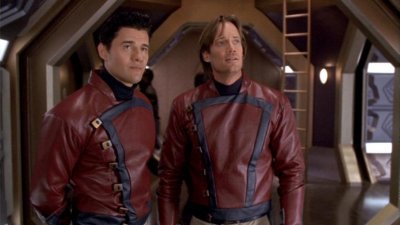
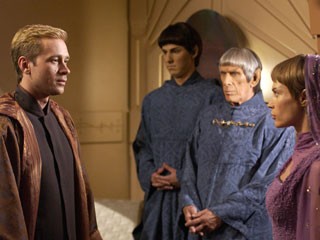
In the late '90s, a decade flush in Star Trek, Majel Roddenberry helped bring a few of her late husband Gene's aborted projects to television.  The first of these efforts was Earth: Final Conflict, sort of V without lizards.

Kevin Kilner, as William Boone, was the original series lead, replaced by Robert Leeshock, as Liam Kinkaid, in the second season, succeeded by Jayne Heitmeyer, as Renee Palmer (who debuted in the third season), in the fifth season.  Others who appeared as series regulars throughout the five-year run from 1997 to 2002 included Lisa Howard (Lili Marquette), Richard Chevolleau (Augur), Leni Parker (Da'an), David Hemblen (Jonathan Doors), Anita La Selva (Zo'or), Melinda Deines (Street), Guylaine St-Onge (Juda), and Alan Van Sprang (Howlyn).  This constantly shifting cast line-up was a source of frustration for fans, but realistically reflected the volatile nature of the Resistance's efforts to thwart to an alien invasion that seemed on the surface to be totally benevolent.  Fortunes changed all the time.
via Earth: Final Conflict Wikia

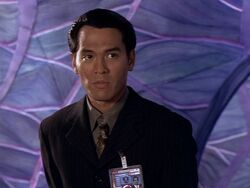
My favorite character was Ronald Sandoval (Von Flores), who appeared throughout the series.  He dies a punk, but embodies the best of Earth: Final Conflict's instincts.  A few of the following episodes unabashedly feature Sandoval's unexpectedly nuanced role at its most dynamic, plus a few key developments otherwise:

1. "Sandoval's Run" (1x12)

Prior to this episode, as with most of the series, you may be forgiven to assume Sandoval is merely a stooge for the Taelons, the so-called Companions, helping to carry out their secret agenda.  Except he's as much victim as anyone.  Thanks to the CVI implant all Protectors receive (along with the Skrill weapon!), he's the opposite of what he'd otherwise be like (a parallel dimension seen in the second season episode "Dimensions" helps confirm this, where Sandoval is definitely one of the good guys).  Turns out his is a tragic story, worse than Boone's experiences from the pilot.

2. "Gauntlet" (2x11)

Expanding the mythology of the series by explaining who the Jaridians are and their relationship to the Taelons, this one hints at how the series ends.

3. "Crossfire" (2x22)

The end of the second season sees Jonathan Doors' bid to become President explode in his face as he clashes with his son and the Resistance seems to come to a tragic end.

4. "Thicker than Blood" (3x6)

Liam Kinkaid's surprising link to Sandoval is exposed to his allies, who find it difficult to reconcile, especially when it means they probably ought to save the dude's life, too.

5. "Atonement" (4x17)

Sandoval's great bid for redemption on his own terms is probably his greatest moment as a character.  Unfortunately it's all downhill from here.

6. "Boone's Awakening" (5x5)

As the title suggests, Boone returns, appearing for the first time since the first season finale, in a moment that helps explain the strange new circumstances for the final season, in which the Taelons and Jaridians have merged back together and become something worse.

7. "Final Conflict" (5x22)

The final episode of the series, in which Renee Palmer and Liam Kinkaid finally get to embrace humanity's destiny in space.

Classic opening theme (one of the best ever):


Wednesday, July 16, 2014

#758. Moxie Day Review!

You may remember me nattering on about Stephen King's 11/22/63, the book that happened to be set in my hometown of Lisbon Falls, ME.  For those who read it, you may remember the Kennebec Fruit Co. store run by Frank Anicetti.
via Sun Journal
King made up a few things (alas, no diner with a time portal exists, at least in Lisbon Falls), but he didn't make up what locals call the Moxie Store, or Frank.  You can't make up Frank.  Thanks to Frank and two preceding generations of Anicettis (the store recently celebrated a hundred years of business; yes, they used to sell fruit there), the Moxie Festival and Moxie Day itself, always celebrated on the second Saturday in July, came to town more than thirty years ago.  If you've never had Moxie, just know that it can be described both as "a treat" and "awful."  It's one of the original soft drinks, and still retains the vaguely medicinal nature they all had (really hard to believe though that is these days).  It's like Barq's root beer with...a different kind of bite, an aftertaste that always takes you by surprise.

Growing up in town, Moxie Day was a given, and it was increasingly a strange thing to realize we had something people came from all over the country to experience every year.  When I moved away in 2005, I began a ten year journey to experiencing Moxie Day all over again.

My oldest sibling, one of two sisters and the one who's older than me (not the one I spent that decade living with and/or near) has made an annual pilgrimage to Moxie Day for years.  She's been away since 1995, so I assume these visits are particularly special for her.  Half of Moxie Day this year was hanging out with her again for a extended period of time, which I hadn't done for a decade, another way this year's festivities were a way of closing a loop (a lot of my life is about closing loops, concluding journeys; don't worry, there are always loops to be closed).  She brought with her the whole family, husband and son, who happens to be my godson, whom I haven't actually seen since probably 2006, about two years into his life.

Also present and accounted for (besides my parents) were my brother (the middle child, older but not oldest brother) and his family, which includes two more nephews.  I've gotten to spend a great deal of time with these boys since returning to Maine last fall.  They're both young (five and two), which makes this an especially fun time to hang out with them.  

The highlight of Moxie Day is the parade and all the vendors who set up shop on Main St.  I got there a little early and slipped into the Moxie Store to at last have my own Moxie t-shirt (loop closed!), which I quickly slipped into (sorry, Rock Paper Scissors Lizards Spock from The Big Bang Theory!).  Walking around, I got to see what everyone was selling (either food, jewelry, or kiddie carnival games; Moxie Day is at heart a children's event with room for adults who want to have a good time).  This included my favorite part of Moxie Day, the library's book sale.  

I love browsing.  I guess for me that's the big difference between real world stores and online retailers.  In the real world you can come across things at random.  Often, online, you're looking for things you already know about.  (The big difference is that online you can find a lot of niche things.)  I know that's not always the case, but it takes less effort to find something unexpected, browsing a book sale.  (Plus you really can't beat the deal; $5 for a bagful.)  

I think it would have been the last time I got to enjoy Moxie Day that I found Thomas Pynchon's Mason & Dixon at the sale.  Most of the books in sales like this will not be a massive Pynchon tome.  But some of them will.  Here's what I got this year:
  • Agatha Christie's Murder Is Easy - I've never read Christie.  I know And Then There Were None was assigned reading for my three older siblings in school, but either I didn't have that class or it disappeared (a mystery that needs to be solved!) from the teaching agenda by the time I reached that year.  Although her best-known creation is Hercule Poirot, this is not part of the series.  (Loop closed.)
  • Winston Churchill's The Gathering Storm - Part of the famed British Prime Minister's history of WWII (six volumes in all).  
  • Eoin Colfer's Artemis Fowl: The Arctic Incident - The second of eight in the series, this was part of the great push in young readers publishing following the success of Harry Potter, and always seemed (along with Lemony Snicket's A Series of Unfortunate Events) one of the more inspired efforts.  I never got around to reading it, but after Colfer wrote the sixth book in the Hitchhiker's Guide to the Galaxy, er, trilogy, I figured I would have to get around to reading one of these eventually.  This was a recommendation from one of the attendants, a very welcome one.  (Loop closed.)
  • Stephen King's Bag of Bones - King (it seems appropriate, plus I was looking for him in the sale anyway, after unfortunately inserting most of my unread hardcovers into the great purge of 2013) has had a few phases in his career.  This book was part of a comeback that began while I was in high school (perhaps highlighted by The Green Mile).  Arguably since then there was also the Dark Tower Surge (to complete that seven book series) that followed it and the Books He Always Wanted to Finish period (I think recently concluded, featuring such novels as 11/23/63, Under the Dome, and Doctor Sleep), while of course the Everyone Loves Me 1980s era and his early success.  (This is a hardcover, by the way.)  (Loop closed.)
  • Michael Shaara's The Killer Angels - The popular work of Civil War literature that was later adapted into the film Gettysburg.  Always wanted to read this one.  (Loop closed.)
  • Gregory David Roberts' Shantaram - A book that used to stare at me expectantly when I worked at Borders, and also the subject of a rare customer recommendation.  So I finally have it (loop closed).  Another epic-sized (darn near a thousand pages) piece of fiction found in the book sale!
Drank some Moxie.  Ate some food.  Hung out with family.  Good times, good times.

Thursday, July 10, 2014

#757. Seven Reasons - Gene Roddenberry's Andromeda

In the late '90s, probably flush in what was a decade saturated in Star Trek, Majel Roddenberry helped bring two of her late husband Gene's other projects to television.  The first was Earth: Final Conflict, which was very similar to V.  The second was Andromeda, which was part of a TV space opera boom that decade that included Babylon 5 and Farscape.  Come to think of it, Andromeda was kind of a mix between those two.  It was an attempt to create an alternative to Star Trek saturated with wild sci-fi concepts heavily steeped in an ambitious mythology.

Fans tended to think of Andromeda in two ways: 1) it was developed by Star Trek: Deep Space Nine writer Robert Hewitt Wolfe and 2) it starred Kevin Sorbo.  A few years after the launch of Andromeda, another Star Trek alumni, Ron Moore, launched a very different kind of space opera in Battlestar Galactica.  Wolfe left Andromeda, famously, partway through the second season, taking with him any sense of creative integrity, at least as far as the fans were concerned.  Left behind was Sorbo, who had made his name previously in Hercules: The Legendary Journeys, which at some point had become better known as the series where Xena: Warrior Princess came from.

Long story short, Andromeda grew to have a poor reputation.  It's another thing I love that very few others do.  Here are seven episodes that showcase the series at its best:

1. "Under the Night" (first season)
via DVD Talk
First episode of the series, establishes the Systems Commonwealth and its fall from betrayal by the Nietzscheans as represented by Dylan Hunt (Sorbo) and his first officer and best friend, Rhade (Steve Bacic, who was far from done with Andromeda despite his character dying this episode).  The second hour, "An Affirming Flame," sets up the salvage crew who round out the rest of the cast and how Dylan hopes to revive the Commonwealth after being stuck in a black hole for three hundred years.

2. "Ouroboros" (second season)
via Andromeda Wikia
The episode where everything changes.  Wolfe's final episode.  Rev Bem (Brent Stait) departs as a series regular.  Harper (Gordon Michael Woolvett) finally loses the nasty Magog larvae he picked up at the start of the season.  Trance (Laura Bertram) switches from purple to gold, loses tail.  The prime example of just how wild the series could be with its science fiction.

3. "Immaculate Perception" (second season)
via Andromeda Wikia
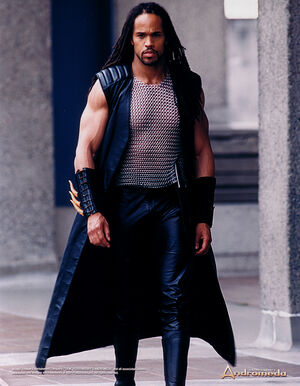
Probably the favorite character of just about every fan was Tyr Anasazi (Keith Hamilton Cobb, whom Jason Momoa can probably thank for his whole career).  Tyr was Dylan Hunt's constant rival, the consummate Nietzschean, incredibly cool, you name it.  When the decision was made to switch focus more heavily on Dylan, every fan assumed this would be at the expense of Tyr most of all.  His great arc begins with this episode, however, after the switch, as he conceives a son destined to be the messiah of his people (and genetic reincarnation of Drago Museveni , a name so awesome I could not pass up the opportunity to put in this series recap) and suddenly his loyalties, always reluctantly in Dylan's favor, shift.  The best character in his best episode.

4. "The Lone and Level Sands" (third season)
via Veehd
The great Tony Todd guest-stars in this episode that features the Andromeda version of Star Trek.

5. "The Unconquerable Man" (third season)
via Veehd
Is that Rhade, the dead Nietzschean, again?  Indeed!  This is before his genetic reincarnation, introduced in "Home Fires" a season earlier, becomes a regular in the fourth season.  That means this is the original, in an alternate life where he's the one, not Dylan, who survived the fight in "Under the Night."  Andromeda frequently meditated on fate, but this is certainly one of its more interesting efforts in that regard.

6. "Shadows Cast by a Final Salute" (third season)
via Sidereel
Although he returns for a handful of appearances in the fourth season (to be killed off), Tyr's farewell must be considered the highlight of Andromeda's stream of ambitious season finales.  This is the man bowing out on his own terms, switching allegiances but getting fond farewells from everyone anyway.

7. "The Heart of the Journey, Parts One and Two" (fifth season)
via OV Guide
The series finale, in which everything is resolved, including the Seefra System tangle, Trance's true nature and ultimate role, the fate of the Commonwealth.  Typically, Andromeda goes out big.

I haven't even mentioned Beka (Lisa Ryder), Rommie! (Lexa Doig), or Doyle (Brandy Ledford), three more strong ladies, or Beka's Uncle Sid (John de Lancie), or any number of exceptional elements or moments from the series.  If anyone ever made a movie out of Andromeda, I think more people would understand how awesome it really was.

Monday, July 07, 2014

#756. Seven Reasons - Star Trek: Enterprise

I'm always among the select few among people who love what I love.  It should be no big surprise that I love Star Trek: Enterprise, unabashedly.  Here are seven episodes of the series at its finest, and then seven more from the character who helped make the series its finest:

1. "Fortunate Son"
via Beyond the Farthest Blog
Travis Mayweather got a lot of flak for being the least featured main cast member in modern franchise history, although he got two feature episodes during the four seasons of the series (far more than similar characters in the original series).  I was fascinated with his backstory, coming from a family of Boomers, humans who lived on ships well before it became the norm in Starfleet.  This first season episode is the first time we have a look at what that kind of life was like, and what it's like to see progress pass you by.

2. "Cold Front"
via Star Trek
The whole concept of the Temporal Cold War baffled fans who thought the series was only going to be a prequel, and then moreso when the conflict only came up occasionally.  The only real disservice the arc ever got was when it was jettisoned at the start of the fourth season.  Otherwise this episode from the first season will always be a highlight, the introduction of Daniels and the best spotlight for Suliban Cabal agent Silik, who tries to convince Captain Archer that they're not actually on opposing sides.  The next most intriguing episode in the arc would be "Future Tense" from the second season.  That one features Tholians, rebooted time, arms being cloaked.  Good stuff.

3. "Detained"
via Star Trek
Scott Bakula's Quantum Leap co-star Dean Stockwell made a visit in this first season episode that took a different look at the Suliban, from a sympathetic standpoint.  The historic reunion was itself worth the price of admission, but the story around it was more than sufficiently weighted to justify it, and completely threw off all expectations.  A similar episode from the Xindi arc third season, "The Shipment," explores the matter of reconsidering assumptions.

4. "Judgment"
via Borg (how awesome is that?)
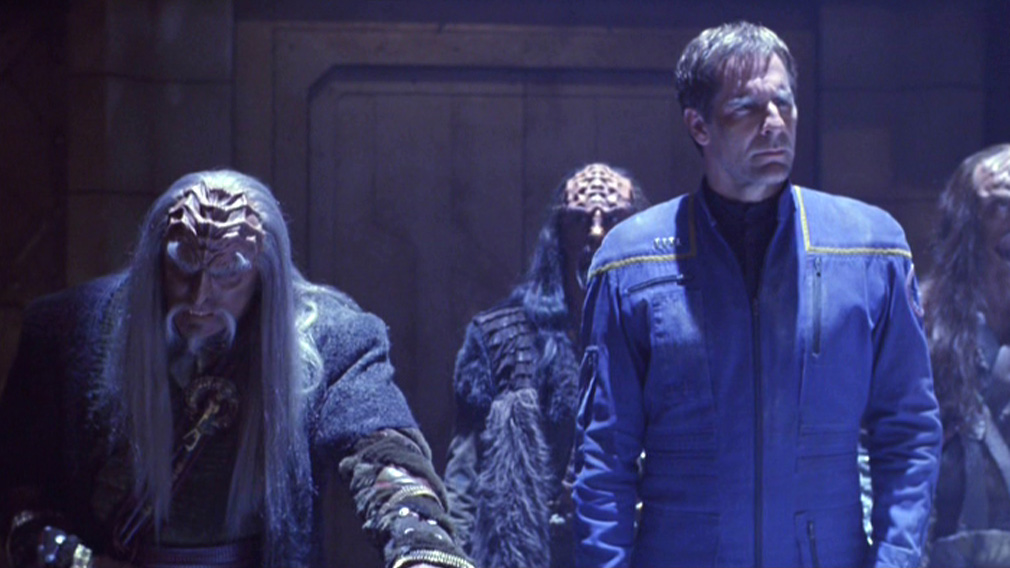
One of two episodes extrapolated from Star Trek VI: The Undiscovered Country (the other is Voyager's "Flashback"), featuring a Klingon trial and sentence to Rura Penthe.  Except this is no ode.  This is one of Star Trek's periodic Rashomon tales, featuring two very different versions of an encounter between our crew and a Klingon ship.  The significant bonus is J.G. Hertzler (best known in the franchise as Martok in Deep Space Nine) helping to broaden our sense of Klingon society, which after DS9 and Next Generation, you probably didn't even think was possible.

5. "Twilight"
via We Minored in Film
Similarities to other reboot episodes are a moot point: this is the best episode of the Xindi arc, one of two standouts (the other is "Similitude") that dramatize the ramifications of the crew's desperate mission that have nothing to do with the mission itself, but rather its human toll.  After an accident, Archer can no longer form new memories.  T'Pol elects to stay by his side and refresh him on current events, a situation that endures for years.  

6. "Stratagem"
via Angriest
Besides "Twilight" and "Similitude," this is the finest episode of the third season, and continues the surprisingly contemplative trend of all these episodes.  And that's the thing about Enterprise.  It's not really merely a prequel or merely another series about space exploration.  It took a great deal of time to just think about things.  It's like the Next Generation episode "The Drumhead" expanded as an entire series.  This one's about the nature of enemies.  Degra had already expressed misgivings about what his Xindi brethren expected him to do in creating a weapon capable of destroying Earth, yet he's no closer to switching sides than any other of his kind when confronted directly by Archer.

7. "Home"
via Cygnus-X1
One of the earliest fourth season episodes looked back at what the series had done rather than attempt to revise its whole approach, as with the rest of the final season.  This one deals with the emotional fallout from the Xindi arc, both its toll on Archer and where it left the relationship between Trip and T'Pol (despite what the above image seems to suggest, it's not marriage).  Similar to "Family" from Next Generation, which found Picard healing from his Borg experience, "Home" is an episode fans of the series can't help but love, and as such may be ideal to help the uninitiated discover a little love for themselves.

The bonus round is for me a no-brainer.  The best character of the series wasn't Captain Archer, but his faithful engineer, Charles "Trip" Tucker III.  He might have seemed like a McCoy knockoff at first, the good 'ol country boy, but the wealth of narrative material, and potential, he provided was invaluable, essential, and exactly the subject that infamous series finale really featured.
via the Green Asterisk
  1. "Shuttlepod One" (first season) Trip and stuffy Malcolm Reed don't kill each other, but rather end up bonding.  The start of one of Trip's many defining relationships.
  2. "Desert Crossing" (first season) The best example of Trip and Archer's relationship, which features the always-excellent Clancy Brown, and Trip saying this (while suffering from heat exhaustion and trying to humor Archer's request that he take his mind off the heat by talking through the major components of the warp reactor): "Well, there's the drumsticks, thighs, wings.  You got anything to eat around here?"
  3. "First Flight" (second season) In which we experience how Archer and Trip meet, which takes the form of a story Archer tells T'Pol, a reciprocation of "Carbon Creek" from earlier in the season.
  4. "The Expanse" (second season) Besides a flood of Trip episodes that season, it became all the more obvious how valuable he was to the series when the Xindi arc was kicked off as affecting Trip most directly with the loss of his sister during the original attack.
  5. "Similitude" (third season) Trip is mortally wounded, Phlox proposes a solution that leads to medical and ethical dilemmas, and Archer must decide how these matters conclude.  The character study of all character studies in this series, with the character of all characters in this series.
  6. "Demons"/"Terra Prime" (fourth season) Often considered the "real" series finale (and featuring Peter Weller in the franchise years before Star Trek Into Darkness), this is the culmination of the Trip/T'Pol relationship.  I dare you to not become emotional at its conclusion.
  7. "These Are the Voyages..." (fourth season) Often listed as one of the worst episodes of the series, mostly because Next Generation characters "hijacked" the final episode, this is actually a Trip story, stripping away all distractions.  And what better way to end the series than with one last rumination on its best character?  I don't even mind that it features his death.  Why would I?  Does death diminish a life?  In a way, it was completely appropriate.  This was the end of the franchise in some ways, certainly that era.  There was a prominent tie-in with another series.  There was Archer finally intoning (part of) the famous motto.  And there was every character talking about Trip.  I couldn't possibly have asked for something better.  I think once fans have a more favorable impression of the series, they'll come around and agree with me.

Thursday, July 03, 2014

#755: Seven Reasons - Star Trek: Voyager

Listen, I know all about Star Trek: Voyager's reputation.  If Enterprise hadn't come along after it, Voyager would have easily been the least popular Star Trek series ever (at least among the fans who don't fanatically remember Deep Space Nine).  Captain Janeway became increasingly polarizing as the series progressed, reaching a crescendo in the sixth season (which itself wasn't...popular; we'll leave it at that) when she and Chakotay clashed over the issue of torture ("Equinox, Part II," one of many episodes in the franchise that would take on far greater significance in later years), and helped define opinions on Voyager as a whole.  Yet the most controversial aspect of the series was tied intrinsically into its premise: a Starfleet ship stranded tens of thousands of lightyears away from home, with a crew comprised of a mix between loyal officers and Federation rebels known as the Maquis.

The creators of the series made the choice to keep Voyager similar to the kind of series that had come before it, which meant the characters lived by a set of relatively fixed moral ideals.  The ship itself managed to make it through seven seasons intact (with an infamously endless supply of shuttlecrafts), the crew didn't end up killing each other, and the Starfleet code of behavior was upheld.  A lot of fans thought these were terrible mistakes.

Surprisingly, Voyager dipped into alternate scenarios about what might have happened on a number of occasions.  Here's a list of seven such stories:

1. "The 37's"
via Trek Core

Usually understood to be the second season premiere, this was the Amelia Earhart episode, but more significantly this was also the first opportunity the crew had to leave the ship and settle down in the Delta Quadrant.  Among all the other scenarios, this one is least often considered because of course it's the least exciting.  By the time Janeway figures out what's really going on concerning Earhart and other human abductees, she decides she's found an ideal place for her crew to be able to decide for themselves if they want to stay on the journey home, which will probably take decades and consume the best years of their lives, or simply start over someplace new.

2. "Cold Fire"
via Robert Beltran (fansite). Not Soval, but the same actor.
The whole reason the ship is in this predicament is because of the eponymous being in the series premiere, "Caretaker," who mentions during the course of that episode that he has a mate somewhere.  Among the other chances of finding an easy solution home, this is clearly the most natural one.  Except when they find her, she's is far less accommodating.  "Cold Fire" occurs during the second season.

3. "Worst Case Scenario"
via Trek Core

This is the third season episode that addresses definitively the potential for decisive conflict between the Starfleet and Maquis crews, cleverly extrapolated from a holodeck program created by tactical officer Tuvok.  Other episodes ("State of Flux" from the first season, "Repression" from the seventh, and pretty much the entirety of the second season) suggest how things might have developed beyond successful integration (which began with Chakotay becoming first officer and B'Elanna Torres chief engineer early on, and then the rank and file trickling in thanks to efforts like the one in "Learning Curve"), but this one, which also features the one Maquis who did refuse to play along (Seska, whose relationship with Chakotay served to provide the series with some of its best material, culminating in "Maneuvers" and the two-part "Basics"), explains pretty well why things played out the way they did.

4. "Year of Hell, Parts I & II"
via Iain's Blog

Otherwise known as the Battlestar Galactica Option, wherein everything that can go wrong does, with the whole ship disintegrating over time, crew complement dwindling, captain going down with her ship, you name it.  This one was one of the earliest two-hour events, from the fourth season, which became a staple for the series.  It's worth noting that although Battlestar was a critical darling beloved by its fans, it still had anemic ratings.  In fact, until recent times, and with the exception of X-Files, every single genre series fans turned to as alternatives to the Star Trek experience wasn't anymore popular than Star Trek itself, and in most cases in fact fared worse with the public.  For fans to say this is how it should have been done still boggles me, because even Battlestar turned less bleak (and arguably less appealing to even its own fans) as it continued.

5. "Message in a Bottle"
via My Year of Star Trek. Be quiet, Andy Dick!
Contact with home started becoming a staple in the fourth season thanks to a Hirogen relay network, which enabled Voyager's irrepressible Holographic Doctor to make a house call (or two), starting with this episode.  Being far easier to transplant from one place to another, the Doctor was always a secret trump card.  Except he couldn't take everyone else with him.

6. "Equinox, Parts I & II"
via Cinema Blend

What if Janeway constantly compromised herself?  That's the basis for this cliffhanger that straddled the fifth and sixth seasons, in which a different Starfleet crew in the same predicament is encountered, and that's exactly what Captain Ransom did, throwing away his Starfleet principles in order to gain whatever edge he could.  When faced with this ugly counterpart, Janeway is herself pushed to the edge.  In other episodes like "Night," fans got to see the incredible strain she was under to remain the stoic idealist she was throughout the series, but this is the one where she nearly crosses the line (to say nothing of the Borg).

7. "Live Fast and Prosper"
via Furious Fan Boys.  (Probably wouldn't like this post.)

Narrowly beating out "Worst Case Scenario" and "Message in a Bottle" as the most fun episode on this list, "Live Fast" is, like "The 37's," an option fans rarely considered for a ship completely cut off from home.  Being on their own and still attempting to represent not just itself but all of Starfleet without any actual Starfleet to back them up left the crew vulnerable to a group of con artists to go around pretending they were the crew.  A different kind of danger than outright hostile aliens could ever represent (and the crew certainly faced plenty of those), these guys visited numerous worlds, making bargains they never intended to live up to, all while presenting themselves as rough proximities of Janeway, Tuvok, and Chakotay.

And because fans often forget that Voyager could actually be pretty good on its own terms (and beyond), here's a bonus list of seven good episodes:


  1. "Non Sequitur" (second season) Harry Kim often gets labeled as one of the worst main characters in franchise history.  Regardless, he's got at least two of the best episodes of this series under his belt ("Timeless" is the other).  This one features one of his alternate lives, in which he never joined the crew.  I think the fact that he was the prototypical officer who was never promoted makes Harry emblematic for a lot of frustrations.  It bears remembering that Ensign Kim was in fact fresh out of the Academy at the start of the series.  In a lot of ways, he's exactly the character the new Star Trek films refashioned Chekov to be, the wunderkind who was instantly fantastic at his job.  "Non Sequitur" confirms Harry's potential as he's still a standout even at home.  When he meets up with Tom Paris in this reality, who's a bum because he never had his shot at redemption among Janeway's crew, everything Harry accomplished right from the start, his willingness to believe in Starfleet ideals (he's also the one who exhibits the most growing pains throughout the series, perhaps best featured in "Nightingale," in which we see a bit of Sulu Complex in him), is pushed into sharp contrast.
  2. "Death Wish" (second season) One of the finest Q episodes isn't from Next Generation but rather Voyager, and features the impish figure in rare dramatic form, forced to confront another member of the Continuum who took his most rebellious instincts to their most extreme conclusions.  This is probably the most commonly acknowledged standout episode of the series.
  3. "Distant Origin" (third season) You don't have to be a fan of Voyager to love this one.  Told almost entirely from the perspective of the featured aliens, "Distant Origin" is an allegory about government repression, and the scientist who dares to hold true to his ideals.  One of the finest episodes of the whole franchise.  A similar experience can be found in "Blink of an Eye."
  4. "Living Witness" (fourth season) I could've listed this one in the above list, except the story is more about the perils of corrupted history (think Richard the 3rd) than specifically our crew itself.  A backup program of the Doctor's is activated centuries in the future and is forced to stand trial for an errant interpretation of the ship's visit to that world.
  5. "Thirty Days" (fifth season) The nature of Tom Paris's conflict with his father as well as his past as a troubled officer booted from Starfleet is revisited in this one.  Voyager had a lot of episodes that explored its characters in great depth.  This is not even the best one, but it explains Paris so well without deliberately doing so, more as reflection based on a current predicament than what might have been done with flashbacks in any other series, that it answers one of the many complaints about the series, that the setup in "Caretaker" was never properly exploited.
  6. "The Voyager Conspiracy" (sixth season) The most famous character of the series wasn't introduced until its fourth season.  Initially, Seven of Nine was greeted with great fanfare, because, well, she was a hot chick in a catsuit, but as time wore on the fans started to grate on her increasing dominance, and began to consider her a cheap ratings ploy.  Yet she was was responsible for some of the best character moments of the series.  This is a whole episode that reflects not just on Seven, but Janeway and Chakotay as well, looking at some of the very alternate scenarios explored above but in a still less-obvious manner.  
  7. "Child's Play" (sixth season) Along with Seven came the Borg, of course.  A lot of fans had a huge problem with this.  It seems the more the Borg appeared the more of their mystique was lost.  And apparently a huge part of the Borg's allure was their mystique.  Yet there were considerable benefits to their increased exposure, such as exploring their untapped story potential.  Earlier there had been "Hope and Fear," in which an alien attempts to take revenge on the ship for the fallout of events from "Scorpion," the two-part episode that started the Borg rolling in Voyager.  "Child's Play" concerns Icheb, one of the drone youths introduced a few episodes earlier, a sort of revamped Wesley Crusher whose parents apparently engineered him to be a weapon against the Collective.  Yikes!
Wednesday, June 25, 2014

#754. Overheard June 2014

This month I'm mostly going to provide links.  The first two will be interrelated (one directly references the other):

I'm including them because, especially in the latter, I've heavily inserted my thoughts into the comments sections.  The latter explains itself.  In the former, I'm thinking of a story I read in The Best of McSweeney's, "Can a Paper Mill Save a Forest?" from Nicholson Baker, which explores the curious facts of life under a digital cloud and the myths of how paper mills only negatively impact the environment.  As it turns out, all those files we save have to be saved on computers servers somewhere, that just because personal devices have gotten smaller that there isn't a need somewhere else for those giant things computers used to be to still exist.  This is something I'm fairly certain has been conveniently overlooked in our rush to digitize everything, arguably for the sake of progress.  But it's also another instance of the emperor wearing invisible pants, hiding unpleasant realities in plain sight with a collective willingness to overlook the obvious.

In much lighter Internet discoveries, I read on Pearls Before Swine creator Stephen Pastis's blog about a far more pleasant con job, the secret return of Bill Watterson to the comic strip page.  Even though Calvin & Hobbes ended nearly twenty years ago, it remains the gold standard for the medium.  The whole reason Watterson ended it was because he feared the format had been irredeemably compromised, whether by newspapers or capitalism.  I hope one day he releases a treasure trove of material he's done since his self-imposed exile.  In the meantime, he popped up in a strip that seems to be the polar opposite of everything he used to do himself.  (Though make no mistake, Pearls is brilliant.)

via Go Comics


Wednesday, June 18, 2014

#753. Christopher Nolan's Villains Revealed

Something occurred to me recently.  In each of Christopher Nolan's Batman movies (Batman Begins, The Dark Knight, The Dark Knight Rises) the villain is introduced by way of misdirection.  Don't believe me?

Now, for those of you who lack the patience or time to view the videos and don't remember how things develop in the films (and are willing to trust that I'm being accurate), here're the bullet points:

  • Ra's al Ghul is apparently introduced in the guise of Ken Watanabe.  Liam Neeson is introduced as Henri Ducard, Bruce Wayne's main contact and trainer in the League of Shadows.  Except Watanabe's al Ghul is a smokescreen.  It's Ducard who is really al Ghul, as Batman discovers after saving Ducard's life.
  • The opening bank robbery in The Dark Knight sees a whole crew of would-be clown wonders under rubber masks.  As they begin eliminating each other, the audience realizes there's more going on than it seems.  This is made clear when we discover these clowns are working for the clown, Heath Ledger's Joker, who emerges from under the mask of the surviving hoodlum at the end of the sequence.
  • Tom Hardy's Bane has a number of reveals.  The second one still kind of infuriates people.  He was not the prison brat who made the miraculous leap.  That was the young Miranda Tate Talia.  In the opening sequence of Dark Knight Rises, Bane is introduced similarly to the Joker, under a hood that makes him seem like just another thug.  Despite his relationship with Talia, he most certainly is not.
Now, all of this is fairly obvious for movies about a man who chooses to run around in a giant bat costume, from a director who had already amply demonstrated his penchant for exploring mutable identity.  In fact, before we go much further, let's do another list, this time of Christopher Nolan's films to date:
  • Following (1998)
  • Memento (2000)
  • Insomnia (2002)
  • Batman Begins (2005)
  • The Prestige (2006)
  • The Dark Knight (2008)
  • Inception (2010)
  • The Dark Knight Rises (2012)
  • Interstellar (2014)
Now, chances are few in my reading audience are quite as interested in Nolan's career as I am.  This is not a boast.  There was a point where Memento was his best-known achievement.  I bet few of you even know what Following is much less have seen it.  How about Insomnia?

For me, these weren't just building blocks, but touchstones in his career.  I was actually disappointed by the news that he'd be doing Batman, and was generally underwhelmed for years by Batman Begins.  I thought it was a step back in his creative development.  It showed none of the flare of his earlier films.  It was a little too obvious, straight-forward.  Yeah, I can be an idiot sometimes.

The thing is, Batman Begins, and the two sequels that followed, were probably necessary for wider audiences to appreciate Nolan's talent.  They were necessary mainstream translations of his instincts, and as such took different approaches.  But they're every bit as remarkable, even the first one.  I came around, like everyone else, by the time Dark Knight was released.  It instantly became an all-time favorite.  The epiphany I began this reflection with is what solidified my overall opinion, however.

It probably seems obvious to interpret a Batman film around the lens of Batman, right?  Except, and I'm not saying this is inaccurate, but it's also not necessary.  Take away Bruce Wayne, take away Batman (either one, really), and you still have a perfectly representative Christopher Nolan experience.

In a lot of ways, Neeson's Ra's al Ghul makes Batman Begins very similar to Following, a student and a master whose relationship becomes increasingly confused.  The true genius of Ledger's Joker has as much to do with the performance as the depiction of a character many might have assumed they knew everything about, which is another way of explaining the story of Memento, which is told in reverse and constantly undoes everything the viewer thinks they knew.  And yes, Dark Knight Rises is a lot like Insomnia, with a compromised hero constantly trying to play catch-up with the villain.

No, I'm not making the argument that Nolan simply remade his own early films with Batman plugged in.  His Dark Knight was from the start a deliberate character study of the famous vigilante.  Bruce Wayne's journey was more important than Batman's introduction.  Back in 2005 I kind of just wanted a Batman movie, or a Christopher Nolan movie.  I wasn't prepared for both and more besides.  I was overwhelmed.  And I never saw coming that Nolan had been making his own story, with the villain, all along, even when it became clear which actor was playing Ra's al Ghul.

via Hippie Refugee. Again, not this guy.
To have the idea echoed, with considerable and effective variation, in the other two films, with more traditional villains who still work as Nolan archetypes, only affirms the accomplishment.

These films remain remarkable and singular experiences.  Whereas Robert Downey, Jr.'s Tony Stark/Iron Man gleefully prances around like a regular Jack Sparrow with the rest of the Pirates of the Avengers acts openly in his duel personality (only the later somewhat misguided handling of the Mandarin in Iron Man 3 compares in the whole Marvel canon), nearly everyone in Nolan's Batman trilogy has another side of themselves they're desperately trying to hide.  Rather than alienating them from audiences looking to find a piece of themselves in colorfully outsized personalities, this humanizes them, Batman especially.  People like to mock Christian Bale's growl under the cowl, but it's his scenes as Bruce Wayne that truly represent the performance.  Exploring his insecurities and struggles, a newly nuanced relationship with Alfred, is a revelation, and how exactly he chose to become Batman why he sticks with it for so long.  It's not his resources that define him but his vulnerability, not his ability but his frailty, both emotionally and physically.

Before Batman, Nolan looked a lot more on the surface than he would later.  His characters are always troubled, and stumbling into crises that overwhelm them.  With Batman, he was finally able to step beyond the line that separated his characters from their own experiences, whether that was a faulty memory or lack of sleep.  Finally Nolan could look at the whole picture, which was another reason why his version of the Joker was so refreshing, because it was the rare moment he allowed himself to fall back on his own instincts.

To have Nolan accepted as a blockbuster filmmaker even outside the Batman films is perhaps more remarkable than people realize even now.  This is not one long hard sell for the upcoming Interstellar.  But can you think of anyone else making movies today who is able to get away with stuff like Inception and find a willing and large audience waiting for it?

This is to say I'm a big fan of the guy, and I think Christopher Nolan's career is really still only beginning. 

Sunday, June 15, 2014

#752. Star Trek: Deep Space Nine...from a Certain Point of View

Ever since the debut of the Defiant in Star Trek: Deep Space Nine (oh...about twenty years ago) and the later introduction of the Breen body armor, it's become easier to view the third live action TV entry in the franchise from a Star Wars kind of light.  That being said, I'm going to have another look at it.

I've made a few special modifications...

Call this An Emissary of Hope.  Our lead character is Jake Sisko, who has long dreamed of ending Dominion tyranny in Federation space, ever since a disastrous war gave way to a new order.  He's recently become aware of a part of his late father's life that he'd never dreamed of before, from the old shape-shifter Odo, who once served under Starfleet but whose life became complicated when his people in the Founders were revealed to be behind the Dominion.  Odo tells Jake that his father was the only one capable of closing the so-called Celestial Temple, the wormhole located in Cardassian space, thanks to his connection to the Bajorans.  Benjamin Sisko's mother was what the Bajorans called a Prophet, or least that's what they thought.  This effectively gave him great temporal powers among other gifts.  Except he wasn't imbued by the Prophets but the Pah-wraiths.  Jake can make things right by embracing the ways of the Prophets.

Jake joins forces with unlikely allies in order to confront the forces of Dukat, ruler of the Dominion who possibly also wields the powers of the Pah-wraiths.  Jadzia Dax and Worf have long had private command of the Defiant, last surviving ship of Starfleet, and they have allies in Julian Bashir and Miles O'Brien (at least when they're getting along).  Jake values the support of Major Kira most highly, however, a Bajoran whose relationship with Odo goes back a long time and one of the few who will be able to resolve the conflict with her peoples' gods.

Along the way, they will also have to deal with challenges provided by Garak, a Cardassian who works only for himself, and Quark, a Ferengi of considerable influence who has long held a grudge against the meddling Jadzia.  The final conflict, however, will be between father and son, Prophet and Pah-wraith. Tthe fate of the galaxy rests in the hands of the Siskos.  Which one will prevail?

...And here's a handy cheat sheet:

Benjamin Sisko = Anakin Skywalker
Jake Sisko = Luke Skywalker
Odo = Obi-Wan Kenobi
Gul Dukat - Emperor Palpatine
Jadzia Dax = Han Solo
Worf = Chewbacca
Defiant = Millennium Falcon
Julian Bashir = C-3PO
Miles O'Brien = R2-D2
Major Kira = Princess Leia
Garak = Boba Fett
Quark = Jabba the Hutt

The scenario I've presented isn't so far-fetched.  Jake and Ben actually did square off against each other (albeit with Sisko backed by the Prophets and Jake the Pah-wraiths) in the sixth season episode "The Reckoning."  Feisty Jadzia and Quark indeed had an association, although an unusually friendly one for the Ferengi.  The Defiant was introduced at the start of the third season in "The Search" as Starfleet's answer to combating the Borg (which finally happened in First Contact...with Worf as its commanding officer!), although it much more frequently went into war with the Dominion.  Ben Sisko learned of his role as the Emissary of the Prophets in the first episode, appropriately entitled "Emissary," and that his mother was a Prophet in the seventh season premiere "Image in the Sand."  Jake and Kira had some key moments together in the fourth season episode "The Visitor" (which also heavily features the Siskos) and are the last two characters seen in the series finale, "What You Leave Behind."  Recasting the Dominion War, which dominated the final two seasons of the series, as a longer conflict, seems easy and fitting.

Here are a few additional associations:

Michael Eddington = Lando Calrissian
Weyoun = Yoda

Wednesday, June 11, 2014

#751: Seven Reasons - Movie Supervillains

In the thirty-plus years of superhero movies, the constant challenge has always been to create supervillains as compelling as the superheros.  Without further preamble, here's my list for the seven best to date:

1. Heath Ledger's Joker (The Dark Knight)
I was always a fan of Ledger as an actor, but it took everyone else and one great role to make him immortal, sadly right before his passing.  The genius of his Joker is that it went completely against the grain, a villain who was less interested in being obvious (which is what virtually every other supervillain does in these movies) and more understating...pretty much everything.  No origin.  Slapdash clown makeup.  First scene he's introduced seemingly as just another goon.  There's nothing I don't like about the performance, the part, how it fits into the rest of The Dark Knight.  Instantly the gold standard for movie supervillains.

2. Tom Hiddleston's Loki (Thor, The Avengers, Thor: The Dark World)
I've been lukewarm on the Avengers movies from the start (Iron Man does not have a representation on this list), but one of the elements I loved instantly was also one of the most unexpected ones: a supporting character in Thor.  I didn't expect great things from Thor.  It was fine.  But it just seemed, right from the start, like a kind of pointless excuse to add to the cinematic Avengers cycle.  Without the rest of the team, would anyone really care that much about the guy?  But his troubled brother Loki?  Even with an arc that still hasn't gone anywhere three appearances later, the dude oozes charisma.  He's a bad guy who's really easy to love (I mean, even blatantly stealing from Terence Stamp's iconic Zod in Avengers with the whole "kneel before me" thing doesn't hurt him).  I would watch a whole movie headlined by Loki.  Easily.

3. Thomas Haden Church's Sandman (Spider-Man 3)

Everyone knows Spider-Man 3 is the black sheep of the Sam Raimi Spider-Man films.  Yet I've always been a fan, and it's mostly thanks to the reinterpretation of Uncle Ben's death.  Turning the story around has a number of intriguing possibilities (arguably Marc Webb's Spider-Man films have benefited greatly from them), but here this means we actually get to sympathize with the villain, which is certainly rare enough.  Haden Church had just experienced a career resurgence thanks to Sideways, which had the effect of finally exposing his dramatic potential.  He's the rare supervillain actor to have been given the chance to explore that side, and because of all the other things going on in the movie, he's free to focus exclusively on that.  He nails it.  I would watch a Sandman movie, too.

4. Tom Hardy's Bane (The Dark Knight Rises)
I've long been a fan of Hardy's, so I was already expecting great things from him, although even for me (see above) it was a tall order to follow Heath Ledger.  He did it.  He knocked it out of the park.  There have been various criticisms, such as Bane's hard to hear (he really isn't) or being revealed as Talia's henchman weakens the character (it really doesn't).  Like Ledger's Joker, Hardy nails the ability to create a character who clearly doesn't mind calling attention to himself without making a parody of a character, which is what happens far too often with movie supervillains.

5. Anne Hathaway's Catwoman (The Dark Knight Rises)
A real argument could be made for Dark Knight Rises being...a Catwoman movie.  Every one of Hathaway's scenes is fantastic and as a whole carry a full story.  Her status as a villain fluctuates throughout the movie, although for most of it there's no real question.  A lot of people have long praised Michelle Pfeiffer's version of the character, as many who have maligned Halle Berry's.  Neither really has a ton of subtlety, which is something Hathaway accomplishes easily despite most of her scenes calling for high emotion or pithy remarks.  If any movie supervillain has approached Tom Hiddleston's Loki, it would be Hathaway's Catwoman.

6. Ian McKellen's Magneto (X-Men, X2, X-Men: The Last Stand, X-Men: Days of the Future Past)
The whole reason I couldn't really get into Michael Fassbender as Magneto in X-Men: First Class is because he wasn't nearly as compelling in the role as McKellen.  McKellen's Magneto isn't even my favorite role from the actor, but c'mon.  The man knows how to act.   Aside from Hugh Jackman, he's the actor who helped the X-Men films really take off in the first place.  Without him, most of their dramatic weight would be gone, and these are movies that need that.  I argue that the Avengers movies are less successful creatively because they don't have a Magneto.  If Loki were more prominent, instead of the guy who keeps stealing movies, I'd like them a lot more.  I like the X-Men movies more when McKellen's Magneto is around.

7. Jennifer Garner's Elektra (Daredevil, Elektra)
I think the whole reason Daredevil quickly lost mainstream support is because Garner stole the movie.  At the time she was best known for the TV series Alias.  In a lot of ways, her Elektra is exactly like her Sydney Bristow.  Like Hathaway's Catwoman, she's not really a villain.  In fact, even less so.  But the story often pits Elektra and Daredevil against each other, and every time, Elektra easily holds her own.  When she received her own spin-off a few years later, it was a nonevent.  Everyone wanted Daredevil to show up.  That's a testament to Elektra's appeal, that it wasn't just her alone, but how she fit so well in Daredevil's story, how essential she was to him and he to her.  The more people disassociated them, the more they only thought about Ben Affleck, who played Daredevil.  At the time he was on the verge of a career decline, and so pretty much everything he did was interpreted unfavorably.  But watch this one again.  It's great.  And Garner's Elektra is a huge reason why.  She's a villain who's not really a villain.  They say all villains see themselves that way.  This is a chance to see that make some sense for a change, cleverly turning classic Hollywood romantic comedy tropes on their head.

I do have a number of runners-up:

  1. Gene Hackman's Lex Luthor (Superman, Superman II, Superman IV: The Quest for Peace)
  2. Kevin Spacey's Lex Luthor (Superman Returns)
  3. Terence Stamp's Zod (Superman II)
  4. Michael Shannon's Zod (Man of Steel)
  5. Colin Farrell's Bullseye (Daredevil)
  6. Jack Nicholson's Joker (Batman)
  7. Peter Sarsgaard's Hector Hammond (Green Lantern)
  8. Sam Rockwell's Justin Hammer (Iron Man 2)
  9. Liam Neeson's Ra's al Ghul (Batman Begins, The Dark Knight Rises)
And all of them I could wax fantastic about.


Who're your picks?

Wednesday, June 04, 2014

#750. Star Trek's Perfect Symmetries...are in the movies

It's funny, but Star Trek only really understands its best relationships in the movies.

I know, there're a ton of great relationships in the TV shows.  The original series was best defined by the Kirk-Spock-McCoy triangle.  Data and LaForge  were the closest family members of the Next Generation set.  Bashir and O'Brien sang "Jerusalem" together in Deep Space Nine.  Drunk.  It was hilarious.  Paris and Kim created Captain Proton together in Voyager.  Tucker and Archer traded stories with T'Pol in Enterprise.

But it only got better, in the movies, every single time.  Removing McCoy from the equation (not completely, but enough) made Kirk and Spock so much better.  The Motion Picture put both of them through the emotional wringer.  Wrath of Khan did it even better.  Search for Spock was probably the definitive statement in that incarnation of the characters.  They came as close to hating each other as possible in The Undiscovered Country.

In the Abrams reboot, Kirk and Spock took the Country dynamic, mashed it up with Search, and ended up with something even more beautiful than ever before.  That's what I've loved so much about these films, Star Trek and Into Darkness.  Every critic says they're more Star Wars than Star Trek, just because they feature better action and budgets than ever before.  That, apparently, is all you need to be Star Wars.  Apparently Michael Bay has been making Star Wars for years.  Who knew?  But to me, the Abrams films have been about Kirk and Spock, almost exclusively, brilliantly, better than ever.  The first one goes back to the beginning for both characters, and then sees what happens when they meet for the first time, try and figure out what their disparate worldviews look like when put up against each other.  A lot of arguments, apparently.  Possibly a few instances of trying to end careers and/or lives.  But in both instances a thing of beauty.  Exquisite.

The thing I've been realizing is that the Next Generation movies are exactly like that.  Data and Picard are the main characters in all four.  They're the only instances where either is so important to each other, besides "The Measure of a Man" (when Picard makes the winning argument for Data's continued independent existence).  In Generations, the stellar cartography scene in which their paths finally cross during the story is perfect.  Picard is thinking of his problems, Data his, and all the while they're supposed to be focusing on something else entirely.  Picard begins musing on the need to focus on the moment.  He forcibly requires Data to do the same.  It's the only time Data wants to deactivate himself.

In First Contact, they unexpectedly converge again as the Borg attempts another invasion.  They're practically inseparable.  It's true, Picard references what Data did for him in "Best of Both Worlds, Part II," but that was less to do, at that point, with what they meant for each other and more a matter of the greater family from that crew.  I think as the years progressed, Picard valued Data more, his unique perspective, something that made more and more sense, especially after realizing how much they had in common during Generations.

Insurrection gets so little respect, but it's almost a sequel to "Measure of a Man," with Picard coming to Data's rescue after Starfleet has apparently decided once again that the android doesn't need a great amount of consideration.  The rest of the movie is about what Picard discovers, that Data was absolutely right to go rogue (ironically, Data himself veers in a completely different direction for the duration), once again realizing how important his friend's perspective is.

Nemesis gets less respect than Insurrection, but it deserves more.  The parallels between Picard and Data's arcs are the most blatant in all four movies, but the conclusion more subtle.  Throughout the movie both must contend with cracked mirrors of themselves.  Both variants are gone by the end, but at the price of Data's life.  What does it all mean?  Most people just assumed that Data would have just come back, just like Spock, and wrote off Nemesis as a cheap knockoff of Wrath (it's the ultimate dismissal for Star Trek fans, their favorite trump card).  The point, I think, was that Data's life was a culmination of the decisions he'd made, just like Picard.  The decision he made was the opposite of the one Picard made, however.  Picard ended his problem by eliminating his doppelganger.  Data had done that before.  He went the opposite way this time.  He sacrificed himself not only for Picard, but for his doppelganger as well.  And I think that was the real point of the movie.  He made the ultimate selfless gesture, something even Picard hadn't been willing to make.  And that was what Picard had always wanted to learn from Data, which he only really started realizing in Generations.

Watching the movies this way, I think, is to discover what Star Trek is really about.  I'm glad we had J.J. Abrams come along to make it so obvious.  Maybe the fans will catch up at some point.  When Gene Roddenberry first came up with Star Trek, his first idea for the pilot, "The Cage," was all about Pike realizing how profound relationships are to human existence.  We try and pretend life is about everything else, our great potential in every other regard.  But it isn't.  It's about what we mean to each other.  Not the families we have but the ones we make.  If that message is best distilled into perfect friendships, their perfect symmetries, then, well, make it so.

Tuesday, June 03, 2014

#749. Seven Next Generation Episodes to Remember

Last November I wrote about characters from The Next Generation (1987-1994) that Star Trek fans who know Picard's crew only from their movies (Generations, First Contact, Insurrection, Nemesis) would never have met.  It recently occurred to me that there are large swathes of the crew's legacy that would be hard to truly appreciate without having seen at least some of the series.  Fans who existed at the time Next Generation was on the air wouldn't need a reminder like this, but we're now twenty years past the end of the series (no, really!), which is plenty of time for new fans who may not particularly have the time to sit through a hundred-seventy-odd hours (although, of course, there's binge-watching as a whole thing these days, which I'm not ashamed to admit I helped pioneer) but could easily watch the movies, if the new movies have indeed been making new Star Trek fans.

Here's the list:

1.) "The Measure of a Man"
Anyone who watches the movie will obviously know Data is an android, but by the time Generations comes around he's undergone a dramatic revision of his character.  He's lost one of the biggest hurdles in his quest to become more human.  "Measure" is the episode that doesn't just spotlight that quest, but threatens to take it away from him.  Insurrection is kind of a sequel to the episode, actually, in a lot of ways (another reason to take this particular movie more seriously), the way Admiral Dougherty casually dismisses Data.  It's also an early look at Data's relationship with Picard, which really doesn't get picked up again until the movies.

2.) "Sins of the Father"
Surprisingly, one of Next Generation's most distinctive characters, Worf, really only has a fitting spotlight in one of the films (First Contact), which doesn't even address most of what he was all about in the series.  Consider "Sins" a primer on everything you need to know about the proud Klingon warrior, from his background to his relationship with other Klingons (don't expect a lot of happiness).

3.) "The Best of Both Worlds, Parts 1 & 2"
First Contact is a sequel to this defining moment from the series, one that is useful in experiencing itself, from how Picard initially confronts the Borg to the process of disconnecting him from it.  Riker has a considerable role in the first part, which goes a long way to expanding his characterization.

4.) "Brothers"
The other side of Data's journey in the series is his surprisingly complicated family situation, which includes his creator, his brother, and the pesky emotion chip that he finally receives in Generations.  This is probably the most concise exploration of the whole affair.

5.) "The First Duty"
There isn't really a good Dr. Crusher episode worth recommending, but there are plenty of Wesley Crusher episodes to choose from (really!), including this one where he admits to wrongdoing at Starfleet Academy, which sees the cadet confront both his mother and Picard.

6.) "Ship in a Bottle"
Next Generation was famous, some might say infamous, for introducing the holodeck to Star Trek lore.  The best use of the holodeck was the underrated character of Moriarty (who debuted in "Elementary, Dear Data"), a truly cerebral villain fit for the character of the series itself.

7.) "Tapestry"
Arguably the best Q episode also explores aspects of Picard suggested in Nemesis, i.e. his surprisingly rebellious youth.  Given a chance to revisit those days, the thoughtful older Picard is surprised to discover that he needed to make the mistakes he did in order to become the man he is.

Have any episodes you think deserve consideration?  Sound off in the comments!

LinkWithin

Related Posts Plugin for WordPress, Blogger...