Showing posts with label Mock Squid Soup. Show all posts

Friday, June 10, 2016

866. Mock Squid Soup - June 2016: What Dreams May Come

Every month various bloggers come together to celebrate movies with the Mock Squid Soup society.  This month I'll be talking a little about 1998's What Dreams May Come.


Released a few months prior to one of Robin Williams' last big hits, Patch Adams, this was a big artistic statement about death that kind of landed with a thud, and has never quite recovered.  I kind of figured this was my kind of movie from the start, but for whatever reason I've only just sat through the whole thing.  Call it confirmation bias if you like, but yeah, I loved it.

What Dreams May Come is the story of a man who dies and discovers the afterlife is an unexpected window into not only the way he lived, but his family as well.  He appears in a full-scale version of a painting his wife made years ago (honestly, this is one of the great pieces of artistry in film, without any danger of overdoing it).  He eventually meets his son and daughter, who appear into different, and surprising, guises.  They both died in a car crash years earlier, and the grief sent their parents in different directions as they struggled to cope.  After Williams dies, his wife commits suicide, which ends up informing the rest of the movie.

I don't know, I think this movie was simply released at the wrong time.  Culturally, we'd stopped accepting the Christian view as the dominant outlook on life, and so a movie that accepted a generally Christian view of the afterlife couldn't have been received comfortably.  The same thing happened because it was a Robin Williams movie, because critics had kind of decided they were over him.  His supporting turn in Good Will Hunting was basically the last time they liked him (other than a few later roles, in One Hour Photo and Insomnia, where he played psychopaths, which was about as far against type as he could get).  Critics also didn't particularly care for Cuba Gooding, Jr., whose own Oscar win (Jerry Maguire) marked the only time they liked him (despite a lot of good work following his breakthrough, including the equally critically hapless but no less brilliant Instinct).

Chances are you won't be thinking of whether you care about a Christian view of the afterlife, or whether you always liked Robin Williams or Cuba Gooding, Jr.  If you've seen What Dreams May Come for yourself, what did you even think about it?  Was it a movie you found easy to dismiss because it seemed so easy to dismiss?

For me, I always liked how bold it was, unafraid to take a look at the moodier side of Williams, which in dramas usually meant he had a beard and acted solemn (this was a good mode for him; see Awakenings, for instance).  Like Patch Adams, though, Williams was able to bring out his playful side in What Dreams May Come.  It may not have been a mistake these two are often seen paired together in home video release.  These are human portraits.  Where Patch Adams played up the comedy, What Dreams May Come plays up the tragedy.

(Fitting, for a movie that in its title alludes to Shakespeare.)

To watch it was to see how intricate the story was, too.  The reveals of who two of Williams' guides are, and why they chose these guises, are just two of the wonderful surprises in the story, which never really flirts with the obvious risk of melodrama for this kind of movie.  It's all pretty frank, and by the time we meet Max von Sydow, even wonderfully fantastical, in a way we'd have to wait for the later Harry Potter movies to see again.

Me, because of the literary tradition with Dante's Divine Comedy, I like to believe that a culture's current impression of what the afterlife looks like is a window into its soul.  I don't know what the immediate reception of What Dreams May Come says about that, but the film itself bridges more than breaks the gaps that have formed between different circles of our society, and I think you only need to see it to believe that.

This is not a story about faith.  It's the story of humanity, broken and then mended, and perhaps found.  I think it's pretty profound, and worth considering as one of the great artistic statements of the last hundred years.

Friday, May 13, 2016

Mock Squid Soup May 2016 - Forgetting Sarah Marshall

Cherdo previously covered for the Mock Squid Soup gang, hosted by Mock and Squid.

Forgetting Sarah Marshall (2008) was the movie that kept on giving.  It gave us Jason Segel as a movie star, introduced the world (yay!) to Russell Brand, featured a spin-off for Brand's memorable Aldous Snow in Get Him to the Greek (2010), and led to Segel successfully rebooting The Muppets (2011).

That's a lot to accomplish, plus an instrumental version of Israel "Iz" Kamakawiwo'ole's iconic "Somewhere Over the Rainbow"/"What a Wonderful World" (which is appropriate, since the movie is set in Hawaii and, y'know, Iz was Hawaiian).

Instead of going on and on (as I usually do), let me just focus on my favorite scene from the movie: the puppet show.


I don't have a clip from the movie itself (the above comes from Craig Ferguson's since-ended late night talk show), but the song, "Dracula's Lament," expresses for itself that unexpected moment when you realize the puppet show that is so crucial to Segel's character is actually pretty awesome.  It's the whole movie in a nutshell.  You can watch the rest of the movie and kind of dismiss it as just another post-millennial comedy, but that song is what launched Segel's Muppets (which gave us the Oscar-nominated "Man or Muppet").

Friday, April 08, 2016

860. Mock Squid Soup April 2016 - The Fall

Hey, everyone, I'm joining the Mock Squid Soup movies group for another month.  Hope you don't mind.  Soup's hosts are Mock! and Squid (although at least one of them would deny it, and we all know which one).  This month I'm going to talk about The Fall.  It's been a favorite of mine since I originally saw it in theaters, completely on a whim, and it becomes more and more a favorite in the years since.  It's just that good.


Hey, so you know The Princess Bride?  Well, The Fall is like The Princess Bride as an art film.  It's the story of a stuntman from the early days of Hollywood recuperating from, well, a fall.  His name is Roy Walker, and he's played by Lee Pace, who at the time was best known for the quirky TV series Pushing Daisies, but has since appeared in Peter Jackson's Hobbit movies and Guardians of the Galaxy.

This movie was a passion project for director Tarsem, by the way.  He labored for four years and largely financed it himself, and finally saw it hit the film festival circuit in 2006, although its theatrical release didn't happen until 2008.  Championed by David Fincher and Spike Jonze, The Fall garnered a rapturous review from the late Roger Ebert, but has otherwise languished in obscurity in the years that have followed.  It doesn't help that Tarsem has since become better known for The Immortals, Mirror Mirror, and Self/less, all of which failed to connect solidly with audiences or critics.  His earlier film The Cell, like the rest of his work, is well worth considering in the context of Tarsem's creative vision, and by itself.

But I'm here to sing the praises of The Fall.  If nothing else, please watch this film.  Here's a list of IMDb quotes from the movie to get you into it.  Most of the exchanges are between Roy and Alexandria, the precocious girl who's half the reason this movie works so exceptionally well.  The interplay, the pathos, and the humanity exhibited between them is breathtaking.  What Alexandria can't possibly realize, or appreciate, is that Roy is contemplating suicide the entire time she knows him.  He's heartsick over the loss his girlfriend to another member of the film production.  He spins incredible tales to amuse Alexandria, and the more time they spend together, the more the tales become a collaboration (whether Roy likes it or not).

The Princess Bride is an ingenious fairy tale told by a grandfather to his ailing grandson.  Yet you can forget the layers of The Princess Bride the more you get into its many fascinating characters.  Well, how about Governor Odious?  The name alone is outstanding.  He's the villain of The Fall, the enemy of a whole host of heroes, including a young Charles Darwin. Like The Wizard of Oz, Roy draws from people he and Alexandria know from the hospital, so that we get to know characters in various guises, including Roy himself, whom Alexandria eventually makes the star of the story as it takes shape, and she becomes his daughter.

Yeah.  And the art of it is a whole different level of what's to appreciate about The Fall.  If The Princess Bride is impossibly romantic, then The Fall is impossibly beautiful.  I think the only reason it's not better known is that it wasn't widely released and it's so hard to completely explain, except by analogy.  Which is why I'm making such a hard sell with the Princess Bride comparison.  Except some people won't give something a chance if it evokes a cherished experience, because some people will never let something touch their cherished experiences, and The Princess Bride has only become more and more beloved as time has passed.

The Fall is like that.  I'm not just saying that because it is for me, but because it's such a complete experience, something you really do need to see to believe, that you will watch again, and again, and still feel as if you haven't fully appreciated it.  It's a truly great film, and it's life-affirming in the best possible way, with an ending that you will laugh over and cheer for, and possibly even cry during...

Just watch it already.  You'll thank me later.

Friday, February 12, 2016

856. Mock Squid Soup: February 2016 - Gravity

The monthly meeting of the Mock Squid Soup film society, hosted by Armchair Squid and Mock! (and excited bloggers everywhere), occurs yet again!

Here were my clues:

1) Directed by someone who helmed a Harry Potter movie.  Alfonso Cuaron, who was responsible for Harry Potter and the Prisoner of Azkaban.  And if you haven't already, definitely see Children of Men

2) Something about LEGOs.  There was a LEGO International Space Station.  I still need this.  I still don't have it.

3) Matt Damon and Jessica Chastain were in similar movies, together.  Yes, first as supporting characters in Interstellar, and then enjoying Damon's hysterical hijinks in The Martian.  All three movies highly recommended.

So, I finally saw Gravity.  My sister fell asleep, but I was absolutely riveted watching it.  The 2013 blockbuster was warmly received by critics and audiences alike, but it took me a couple years to catch it myself.  As I assumed I would be at the time, I was impressed with the results.  In it, Sandra Bullock endures a series of unfortunate events, in space (with no snarky narrator), and in the process blows up the remainder of NASA's assets (more or less), but she makes it back, darn it, and that's what counts. 

I may be sounding flippant, but that's just because it makes me easier to read (hopefully).  It really is a great movie, and a sad statement on the state of space exploration affairs, in which disaster really is the best we can hope for these days, as we wait for something better in the future.  Fifty years ago we saw man walk on the moon, and yet in all the time since we've been slowly floating away from such ambition (if you'll, ah, pardon the allusion), with one disaster after another, in real life, curtailing the public's interest and the program's budget, one at a time.  We have more nations in space than ever before (the ubiquitous box office attraction these days, China, makes a cameo in Gravity, naturally), but all we're doing is place-holding.

It's depressing, but Gravity, strangely, isn't.  It's one of the big hits Bullock has had in recent years, a whole string of them after a long period where it seemed like she, too, had been left behind (not quite like, say, Mark Watney, but still).  Although we experience her journey far more than follow her along (she doesn't do a ton of talking to herself), she's far more hopeful about her prospects than the grim suggestions of her fate and inexperience suggested before anyone actually saw it.

It doesn't hurt that George Clooney appears. He sat through a dry spell, too, but nowadays people kind of like him, and for good reason.

Another space movie you should probably see is Moon, in which Sam Rockwell discovers there's more to him than he knows (heh).  The proliferation of astronaut movies in recent years, regardless of their subject matter, has been very good to see for someone like me whose childhood was filled in part by fantasies of going into space.  Even if everything does go wrong, we've done enough so that we aren't completely lost.  I'd call that hopeful enough to think the future still looks bright.

Now, going back to Gravity itself, this is a prime example of filmmaking at its finest, a director firmly in control of his craft, not needing anything more than a relatively simple subject, two characters, and for considerable periods of time not even needing either of them to speak.  Survival cinema (Cast Away, All Is Lost, The Revenant) isn't even where I would classify Gravity.  I'm of the school where if I'm going to be impressed with a movie, it's because there is something sensational about it, not so much special effects (because at this point any movie can do something flashy with that and not necessarily stand out because of them), but simpler things like dialogue (though, oddly, I've never really cottoned to someone like Aaron Sorkin, who's supposed to be the Greek god of banter; my examples from The West Wing and The Social Network suggest he's better at having characters bandy about talking points but never really getting anywhere, with the ambiguity not so much being an asset as an indicator that, really, Sorkin has nothing to say, which is to say, I'll always be more of a Tarantino guy, who builds entire scenes of seemingly inconsequential conversation to speak volumes about the characters involved) or how something is shot (which is why Orson Welles is the Greek god of cinematography).

And the mastery Cuaron displays in Gravity is different from the splendid tracking shot that is Birdman (Cuaron, it should be remembered, still holds the mark for tracking shots in the aforementioned Children of Men; seriously, if you haven't watched it, what are you waiting for?), in that following Bullock in her dilemma is totally different from following Damon in his during The Martian.  We aren't given any prelude material, but rather we're dropped right into the midst of the crisis.  A lot of viewers have assumed that Bullock is simply incompetent, but the disaster began before she had to deal with it, virtually on her own.  Clooney talks her through the early panic, but most people would panic in that situation.  It should be noted that Clooney in fact sacrifices himself to save her.  That's a completely different mindset from the one we follow.  Because Bullock does settle down, and figures out how to survive, just like Damon. 

Like Apollo 13, this is all about damage control.  And maybe it is metaphor, but it's also about resilience and trusting the systems that have been set in place around you.  By the time Bullock is hurtling to earth, we're once again in that scenario where we kind of expect to see her happy ending through to conclusion.  Except the conclusion isn't always what we expect.  When Cast Away settled on Tom Hanks and Helen Hunt not happily reconciling, it tainted the whole movie's legacy, so that the only thing people remember about it now is Wilson.  Which is fine, but it's also basically exactly the same as The Martian, all things considered, or half of Robinson Crusoe.  I've suggested elsewhere that Matt Damon essentially becomes Tom Hanks in The Martian.  I mean, I like it, think it was one of 2015's true pleasures. 

But Gravity is better.  Maybe not for everyone.  I mean, as a spectacle, because we love spectacles, it is, but I think more people would happily rewatch The Martian than Gravity, just as fewer people are willing to give Interstellar its due, much less something like Tree of Life, which is like 2001: A Space Odyssey, but a million times better.

Which, by the way, is what I'd also say of Oz the Great and Powerful over The Wizard of Oz.  The China Girl is a thousand times more fulfilling than the Scarecrow.  James Franco, who fits this material better than, say, the horrid mess that was Dawn of the Planet of the Apes, makes a better career statement than Judy Garland connecting with "Somewhere Over the Rainbow."  And that's cinematic heresy for you right there.  But what are you going to do?

As an art statement, Gravity is exactly in the direction film should be going, letting great filmmakers make great films.  Not comfortable films.  Not small intimate films or big historical dramas.  We've latched onto Star Wars because it reached further than any big idea had gone before, and did it in as simple a way as it could, given the circumstances.  George Lucas had previously made American Graffiti, the cultural predecessor to Happy Days.  So basically Luke Skywalker is Richie Cunningham and Han Solo is the Fonz, and the Millennium Falcon is a set of hot wheels.  Pure and simple. 

Gravity is pure and simple, but it's also big and complex.  If we're not exactly looking like we're making progress in space anymore, or as a culture in general, if you want to be expansive about it, this is a film that says all is not as bad as it looks.  We follow Bullock home.  Pure and simple.  And we let the character worry about the rest.  Because the rest belongs to us, not in the sense that we will use our imaginations concerning what happens next, but we in all our seemingly stagnant progress will have something else to experience tomorrow, even if all the important pieces of the story, of history, have already happened, all the International Space Stations and Chinese units gone.  But not forgotten. 

That's our advantage.  Our wonderful, terrible, inspiring, limiting, source of all our abilities.  Memory.  Like gravity.  It's an anchor.  It brings us home every time.

Friday, February 05, 2016

855. Mock Squid Soup: February 2016 - Three Clues

In anticipation of next Friday's meeting of the Mock Squid Soup film society, hosted by Armchair Squid and Mock!, we're supposed to provide three clues as to what movie we'll be talking about.  Here're mine:

1) The director helmed one of the Harry Potter movies.

2) One of the elements of the movies was featured in a LEGO set that I've been obsessing over since I failed to buy it originally.

3) That second clue is useless to you.  So here's a better one: Matt Damon appears in two recent movies that are thematically similar, and so does Jessica Chastain, actually.  But if you Google to find out where they appeared together, you will inadvertently discover a secret that the NSA will hound you for.

That last sentence is a total lie.  But I will still know, and my sister's cat will judge you harshly.

Friday, March 13, 2015

#795. Mock Squid Soup: Superman Returns

via Flaming Skull
for Mock Squid Soup
I don't really get why audiences find Superman so hard to love these days.

Everyone hotly anticipated Man of Steel two years ago, and loved everything about it, until they saw the film itself.  This was what happened to Superman Returns in 2006 as well.  It figures that I love both of them.

Bryan Singer had been known as the director of The Usual Suspects and the first two X-Men movies.  While Suspects gave him considerable film geek cred, it was, particularly, in X2: X-Men United where he gave superheroes an entirely new level of social commentary, marrying the outsider status of mutants with the ongoing struggle for the LGBT community to find acceptance.

The year prior to Superman Returns' release, Christopher Nolan had just delivered the first installment of his Dark Knight trilogy with Batman Begins.  Marvel was still a few years away from launching its hugely successful Avengers franchise.  Audiences were still hot for Sam Raimi's popular Spider-Man movies, which helped set the stage by proving how dynamic superheroes could look in the modern era.

Perhaps "playful" is the more optimum descriptor.  Superman hadn't been on the big screen since 1986 (Superman IV: The Quest for Peace), although many viewers considered the climactic duel between Neo and Agent Smith in 2003's The Matrix Revolutions to be what it would be like to see the Man of Steel in a real cinematic fight.  Superman Returns didn't have anything like that, and it wasn't playful, either.

More like contemplative.  Now, I personally love contemplative.  The more contemplative the better.  My favorites movies are always like that: Alexander, The Assassination of Jesse James by the Coward Robert Ford, even The Truman Show.  One of the things Singer clearly set out to do was update the classic Christopher Reeve version of Superman that for a decade had completely defined superheroes at the movies.  Superman Returns was billed as a sequel twenty years in the making.  Except, of course, it had an entirely new cast.

The only link was archival material featuring the late Marlon Brando, who had been featured in 1978's Superman as Clark Kent's Kryptonian father, Jor-El.  He'd been meant to reprise the role in Superman II, which in 2006 Richard Donner was finally able to present a facsimile of his own vision using a combination of test footage and computer trickery to round out an experience his successor, Richard Lester, had dramatically altered in the original release.  Lester heavily favored comedy, an approach that broadly defined the next two releases in the series.  Finally, Singer would bring back the idea of reverence for the material.

Wait, reverence for superheroes?  In a way, I think this has always been a problem for audiences.  Anytime superheroes are taken too seriously, they shy away.  Superman tends to bring this side out in filmmakers, a character so emblematic of the whole genre that even when Richard Pryor is hijacking the story, Reeve still spends all his time in dire problems of his own (literally battling himself in Superman III).

The idea of updating Reeve's Superman was in some respects something that Singer used mostly as a nod to his predecessors.  Superman Returns is very much its own statement on the character.  Tellingly, Lois Lane wins a Pulitzer for an article suggesting, "Why the World Doesn't Need Superman."

Lois herself, as embodied by Kate Bosworth rather than Margot Kidder, looks years younger, as does Brandon Routh's Superman.  According to the story, Superman has been gone five years.  If the leads look this young after five years, how much younger five years earlier?  Arguably the real connection to previous continuity is the presence of Jason, the son Lois had with Superman, presumably after their tryst in Superman II.  It's also the meditative representation of the saying Brando's Jor-El imparts on his own son, and which Superman later whispers to Jason: "The son becomes the father, and the father becomes the son."

Hey, and by the way, what does that even mean?  It may be the key to the whole movie.  The story of Superman is really about about loss and what can still be gained.  Jor-El saved his son from the destruction of Krypton, and of course Earth becomes a welcoming new home.  Unless you're Lex Luthor.  Kevin Spacey's version is brilliant.  Everything I always wished Gene Hackman's would be.  Menacing, still bothered by lesser minds around him.  Spacey's is very much a counterpart to his hated opposite number, wondering where his inheritance has gone.  Everything's displaced in Superman Returns, looking for realignment, just as Superman's story has been about all along.  Looking for acceptance.  Not being an alien.  Except with Superman, who as the ultimate superhero seems to have gotten that acceptance without much difficulty.  To find the alienation again, Singer takes everything away.  And gives him a son. 

 In a broad sense, you can probably figure out how one generation leads to the next, growing into and passing on responsibility.  In the case of Superman, it's trickier.  Lois struggles to admit it, but she was devastated when Superman left, all the moreso because of what he left behind.  Jason seems like such a frail boy, but during the course of the movie, he begins to exhibit his own great abilities.  Like Superman, and certainly Singer's Superman, the mild manners usually ascribed to Clark Kent are held as part of Superman's nature, a humbleness and protective instinct that belies someone who otherwise is completely vulnerable.  And it's telling that the only fight Superman gets into in the movie, he gets his (pardon my Kryptonian) ass kicked.  This is a vulnerable Superman indeed.

And I think audiences hate seeing that.  The consistent criticism against Superman in the modern age is that he's too powerful to be truly relatable, and yet for two movies now, he's been both powerful and relatable, someone just trying to fit in, find acceptance.  In a weird sense, Singer played that hand so overtly with mutants, that when he did it again with Superman, it seemed out of place, and even when it was done deliberately, in Man of Steel, suddenly, because everyone now had adjusted to superheroes as fish out of water, they wanted that archetype, Superman, to be the one superhero who was totally adjusted, who was everything every situation needed him to be.

To be a paragon.  That's Superman, right?  

Singer's Superman has a streamlined physique, a swimmer's body contrasted with his well-documented savior complex.  He's posed so often in the movie, whether with his arms stretched out or placing the globe of the Daily Planet safely down, the idea of the character becomes a challenge all over again: we're asked to consider him as more an idea than action hero.  He's only just recovered from a terrible beating and near-drowning when he realizes he still needs to save the day, and after that, crashes down to Earth and needs rescuing from ordinary paramedics.  

Anyway, I can't watch this movie without being impressed.  Christopher Reeve was Superman for an entire generation.  I don't know that Brandon Routh ever had a shot at replicating that.  But his Superman is one that yearns.  Much like all of us.  He might fly around in a red cape, but at heart he contemplates his place in the world.  He lost one he never even knew, and confirmed for himself as no longer existing.  He comes back home, and wonders if that term is still appropriate.  Superman Returns concludes with the idea, as Jor-El originally suggested, that the hero in question will always have another chance.  Maybe it's disconcerting to even think of Superman himself admitting to audiences that no matter how iconic he is, the story isn't really about him.  It's about fathers and sons, parents and offspring, one generation to the next, embracing the great and mundane challenges of life.  It's not about what Superman can do, but who he is.  And what he is.  He is not alone.  And there's still plenty to learn.  His son will help him with that.


Friday, February 13, 2015

#792. Mock Squid Soup: Napoleon Dynamite

Mock Squid Soup returns another month to discuss movies!  This month:


Despite Napoleon Dynamite being more than a decade old at this point (!), I have never gotten around to seeing it.  This was one of those hugely improbable smash hits, like The Blair Witch Project or My Big Fat Greek Wedding (or Blair Fat Dynamite for those running out of time to read my gibberish).  And yet, somehow, star Jon Heder went on to a somewhat lengthy mainstream Hollywood career.

He made these:


I was working at a movie theater when Benchwarmers opened, and the trailer was on a loop at the concession stand.  Good times.


School for Scoundrels was part of Billy Bob Thornton's campaign to be liked for being unlikable, which he began a year earlier in the Bad News Bears remake.  No, he started the campaign with Bad Santa.  (You can tell he's supposed to be bad because it's in the title.)  Actually, people are kind of ambivalent about him now...


Blades of Glory was part of Will Ferrell's campaign to make a movie out of every sport, including racing (Talledega Nights: The Ballad of Ricky Bobby, which is awesome), basketball (Semi-Pro), male modeling (Zoolander), and of course competitive news-anchoring (Anchorman).

Eventually Heder went back to the great high school in the sky, where he voted for Pedro.

You can also thank director Jared Hess for Nacho Libre.  Which I do, every day.


Napoleon Dynamite also features Jon Gries, who played Roger Workman Linus, Ben's father, on Lost.  And of course Diedrich Bader, who is awesome in everything.

With all due apologies to Jon Heder and Napoleon Dynamite, my favorite unlikely movie star will always be Christopher Mintz-Plasse, who gained fame as "McLovin" in Superbad.


Mintz-Plasse later appeared in two Kick-Ass movies, Role Models, and Fright Night, among other films.


And totally pulled off the fake I.D.  If you feel like blaming Bill Hader for that, it's fine, because Bill Hader is awesome in everything, too.

Friday, January 09, 2015

#786. Mock Squid Soup: Better Off Dead

via Entertainment Weekly
I'm the mock squid this month!  (To be clear, there is no "mock squid" in the Mock Squid Soup club.  "Mock" refers to the proprietor of What's up, Mock?, just as "Squid" refers to the host of Armchair Squid; Mock and Squid are the founders of our little film society.  As far as I know, there is no "Soup."  Although if there were, what would be your pleasure, and do you often have soup while watching movies?)

I'm the theoretical mock squid because this is the first month in which I have not seen the selected movie, 1985's Better Off Dead, starring someone who is apparently obsessed with Q-tips.  Incidentally, if you remove said Q-tips, the pictured actor looks a little like How I Met Your Mother's Josh Radnor.  Upon reflection, Better Off Dead could almost read like something Radnor's character Ted Mosby would have done.  This sounds all too plausible, actually...

But the actor in question is not Josh Radnor, it's John Cusack, who is famously tall.  Although he's really only 6'2", which would be short for, say, a professional wrestler, or Shaq.  Apparently Tom Cruise is not the only short actor...

Cusack would be a pretty good reason for me to have watched Better Off Dead (although I had every intention to, and simply let the calendar get away from me).  He's pretty darn great in Grosse Pointe Blank (which is itself pretty darn great in general!), and Martian Child is quite amusing.  That is more or less the extent of my first-hand experience with John Cusack.  I've probably seen more of his sister Joan's work.  Or maybe it just seems that way?

I've never seen Say Anything..., which features one of the iconic images of '80s movies, John holding a boombox above his head (this is one of those things that cannot be duplicated today, along with disco), but, and no offense to Mock Squid Soup or Better Off Dead, I would probably prefer to have watched Say Anything... as my '80s John Cusack movie over Better Off Dead.

I'm sorely deficient in my '80s teen angst movies in general.  I've never even seen The Breakfast Club.  I did see Risky Business, which features Tom Cruise, a shorter actor than John Cusack (although Shaq is taller).  Also, Ferris Bueller's Day Off, and of course Bill and Ted's Excellent Adventure, which was excellent.  Does Back to the Future count, or does the image of Michael J. Fox and the actress playing his mom in the backseat of a car cancel out that sick guitar solo?  Jumping gigawatts!

Bueller?

Friday, December 12, 2014

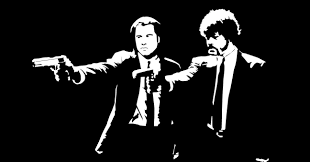
#779. Mock Squid Soup: Pulp Fiction

via Wallpaper Vortex
The merry meeting of the Mock Squid Soup society has nothing to do with Marvel Comics and less to do with counterfeit cephalopods (what a horrible thought!), but does involve a dude named Mock and another dude named Squid and movies that they've selected and sometimes watched together, because they don't just know each other on the Internet but somehow still communicate here and not through social media invented this millennium (I kid because of the soup!).

This month they selected Pulp Fiction, which was released twenty years ago but only five and a half films ago from director Quentin Tarantino, who lately has built his career out of helping Christoph Waltz win Best Supporting Actor honors from the Oscars.

It's a great selection, one of the defining pieces of modern cinema, and I don't just say that because there have seemingly been whole careers for critics built out of trying to identify which filmmakers were inspired by it.  Personally, I'd recommend you watch The Usual Suspects, Smokin' Aces, In Bruges, London Boulevard, Seven Psychopaths (incredibly those last three movies star Colin Farrell, but no one has ever identified him as prime Tarantino material), but start at the beginning with On the Waterfront and maybe Casablanca.

Tarantino has been called the child of pop culture, but that's not really true.  He's a veteran of the video store era, back when people watched movies as a hobby, and there was no bigger aficionado than Tarantino.  Except maybe this was a kid who grew up in the '70s and spent the '80s dreaming of a way to pay his respects, because that's what his budding career looks like, the best way to summarize Pulp Fiction.

Everyone remembers John Travolta, Uma Thurman, and especially Samuel L. Jackson, but perhaps the most telling elements of the movie revolve around Bruce Willis.  And mind you, Pulp Fiction is basically a Western, born from the aftermath of Clint Eastwood's Man with No Name emerging and John Wayne dying and then later Eastwood's modern cowboy Dirty Harry, but with all the good guy glamour finally drained.  Pulp Fiction is a world of bad guys.  It's also a world without a defining war for the first time in the 20th Century, when such things came around every twenty years.  You can't be an American and not have thought about that.  But Bruce Willis is part of a new generation.  His character's great-grandfather fought in WWI, his grandfather in WWII, and his father, as memorably explained by Christopher Walken, in Vietnam.  Willis is a boxer, smack dab in the era when boxing began to become culturally irrelevant, Mike Tyson's career crumbling and nobody emerging to replace him.  This is also around the time when football began to take over with two Super Bowls dominated by, you guessed it, the Cowboys.

How any of that makes sense: actually, pretty much the same way as the pretzel logic of Pulp Fiction, in which Willis shoots Travolta dead in the middle, apparently, of Travolta's adventures.  I can't possibly argue that Americans liked the idea of war.  By Vietnam we positively revolted it, and that's shaped our culture ever since.  We'd once again be stupid enough to let Hitler run rampage through Europe.  It's the idea of individuals running around doing exactly how they please.  Not exactly lawless, but the law of the land is chaos.  The boxer is free to go unscrutinized.  Tyson bites someone's ear off, everyone screams bloody murder, then forget that boxing is already a pretty brutal past time and then decide, hey! MMA looks like an acceptable alternative!  So then we embrace football, where chaos is definitely the law of the land, and by the time another war or two rolls around, everyone decides that we should end them as soon as possible regardless of whether or not our objectives are clearly identified let alone met, and yeah, so ISIS.

And crazy people running around with guns executing people.  I'm not calling Tarantino a visionary, but his hand was definitely on the pulse.  In his later movies, he worries less about tricks than he does explaining himself so that he can't be misunderstood with all that showmanship he's so good at, everything people expect from him.  And somehow, his message keeps getting lost.  I think Tarantino gets away with breaking rules because people ultimately decide, it's Quentin being Quentin, but like the old rock critics, they also proclaim that he's not as good as he used to be and they'll never make another like him.

Whatever that means.

All his good guys are bad guys, and there are huge pieces of his stories that are never told.  Ving Rhames already has a band-aid on the back of his head when we first meet him, chronologically and story-wise.  It's not quite as extreme as Brad Pitt with the giant scar on his neck throughout the whole of Inglorious Basterds, but it's also the visual equivalent of the story Travolta and Jackson share about the last time someone had the task of babysitting Thurman, the story Travolta has in the back of his mind through most of the movie, and by turns, the idea of the watch Willis inherited from three previous generations, and even the mystery of what's inside Rhames' briefcase that Jackson carries around throughout, what he refuses to give Tim Roth, because it belongs to someone else.

Because it belongs to someone else.  That's it, really, isn't it?  It's the idea of greed, and what some people are willing to do and what some aren't.  Twenty years and counting without a war at that point.  Everyone was waiting for the next shoe to drop.  And it seemed like it never would.  What does that say about us?  It's a heck of a responsibility.  Everyone talks about peace, but even Jackson wants to retire but to "adventures," which is to say no peace at all.  The idea of "pulp fiction" harks back to a time when we glorified the bad guys (who else do you think Jesse James and Billy the Kid were, guys who helped inspire this subject matter?).  Pointedly, until Willis kills his opponent in the ring, without even realizing it, without giving it a second thought because he desperately needed to save his own hide knowing that he's made a deal with Rhames to lose the fight, he's never killed anyone.  He kills several people after it.  He kills one person with a samurai sword (the whole idea of Kill Bill percolates throughout Pulp Fiction).  It becomes a farce.  Okay, the whole thing's a farce.

It's a movie with multiple narratives, like the later Traffic, Crash, and Babel, but strangely I don't know that Pulp Fiction is thought of in that way.  Like I said, usually as a Tarantino film, a Travolta film, a Jackson film (arguably, somehow, still the only movie to have truly appreciated having him in it), but not a Willis film.  But it is a Willis film.  Watch the later 16 Block.  You wouldn't have 16 Blocks without Pulp Fiction.  But it's all of these things, and it doesn't even start with Travolta or Jackson or Thurman or Rhames or Willis, but with Roth, who has the least to do with anyone else.  By the time he interacts with Jackson, at the end of the movie, Roth's presence has completely vanished.  He's the least important element, but he's also a crucial element.  What is it that belongs to somebody else but has crucial value to yourself?  It's the movie's unspoken riddle, the answer you don't even realize you were looking for.  Maybe this is a movie about life in general.  It's a topical movie, eternally so, without even looking like it's trying to be.  That's film-making.

Of course it changed everything.  It's not an easy movie to figure out, and so you have all these people trying, and failing miserably, to do so, and identifying all the wrong elements about what Tarantino's contemporaries did after its release.  You might as well say it's exactly the same movie as Forrest Gump or The Shawshank Redemption, which by the way it basically is.  It's just, Pulp Fiction has flare.

Just as Willis is routinely overlooked, there's also Rhames.  Do you even know Ving Rhames offhand?  You probably should, but the fact that you might not speaks about all the injustices Tarantino is really talking about, the little crimes we perpetrate against each other (a foot message, say) while focusing on all the bad guys shooting their guns all over the place.  That's why Jackson and Travolta seem to talk in trivialities, because Tarantino realized that suddenly it's no longer the big events happening, at that time, but all the mundane little moments that get to us.  We try and focus on everything else, but really, who are we kidding?  That's what Jackson is thinking at the end of the movie.  Harvey Keitel shows up and he's the only guy who can calmly talk people through a crisis, until Jackson, the only one who learns anything, replicates the fete.  Love and war.  It's the idea of breaking eggs to make an omelette.

Rhames, by the way, has appeared in all of the Mission: Impossible movies, and starred in the excellent Rosewood, another unusual Western.  He's still routinely overlooked.  I think Thurman as a brunette in Pulp Fiction causes a lot of people to forget she was in that, too, why it took Tarantino to collaborate with her again in Kill Bill for people to remark that she was still making movies and very much capable of turning heads (you know, or decapitating them), but somehow still like Pam Grier and Robert Forster in Jackie Brown, a couple of born stars who outside of Tarantino can't catch a break.

And you know who I realized seems to have adopted a lot of her persona from Thurman in Pulp Fiction?  Zooey Deschanel.  Obviously there are differences, but not as many as you'd think.  People tend to overlook her, too.  And she's as least as lethal a catch in (500) Days of Summer as Thurman in Pulp Fiction.

This is not my favorite Tarantino film.  Lately it's been whatever the newest one was, and that started with Kill Bill Vol. 2 and continued with Inglourious Basterds and currently rests with Django Unchained.  Because Quentin Tarantino is, ultimately, restless.  He's never happy unless he's challenged himself.  He's said that he's looking to retirement relatively soon.  He got angry after his script for The Hateful Eight was leaked, vowed he wouldn't make it as a result, but of course he will.  This is a guy who has probably spent his whole life telling himself stories.  You can see that in Reservoir Dogs, and even Death Proof.  That's why he's such a vital storyteller, because he believes in stories, the stories other people have told, and the ones he wants to tell as a result.  Some claim that he's nothing but a glorified rip-off artist.  I call him aware.  More and more, he's trying to make his viewers aware, too, cut through all the nonsense we like to tell ourselves (the telling scene in Django Unchained as Leonardo DiCaprio explains his version of why the black man is inferior, and the irony of Waltz explaining to him later that his idol, Alexander Dumas, was black).

Anytime you compare someone to Shakespeare, you have to have a really good argument, but you also have to remember, if it hadn't been for the folio of his works, Shakespeare likely would have been forgotten, and we wouldn't be sitting here explaining the eternal brilliance of him, either.  Tarantino, I'm convinced, is in Shakespeare's league. Pulp Fiction might be considered, above all else, A Midsummer Night's Dream.

And yeah, it's still cool, after twenty years.

Friday, November 14, 2014

#777. Mock Squid Soup: Space Battleship Yamato

via Star Advertiser
The Mock Squid Soup society is meeting again to discuss Space Battleship Yamato, a 2010 Japanese movie based on a 1970s anime.  As always, Mock Squid Soup is, astoundingly, presented by a couple of people named Mock and Squid, but not by a mock squid.  That would just be silly.

This is the first selection of theirs that I had not previously seen.  I scrambled for a few weeks attempting to find a copy, and when all else failed I did what people have done for thousands of years: bummed it off the Internet for free.

A large swath of Space Battleship Yamato is right up my wheelhouse, which is to say it features significant portions of spaceships going boom! boom! boom!  I have an incurable knack this kind of movie, and an even worse impulse to like the result regardless of its overall critical merits, which include things like what everyone else says about it.

But Space Battleship Yamato has a secret weapon in that regard, in that it's not generally known among American audiences, who tend to hate even the things they like.  So I was pretty safe this time.

The thing about this movie, however, is that it owes more to fan films than to Hollywood.  That's okay.  I've watched my share of foreign productions.  In my first year of college there was a standing date when a new one would be screened every week (or whatever the interval was), movies like Earth (1998), The King of Masks (watch for the teapot!), and Dancing at Lughnasa (in which Meryl Streep convincingly plays Irish!).  

I've watched plenty of Japanese movies, too, including a bunch of anime, far too little Kurosawa, and probably the most similar experience to Space Battleship Yamato, the trippy Versus.  But I would probably call the most relevant experience Clint Eastwood's Letters from Iwo Jima, the movie that made its predecessor Flags of Our Fathers instantly irrelevant in comparison.

If you've never seen Letters, you should correct that as soon as possible.  Outside of Tora! Tora! Tora! it's probably the only movie a classroom should screen regarding the Pacific Theater during WWII.  Ken Watanabe leads a cast that explores the face of the enemy in such a way that you can't help wondering...these guys were the enemy?  WWII wasn't exactly known as that kind of war (but then, what war is?), and no matter what Quentin Tarantino did with Inglourious Basterds no one will ever manage that with the Nazis (except, Christoph Waltz!), so that's a heck of an accomplishment.

Space Battleship Yamato is sort of that kind of experience, in that it relates the Japanese perspective of WWII via allegory via aliens and spaceships.  Watching it, you probably don't even realize the bad guys are essentially those dastardly Americans.  Although you have to admit, it's probably wrong to say "those dastardly Americans" so flippantly when you think that the only use of nuclear weapons in warfare on record was in fact by Americans on the Japanese.  Twice.

This is a grim movie in a lot of respects.  The actors talk almost uniformly in solemn tones, which makes for tough listening after a while (if you're looking for something other than one-note performances, this is not the movie you're looking for).  Putting the story in its proper context (the historic Yamato was Japan's last best hope for glorious victory, so to make a futuristic one carry the same role and to actually accomplish it is not just science fiction but wish fulfillment in a way you probably hadn't thought of before; it's not all Godzilla over there in terms of the national post-nuclear psyche) takes a lot of the wind out of its escapist sails.

I think I would have to watch it again to quit worrying so much about its implications and just lose myself in the experience.  But in all seriousness, that goofy captain's hat has got to go.

Friday, October 10, 2014

#773. Mock Squid Soup: Unbreakable


Mock Squid Soup is a film appreciation society brought to you by people actually named (on the Internet) Mock and Squid.  They are both deeply disturbed.

No, actually, all the characters in Unbreakable are.  As is director M. Night Shyamalan.  As are the fairweather film fans who quickly thought he was completely untalented the moment he was no longer flavor of the month.

Let's start our discussion with Shyamalan!  His popular career began with the surprise late-summer 1999 blockbuster The Sixth Sense, which famously had a twist ending.  Apparently if you have something like a twist ending with all your films (or, you know, have something like personal style) this is a sign of creative bankruptcy.  If I sound flippant about it, it's because I never understood that.  As far as I'm concerned, the man's a genius, easily easily one of the best filmmakers of the past fifteen years at least.  I think part of the reason people cooled on him so quickly was because of Christopher Nolan's rise at around the same time.  Shyamalan seemed to come out of nowhere (he didn't; actually, his first movie, Wide Awake, is a charming family movie) whereas Nolan's career had a chance to build in increments, from the widely respected but cult-sized Memento (although again, there was an earlier film: Following) to blockbusters like The Dark Knight and Inception.  Both are craftsmen who tend to focus on journeys where the intensity can be about emotion instead of bluster.  But while Nolan's audience had a chance to build up, Shyamalan's only had the expectation of eventual disappointment.

A slight simplification, but that's my view.

His third major release, The Village, may have been the movie where everyone took their later impression of him from, a movie that changes everything you thought you knew about the story without any real clues to prepare you.  Strangely, he rebounded popularly with Signs, but was never able to recover after that.  Lady in the Water is a terrific fable.  The Happening was never even given a chance, dismissed instantly as just more of his nonsense.  I liked The Last Airbender.  I still have yet to see After Earth.

Anyway, it isn't all Shyamalan worth considering about Unbreakable.  There's also Bruce Willis, who was also the star of Sixth Sense.  This was a period of career renaissance for Willis, where he could break away from his action persona for a change and find real success.  His two collaborations with Shyamalan were the peak of this period, and for me personally his career highlights (others still swear by Die Hard, although that's a franchise that has finally died.  hard) aside from the inspired lunacy of The Fifth Element.

There's also Samuel L. Jackson, who like Willis was turning a popular corner, and who unlike Willis has continued to parlay this period to great success, possibly because he figured out how to keep it going.  (Seriously, would anyone mind seeing a solo Nick Fury movie at this point, or does Captain America: The Winter Soldier technically count?)

Both of them were in Pulp Fiction, by the way.  I think people tend to forget Willis was in that, but of course everyone remembers Jackson's scripture-quoting hitman. They should work together more often.  (It didn't work out so well when Jackson reteamed with John Travolta in Basic, although there's at least one scene totally worth watching for having them together again in it.)

Remember the kid from Gladiator?  He's in here, too.  I think it was an odd choice for Shyamalan, because the kid kind of looks like Haley Joel Osment.  Same general hairstyle.  May have been an unconscious thing people held against the director.

Robin Wright!  Who doesn't love Robin Wright?  Her career is probably one of the least needy ones in Hollywood.  It's always a pleasure to find her in a movie you're watching.  You might consider giving The Conspirator a shot if you're looking for something new.

Besides all that, Unbreakable is also a superhero movie, and as a 2000 release (same year as X-Men) just on the cusp of that actually being a very good thing.  It's probably one of the reasons the public started liking them so easily.  It's part of a holy trinity for me, along with Hancock and The Dark Knight, as the best superhero experiences yet featured on the big screen.  Like Hancock, it's a rare modern original effort, rather than an adaptation from comic books.  Like Dark Knight, it's a movie that takes superheroes completely seriously.

It's an absolute favorite of mine, featuring a number of absolute favorites behind and in front of the camera.  For me, there's nothing but plenty to love.

Friday, September 12, 2014

#766. Mock Squid Soup: Burn After Reading

The second meeting of Mock Squid Soup, which oddly enough originates from a dude named Mock and another dude named Squid, is exploring the Coen Brothers' Burn After Reading, released in 2008.
via Stand By for Mind Control

The Coen Brothers, otherwise known as Joel and Ethan Coen, have been making some of the quirkiest movies of the past thirty years (beginning with 1984's Blood Simple).  I'm sadly lacking in some of the essentials (Fargo, Miller's Crossing, The Big Lebowski, Barton Fink, Raising Arizona), but I've been a die hard fan since the release of 2000's brilliant O Brother, Where Art Thou? (which conveniently enough for my personal tastes is a pastiche on The Odyssey).  My dad is a big fan of John Wayne, so I saw the original True Grit when I was a kid, but I love the Coen version more.  No Country For Old Men is a movie I actually made a personal holiday out of catching when it was in theaters, and while I appreciate it a great deal, it's one of those movies I really need to see again, because like everyone else my enduring memory of it remains Javier Bardem's Anton Chigurh ("Call it, friend-o"), even though it was the culmination of a hot streak for the perennially underrated Josh Brolin I very much appreciated at the time.  And I love Tom Hanks in The Ladykillers.  One of his many classic performances.

But getting back to Burn After Reading, and why I selected an image of J.K. Simmons, I'm actually realizing for the first time in a while (because it's been a while since I saw it), that the image I want is actually probably John Malkovich:
via Cinematic Thoughts
I'm now pretty sure it's Malkovich who repeatedly utters a phrase...I cannot share on a family-friendly blog.  It contains the word "morons," and another word that ends with "king" but certainly does not begin royally.  I remember the phrase if not exactly who utters it (I'm pretty sure Malkovich now!) because I subsequently adopted it as my foul-mouthed oath to the world.  I have issues.  I indeed think a lot of people are "[...]king morons."  

Judge me.  But that's the major reason I love Burn After Reading.  For me, it's about as accurate a movie as I've ever seen about how the world really works, when there really are no competent people around and everyone's flaws are magnified into their dominant personality traits.  (I can be cynical.)

I know, I know, it's terrible.  But c'mon!  Okay, so maybe you don't relate.

I also love it because Brad Pitt is running around in an overtly comedic performance.  This was before Inglourious Basterds, which for me instantly became one of his defining performances.  (Great movie.  Tarantino found his perfect muse at last in Christoph Waltz.)

Speaking of perfect muses, other than Jeff Bridges, do the Coens have a better or more consistent one than George Clooney?  He's in the mix here, too.  I love Clooney, have ever since I saw him in ER.  I don't know why it took so long for everyone to admit the guy has charisma to spare, but at least it finally happened, and he landed in a perfect groove to exploit it.  I make no qualms about saying so.  Clooney exploits his charisma, sometimes for some truly dramatic performances (Syriana, Up in the Air, Three Kings), sometimes just being Old Hollywood goofy.  I think he's less consistently successful with wide audiences, not to mention critics, because he's so sure of his own skills.  It's not that he can't disappear into a part, but his movie career came about only after everyone discovered Clooney could be a star.  It wasn't a role, other than a few seasons on a TV show, that made him.  It was pretty much Clooney himself.  He's what Hollywood stars used to be, but stopped being decades ago.  Which come to think of it probably explains his whole career.

But getting back to Simmons, I love that his career finally became a thing, and it's the major development I take away from Sam Raimi's Spider-Man movies, where Simmons played the blustery J. Jonah Jameson, the one cartoon performance that's been completely owned in a comic book movie to date.  He's been consistently great ever since, and like Clooney all he has to do is do his thing.  Great in Juno (but everyone's great in that one).  Great in those All-State commercials.  Even if he isn't the one to...utter the phrase, he's still a great reason to watch this movie.

Maybe I've already spoiled the movie and perhaps even your opinion of me with some of the things I've said here today (but were they really surprises?), I don't know.  Just watch the movie.  Watch more Coens movies.  Watch more Clooney movies.  Watch movies.  They have weird ways of explaining the world around us.

Friday, August 08, 2014

#761. Mock Squid Soup: Stand by Me

Coming at us from Mock and Squid is a monthly movies bloghop, Mock Squid Soup.  The inaugural meeting concerns 1986's Stand by Me.

We're going to rewind a little before we reach the movie, however.  Stephen King's book Different Seasons was released in 1982.  The '80s were a boom decade for the Maine native.  This was the first time he consciously stepped away from the horror genre.  Clearly fans still found plenty to connect with, King's patented intimate viewpoint of humanity coming to the forefront of his storytelling for the first time.  The book was a collection of novellas that went on to great pedigree.  (Each of them are loosely associated with a season, so that's how the title came about.)  The first novella in the book is Rita Hayworth and Shawshank Redemption, which of course later became the movie The Shawshank Redemption; this is arguably King's best-received story to date.  The second is Apt Pupil, which also became a movie.  The fourth is The Breathing Method, which to date has not been adapted into cinema.  The third is The Body, which became Stand by Me.

Now, Stand by Me was a movie that for me originally was best known as the secret (or not-so-secret) origin of Star Trek: The Next Generation actor Wil Wheaton.  Later, it became, cruelly, perhaps the defining film of the late River Phoenix's career.  Rounding out an excellent ensemble were Cory Feldman and Jerry O'Connell as the other two lead boys as well as Kiefer Sutherland, John Cusack, and Richard Dreyfuss.
via Prime Movies
The irony of the movie is that the way the boys talk would become the pattern of geek talk, Internet speak.  The adventure itself is something that would become known as Spielbergian thanks to The Goonies from a year earlier (which was...directed by Richard Donner, with a script from Chris Columbus...based on a story from Spielberg), which for me actually means...Super 8, J.J. Abrams' 2011 movie.  Any fan of Stand by Me owes it to themselves to watch that one, too.

But I will round out this retrospective talking about River Phoenix.  The dude had obvious talent, from an early age.  He's this generation's James Dean.  Stand by Me remains his Rebel Without a Cause.  He made a few other movies, but none of them seem to have particularly stuck out in the same way.  The closest, and I'm always meaning to watch it, would be My Own Private Idaho.  The other one I've seen so far is The Thing Called Love, released in 1993, the same year he died.  It's about aspiring country music performers, and co-stars a young Sandra Bullock.  It may not be a classic but it's entertaining.  The lost movie Dark Blood was finally completed a few years back and released to the general public.  I want to see that, too.  It should be worth noting River's kid brother Joaquin turned out to be an exceptional talent, too.  You may know him best from Gladiator, but I'd recommend you catch Two Lovers.  He's received great acclaim in recent releases The Master and Her, and of course is perhaps best known for the notorious experiment known as I'm Still Here.  He also played Johnny Cash in Walk the Line.  I also recommend Buffalo Soldiers and Signs.

LinkWithin

Related Posts Plugin for WordPress, Blogger...