I've just finished S. from J.J. Abrams and Doug Dorst. Put simply, it's amazing. Put less simply, it's kind of the answer to all the questions you ever had about a J.J. Abrams project.
The project you ought to keep in mind, if you ever read it yourself, is Lost. You know, that mesmerizing, confounding puzzle of a TV show that fans alternately love and hate. There're so many elements to S. that it seems a rank injustice to single out only a few, but a lot of them seem tailor-made to anyone still trying to figure out what happened on that mysterious island. It's the answer to what's inside that mystery box that seems to be at the heart of every Abrams story.
And it actually helps put Abrams into better context than ever. I started ticking off all the associations I could easily make: Christopher Nolan, M. Night Shyamalan, Orson Welles, Frank Miller, Dean Motter, J.K. Rowling, Grant Morrison. All his stories involve people trying to sort out the vagaries of identity while pushing up against powers much more frightening than they ever wanted to confront.
Getting back to Lost, however, and how S. offers such rich parallels, it reminds me all over again how drastically the series changed after its third season, the one the fans hated so much it forced a course-correction and abbreviated run of only three more years. The third season is the one where the fans thought things started to drag, become less inspired, more predictable. But I never really saw that. The opening suite of episodes are especially electric. Jack, Sawyer, and Kate are being held captive by the Others. Finally, we're finding out what the enemy actually looks like. And other than Jack's initial predicament...it's pretty mundane, actually. It plays out a lot like the action in S., in which an amnesiac man finds himself thrust into a war of attrition between two sides who operate below the public radar, both completely convinced about the legitimacy of their actions and committed to eliminating the other. He keeps ending up on the same boat, and struggles to connect with the woman of his dreams. Just from the first moment we meet Jack in Lost, you can begin to see parallels.
The whole book is like that. The approach, however, delves deeper. It speaks to what Abrams might have thought as fans followed Lost's developments, whether in the series itself or the ephemera that gave secret clues about what lay ahead, such as the earliest references to the Dharma Initiative. And just what did the mysterious organization turn out to be? That's what the third season was headed toward, the same one where Jacob was referenced for the first time, who would eventually embody the war of black and white pieces Locke shows Walt from backgammon all the way at the beginning.
The moment the series acknowledged the wishes of the fans, I think Abrams felt it was the moment to give the series over to his collaborators. The shift is so obvious, the approach altered in ways more profound than the length of seasons. It becomes a lot more mythologized. By the end of the series, the fans, who had become aware that they could affect the shape of the Mystery Box, felt it was appropriate to be disappointed when they realized the answers they thought they wanted didn't materialize. And who is to blame? The fans. They scared off Charles Widmore. The Dharma Initiative that showed up in the fifth season was as ineffectual as Widmore's role in the sixth. I daresay both would have been far different with Abrams still steering the course.
None of this is to say I personally was disappointed with the series. Abrams has explored the same story over and over, from Alias to Fringe to Person of Interest, the last of these most successful at hiding in plain sight the Mystery Box. The Smoke Monster had different permutations, too, in Super 8 and Cowboys & Aliens. Once Upon a Time took a different approach to the same fantastic lives ordinary people experience when they encounter open the box. Abrams (and the creators who will be forever linked to Lost) likes characters with daddy issues, surrogate families, and conspiracy theories. I think all these things come to their best form in Fringe. Fans can pick their favorite.
S. is a way of affirming that Abrams can be a genre all to himself. You can enjoy the book on its own merits, for its own accomplishments. You can approach it by way of Lost (and come to different conclusions if you like). But I think you'll enjoy it, one way or another. It's ambitious. It's a way of approaching Abrams as a pure storyteller, someone who clearly enjoys what he does, no matter his motives or proclivities or the demands he asks of his audience. That he asks anything at all has always been one of my favorite things about him, the moment the name "Milo Rambaldi" was uttered for the first time. I like a challenge in my entertainment, and Abrams is one creator always game to provide one. I'm glad his efforts exist in book form now.
Monday, May 26, 2014

Wednesday, May 21, 2014
#746. Blockbusted Blogathon: Batman & Robin

To be perfectly clear: Batman & Robin is not my favorite movie. It's really not even close. That being said, I unabashedly love Batman & Robin.
I realize that this is not the usual position to take on this particular movie. In a lot of ways, its popular reputation is absolutely earned. This was as close to the 1960s Batcamp as the modern movies will hopefully ever get. But there's so much to love about it.
There really is.
Released in 1997, the second (of two) Batman flicked directed by Joel Schumacher (after 1995's Batman Forever), Batman & Robin closed the book on that particular wave of superhero movies, and it killed a four-film-deep series that had begun with Tim Burton's Batman (1989) and Batman Returns (1992). It was the second one to feature Chris O'Donnell's Robin, and first (and only) to have George Clooney under the cowl.
In a lot of ways, there's nothing but logical progression behind what this movie became. Easily best known for its villains, Arnold Schwarzenegger's Mr. Freeze, Uma Thurman's Poison Ivy, and Jeep Swenson's Bane, chances are most of what you know and/or think about it is associated with one or all of them.
For the record, there's also Alicia Silverstone's Batgirl in the mix.
To my mind, the most egregious mistake of the movie is actually Thurman's Ivy. She's the most irredeemably campy presence in the whole thing. I love Uma Thurman. I think my whole generation loves Uma Thurman. She did what was asked of her. Didn't ultimately hurt her career, whatever anyone might think of her Ivy. Such is the power of Uma Thurman. Schwarzenegger, O'Donnell, and Silverstone all basically kissed their popular movie careers goodbye after Batman & Robin landed as a turkey. But Thurman, who was never herself considered a major box office draw, didn't really have to worry about that. A half-dozen years later, she was The Bride in Quentin Tarantino's Kill Bill flicks. Legacy assured.
And really, I can even redeem that element of the film. While the character herself is like Michelle Pfeiffer's Catwoman stripped of all pretense (I'm not really a fan of that performance, either, clearly), Ivy serves as a strong impetus for the Batman/Robin dynamic that's...pretty important to the movie (if you weren't able to tell from the, um, title).
Associated with Ivy otherwise is Bane, who was only a few years removed from his biggest comics moment when he broke Batman in the "Knightfall" story arc. Bane in this particular movie appearance is a very dim echo of pretty much every other depiction ever (hopefully). But it's about as accurate a depiction of the Venom-fueled (read: super steroids) monster aspect as you could hope to find. This is what baseball fans would be thinking in just a few years. Just a year later, Mark McGwire would carry that particular era to its greatest popular heights. But even he would crash back down to earth. In recent times Captain America's super steroids enhancements fuel him to 1998 McGwire-like, but the truth is, as certainly Lance Armstrong will tell you, people really aren't that hot on this sort of thing. So Bane in this movie makes perfect sense, especially in hindsight.
Schwarzenegger's Freeze is actually the most redeemable element of the movie. Yes, I just said that. I've already admitted that Batman & Robin pretty much destroyed his career. But it may also be one of his greatest performances. For years, the future Governator had been trying to be the perfect action movie/comedy star, setting a template his successors still follow (and that's how we got Tooth Fairy). This is the movie where he combines them most perfectly, as well as his ability to deliver quips better than anyone. Nearly every line Schwarzenegger delivers in this movie is a quip. It's so ridiculous it's awesome. Like Thurman's Ivy, there was every precedent for Freeze in his Batfilm predecessors. Critics were charging that Jack Nicholson gleefully upstaged Michael Keaton from the start. Is there really any arguing that? Batman Returns not only features Pfeiffer's loony Catwoman, but Danny DeVito's cartoonish Penguin (who is arguably even more the star of that one than Nicholson in Batman), and Christopher Walken. Who is Christopher Walken. Batman Forever has Tommy Lee Jones mugging awesomely as Two-Face and Jim Carrey. Who is Jim Carrey.
So by the time you reach Schwarzenegger's Freeze, it's really a heck of a lot more logical than anyone has ever cared admit. The thing is, just like Thurman's Ivy, this is a Batman villain stripped of all pretense. He has a great time being a villain. But he has arguably some of the best moments of nuance for any Batman villain, too.
Really??? Really.
Because that's there, too. Schwarzenegger's Freeze is a tragic villain, and the true genius (I just said that) of the performance is that his best moments are actually subdued. The complete opposite of anything else you know about it. Freeze has a wife who is mostly completely left offscreen except in her holding tank. There's a flashback to Freeze's origin, and the end of the movie, which I will get back to.
What I love so much about Schwarzenegger's Freeze is that he set a positive precedent. He really did. Another of my all-time favorite superhero movie villains, Thomas Haden Church's Sandman from Spider-Man 3, might not have happened if it weren't for this performance, this depth in the heart of a movie that seems to lack it. But it's there. It's there in spades. But I'll get back to that.
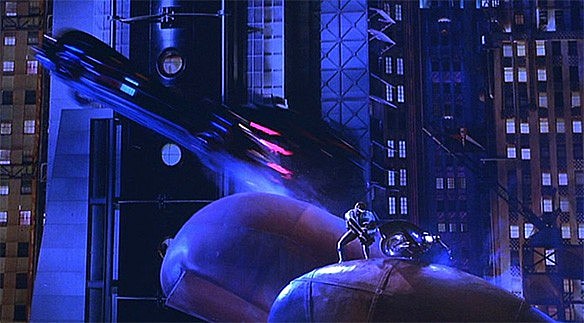
Another big precedent Batman & Robin sets is big action in a superhero movie. Until then, the most outlandish thing fans could expect from them was believing a man could fly. Technology just wasn't ready for anything bigger at that point. The Batman flicks had been upping the ante with each entry. By this point, all stops had been let loose. Batman no longer resembled the Gothic vigilante. There's very little about this movie that resembles Gothic. Completely the opposite, really. But this was one step along the way to reaching The Avengers, the most financially lucrative superhero movie ever. In other words, a movie that the fans loved. Big time. But in order to reach that point, Hollywood had to know that big risks could pay off. They could achieve the kind of action comic books had featured for decades. And that started in Batman & Robin.

The thing to love best about Batman & Robin, though, is its heart. The whole thing, rather than being about the cartoon villains, is for the first time wholeheartedly about Batman. This sounds like an odd statement, because this is perhaps the movie out of the first four with the least focus on Batman. Clooney's Bruce Wayne receives the least screen time out of all three original actors to play the role. It's pretty much the opposite of his predecessor, Val Kilmer.
And yet this is a Batman whose career has significantly advanced since the last time we saw him. He's become a media darling. But he also has a partner now. Robin. That was the true legacy of Batman Forever, too. The decision to feature an older version of the character than was traditional in the comics had a significant impact. Batman and Robin were from the start, in this version, far less a matter of hero and sidekick, and more...partners. By the end of Batman Forever, that hadn't really been resolved. Batman & Robin is in a lot of ways a resolution of its predecessor. Robin learns about what it means to accept personal responsibility both from the rivalry Poison Ivy ramps up with Batman as well as the introduction of Batgirl, who is really a means of forcing Robin to see things from Batman's point of view for the first time.
With a lot of dayglo, by the way.
Part of the reason I've always liked Batman & Robin more than is reasonably common, I admit, is that I'm a fan of George Clooney. In an alternate universe, he would have been easily digestible as Batman. He's a natural. It's just, in his one appearance in the role, he's got a supporting role, just like Keaton in Batman Returns. This was one of Clooney's first movie roles, and to this day still one of his few efforts to make a truly mainstream movie. You might almost say that the failure of this effort allowed him to do what he wanted to do, and that's been pretty good for his career.
But the element I love best about Batman & Robin is Michael Gough's Alfred. Gough played Batman's butler in all four movies from this era. He was such a reliable presence (even moreso than Pat Hingle's Commissioner Gordon) that he was easy to take for granted. In this fitting finale, he finally steps into the spotlight.
That's the arc you really ought to pay attention to. Bruce Wayne has a love interest (played by Elle McPherson, by the way!), but the relationship that matters most in this movie is the one that endured the whole series. It's a classic case of emotional manipulation, of course. Alfred becomes significant because of a mortal illness. But it works. It works completely.
And it just so happens that Alfred's illness is the very same one that has been plaguing Mr. Freeze's wife. This sets up the ending, where Freeze finds redemption by agreeing to work with Batman to cure Alfred. It's the rare instance where the villain, who in comics is typically some kind of genius who "if not for..." would probably be of great benefit to mankind but instead is trapped in a loop of their worst impulses, actually steps away from their petty nonsense.
Granted, Freeze has very little left to lose. He's already been defeated. He's lost his wife (seemingly). But Batman saved her. And now everything he's been doing as a villain is actually...meaningless again. So he can go back to what he was. Which was actually a pretty nice guy.
Which, again, also saves Alfred's life.
So I love that. Unabashedly. A lot like The Amazing Spider-Man 2, if you mostly ignore the elements that don't work as well as its best elements, you end up with something pretty awesome. Maybe it's harder to see with Batman & Robin. But I've never really had that problem.
One last thing worth mentioning about it. The soundtrack boasts the song "The End is the Beginning is the End" from the Smashing Pumpkins. This song is awesome. It was featured in the original trailer for Watchmen. One of the best trailers ever. Premiered in front of The Dark Knight. That's a kind of redemption, too, isn't it?
This post was part of the Blockbusted Blogathon hosted by Girl Meets Cinema's Katy, which I learned about from the Geek Twins, who encouraged me to participate. So you can blame them for this defense of a defenseless movie!
Monday, May 19, 2014


Sunday, May 18, 2014
#744. Overheard May 2014
Count me among those who won't be going. I'd been living in New York a month when the attacks happened and saw the whole thing from my company's Learning Center, located on the Queens side of the East River, right across from the UN. My "Prints, Plates, and Diagrams" class was on a break, so along with the rest of my class, I was down on the Center's back deck drinking coffee, enjoying what would otherwise have been one of the nicest days I'd ever spent in New York.
I don't mind saying that the memory still haunts me. I have absolutely no desire to relive it.
By the time the weekend rolled around, Hoboken was plastered with "Have You Seen This Person?" fliers. They were on ever vertical surface in the Mile Square. One poor guy lost his beautiful blonde wife or girlfriend. I don't know the story. But he kept putting those posters up for months and months and months. I bet I saw her particular "Have You Seen This Person?" flier for a solid eight months after the attacks. I still feel bad for that guy.
Anyway, that was a long time ago.
I worked the phones for the telethon they held right after the attacks, and for awhile I jumped every time I saw a bunch of police cars rushing down the street to get anywhere. But New York is eight million people and probably a million buildings, and for the most part, the City barely skipped a beat. The Stock Exchange was out of lights for maybe four days, and I remember distinctly that when the mayor asked folks to go out and shop on Black Friday that year to help the City's economy, my mom came up, and we literally shopped 'til we dropped. That was a pretty good day.
That's Dan Head over at Dan & Sally's Digital Domain reacting to the opening of the 9/11 Museum. I've known Dan since 2006. We both wrote about comics at the defunct Paperback Reader, and also overlapped at Digital Webbing (which is probably where we originally overlapped, in the message boards), so it was nice to reconnect with him in the blogging sphere. 9/11 is a subject that remains relevant to me. Every time there's a piece of news concerning it (last week I read in the paper about the current status of unidentified remains) I still want to clip it and save it (which is what I did for years). But I'm not a New Yorker (although, in some respects we're all New Yorkers since then), certainly not back in 2001. That morning I was in a college dining hall. Dan's memories are so much more...real. I was fascinated to read his perspective years after the fact. They're almost mundane. I never really imagined it like that, what it was like to live there days, weeks, months after the fact. The rest of us really only heard about the rescue efforts, the cleanup. But those who lived with it...Anyway, just thought I'd send you some perspective.
Eh. It's fine that they have a museum, but I think it's mostly for the tourists. Anyone who was there won't need to see it to remember what it was like.
Speaking of which:
I finally took a breath and dove into The Goldfinch, Donna Tartt's doorstopper of a novel. It just won the Pulitzer Prize (like, a few days ago) and was also shortlisted for 2013's National Book Critics Circle Award, so go Donna! As with Chang-Rae Lee's novel, this was a coming-of-age story and chock full of adventure. Our hero, young Theo, goes through a delightfully Dickensian childhood full of misery and joy, hijinks and heartbreak ... just one damn thing after another. I adored the thrill ride, implausible as some of it was, but the ending was terrible. OK, so you know dramatic structure has five parts — exposition, rising action, climax, falling action, denouement? It was all good until the denouement. When you get to that part, do yourself a favor and just stop reading. Because 90% of the book was excellent, I still recommend it. The ending doesn't kill the book, it's just boring....
I'm reading Goldfinch right now. I think the book lost the bulk of its momentum after Theo went to live with the Barbours. Tartt's best writing was easily her breathless opening sequence. So far she hasn't come close to recapturing it. And I don't much care for Boris, and I've gone ahead and saw that he comes back again. "Implausible" is a good way to describe the unnecessary sequence of histrionic events. Like a literary soap opera....
I loved Boris! I really enjoyed the Barbours, too; and the bombing scene became almost unlistenable to me (possibly because it triggered some PTSD for me, but also because it was. so. incredibly. long.). We seem to have had opposite reactions to this book! :) But I agree that it is indeed a literary soap opera.
That's from Stephanie over at Words Incorporated. It's actually from the end of last month, one of several books she discussed for the Cephalopod Coffeehouse (yes, officially I'm no longer participating in that), then a response I made in the comments, and then her reply. I finished reading it right around the end of that month, too. Actually, "finished" isn't quite the word for it. More like, "abandoned." Because ultimately, I just never got back into it, once I realized I was no longer enjoying it. The funny thing is, Goldfinch from Donna Tartt isn't really as random a topic to bring up along with 9/11 as you might think. At the start of the book the main character finds himself in the midst of a terrorist attack in New York. One of many things I would've changed about the book is that I would have just gone ahead and made it a 9/11 story. It was all but one at that point anyway; I just didn't see the point in shying away, which is what I think Tartt did. Instead it's just a random attack specifically on a museum, that's never really explained, just one of many inexplicable elements that the author uses to create unearned dramatic tumult. Stephanie loved it, though, and as you can tell even a character who rubbed me the wrong way almost directly from his introduction, the wacky foreigner Boris. But the thing is, she and I differ again, concerning the ending, and Boris is part of the reason I think Tartt managed to pull a late book redemption, because Boris actually finds some useful redemption as the story finally takes some shape after a lot of meandering through Theo Decker's life (which, as I said in my comment, was at its strongest in the opening sequence when Tartt's writing was at its sharpest and most focused). But the contrasts between Stephanie's thoughts and mine, just serve to remind me that everyone's perspective is different.
Which is also what Dan's post made me realize. But then, we all know that already, don't we? I think we tend to forget that. So this is a new feature where I will try and explore that, highlighting not just interesting things I've read, but thoughts that have made me think. Because that's about as relevant as communal blogging is for me.
Monday, May 12, 2014


Tuesday, May 06, 2014
#742. The Amazing Spider-Man 2, which was amazing
Spider-Man was my earliest favorite superhero. As I got older, though, I came to realize that he didn't often have stories that lived up to the potential I saw in him. It got to the point where I wasn't even sure what that potential was anymore. The first couple Sam Raimi flicks from a decade ago were hugely popular, but they always kind of rubbed me the wrong way. And I love Tobey Maguire, but I'm not sure Peter Parker was supposed to be so...dorky. I think in hindsight those were as much Raimi flicks and the earliest attempts to keep superhero movies faithful to the comic book source material than anything I personally could really appreciate.
And yes, I was one of the few people to actually like Spider-Man 3, mostly because of how excellently Sandman was portrayed, one of the earliest true success stories in movie supervillainy.
So I was actually pretty excited when I heard about the Spider-Man cinematic relaunch a few years back. I was already a pretty big fan of director Marc Webb. (500) Days of Summer is easily one of my all-time favorite movies. Andrew Garfield had also already proven a favorite from his appearance in The Imaginarium of Doctor Parnassus. There was also Rhys Ifans, whom I've followed since Dancing at Lughnasa (it's the movie where Meryl Streep is Irish, in the likelihood that you've never heard of it). (Another note on Ifans was the wonderful juxtaposition of his appearance opposite another Peter around the same time in the SyFy Peter Pan flick Neverland.) And I loved that finally someone figured out that Peter's story is intrinsically linked with the death of his parents. The only thing I didn't love about The Amazing Spider-Man was that the villain becomes meaningless and almost spoils the whole thing once he actually becomes the villain.
The only thing wrong with The Amazing Spider-Man 2 is what I can only conclude is studio interference. I think this is more common than moviegoers think. It was pretty clear in John Carter, for instance, the parts that seem blatantly Disneyesque. I think this happens when the filmmaker maybe doesn't have enough clout to get things more or less exactly the way they want. I'm even willing to believe at this point that Joel Schumacher, the great demon of the Batman franchise, was a victim of this, because it's so clear seeing the earliest scenes of Jamie Foxx's Electro the commonalities with Jim Carrey's Riddler, for instance. Just the sort of thing studio executives think is necessary to make the end product kid-friendly.
Because otherwise this is a pretty dark picture, filled with foreshadow and foreboding, which began in the first installment of the rebooted series, made all the more clear by Denis Leary popping up periodically even though he's dead. Because Peter Parker knows it's not just great power and responsibility anymore, but the danger to those he loves he needs to worry about.
Bottom line is, this is Marc Webb getting to make the superhero version of (500) Days. That's what making really good smaller films gets you these days, the chance to replicate them as best you can in much bigger ones. That's exactly how Christopher Nolan started out. Maybe Webb is not exactly Nolan, but he's the next best thing. He really is, and Amazing Spider-Man 2 is all the proof I need. It's my new favorite movie based on a Marvel property. Easily. Easily.
The charm works all the way around. Foxx eventually settles into the role, once he doesn't have to sell his character's weaker instincts. It's the kind of role that reminds you that he used to be known as a comedic personality, just as Paul Giamatti's performance is a reminder that this is a guy who wholeheartedly throws himself into all of his roles, no matter what they are. I once suggested that he could have taken up the role of the Joker after Heath Ledger's death. And he easily could have. Clearly Rhino is no Joker. But he didn't have to be. He's just a tease for what comes later. These are movies that always have their pulse not just in the moment, but what comes later, sort of like Spider-Man himself (such as in the bravura moment where he saves dozens of people at the same time by figuring out how everything connects).
And I even love Emma Stone in it. This is the first time I've really been able to say that. I know she's adorable and all that, but she's normally so precious, as if she can't get past knowing how everyone thinks she's so cute. Finally she's breaking away from that. Who better than Webb, who was completely unafraid to throw romance under the bus at least once before? Except Stone's Gwen Stacy knows better than anyone that happy endings can be complicated.
I love that the whole movie has its moving parts figured out. It builds on and improves the legacy of Peter's parents, figures out where they fit in the mythology. Maybe it's been done before. But certainly not with anywhere near this prominence. Even if the spider bite was an accident, it was still a matter of destiny. And why anyone else trying to replicate it is doomed to fail. I mean, there are two characters in this movie who are radically transformed. They're as damaged as Peter was when his life was changed forever. The difference is that he figured out a way to look outward. Forget all those attempts to explain that he needed the death of Uncle Ben to become a hero. Mistakes can be made, courses corrected. But the strength of his character was always there.
This is a Spider-Man I can believe in. It's the first time he truly looks authentic on the big screen, too. Sure, they were able to make the character look convincing in 2002 (you believed a man could websling). It's not even just that Garfield is pitch-perfect with all his quipping, but that he's having fun, he's taking risks, he's going for broke. And sometimes it doesn't work out. But the strength of Spider-Man is that he always gets back up. (I confess that I had some help realizing this from some of the recent comics, where Peter finally reclaimed, ah, his own body. You really have to read those to understand what the heck I'm talking about.)
Assuming there isn't backlash from, um, everyone else's opinion of this movie, that it's a step back and a relative failure even at the box office, I want to see the next one really, really badly. I want to see what Webb does next. I want to see Peter meet Mary Jane. (In hindsight it was absolutely the right move to cut her from this one.) I want to see, by god, the Sinister Six.
Of course, regardless, I have this nearly perfect movie, and its predecessor, which shines brighter in reflection. I love Amazing Spider-Man 2.
And yes, I was one of the few people to actually like Spider-Man 3, mostly because of how excellently Sandman was portrayed, one of the earliest true success stories in movie supervillainy.
So I was actually pretty excited when I heard about the Spider-Man cinematic relaunch a few years back. I was already a pretty big fan of director Marc Webb. (500) Days of Summer is easily one of my all-time favorite movies. Andrew Garfield had also already proven a favorite from his appearance in The Imaginarium of Doctor Parnassus. There was also Rhys Ifans, whom I've followed since Dancing at Lughnasa (it's the movie where Meryl Streep is Irish, in the likelihood that you've never heard of it). (Another note on Ifans was the wonderful juxtaposition of his appearance opposite another Peter around the same time in the SyFy Peter Pan flick Neverland.) And I loved that finally someone figured out that Peter's story is intrinsically linked with the death of his parents. The only thing I didn't love about The Amazing Spider-Man was that the villain becomes meaningless and almost spoils the whole thing once he actually becomes the villain.
The only thing wrong with The Amazing Spider-Man 2 is what I can only conclude is studio interference. I think this is more common than moviegoers think. It was pretty clear in John Carter, for instance, the parts that seem blatantly Disneyesque. I think this happens when the filmmaker maybe doesn't have enough clout to get things more or less exactly the way they want. I'm even willing to believe at this point that Joel Schumacher, the great demon of the Batman franchise, was a victim of this, because it's so clear seeing the earliest scenes of Jamie Foxx's Electro the commonalities with Jim Carrey's Riddler, for instance. Just the sort of thing studio executives think is necessary to make the end product kid-friendly.
Because otherwise this is a pretty dark picture, filled with foreshadow and foreboding, which began in the first installment of the rebooted series, made all the more clear by Denis Leary popping up periodically even though he's dead. Because Peter Parker knows it's not just great power and responsibility anymore, but the danger to those he loves he needs to worry about.
Bottom line is, this is Marc Webb getting to make the superhero version of (500) Days. That's what making really good smaller films gets you these days, the chance to replicate them as best you can in much bigger ones. That's exactly how Christopher Nolan started out. Maybe Webb is not exactly Nolan, but he's the next best thing. He really is, and Amazing Spider-Man 2 is all the proof I need. It's my new favorite movie based on a Marvel property. Easily. Easily.
The charm works all the way around. Foxx eventually settles into the role, once he doesn't have to sell his character's weaker instincts. It's the kind of role that reminds you that he used to be known as a comedic personality, just as Paul Giamatti's performance is a reminder that this is a guy who wholeheartedly throws himself into all of his roles, no matter what they are. I once suggested that he could have taken up the role of the Joker after Heath Ledger's death. And he easily could have. Clearly Rhino is no Joker. But he didn't have to be. He's just a tease for what comes later. These are movies that always have their pulse not just in the moment, but what comes later, sort of like Spider-Man himself (such as in the bravura moment where he saves dozens of people at the same time by figuring out how everything connects).
And I even love Emma Stone in it. This is the first time I've really been able to say that. I know she's adorable and all that, but she's normally so precious, as if she can't get past knowing how everyone thinks she's so cute. Finally she's breaking away from that. Who better than Webb, who was completely unafraid to throw romance under the bus at least once before? Except Stone's Gwen Stacy knows better than anyone that happy endings can be complicated.
I love that the whole movie has its moving parts figured out. It builds on and improves the legacy of Peter's parents, figures out where they fit in the mythology. Maybe it's been done before. But certainly not with anywhere near this prominence. Even if the spider bite was an accident, it was still a matter of destiny. And why anyone else trying to replicate it is doomed to fail. I mean, there are two characters in this movie who are radically transformed. They're as damaged as Peter was when his life was changed forever. The difference is that he figured out a way to look outward. Forget all those attempts to explain that he needed the death of Uncle Ben to become a hero. Mistakes can be made, courses corrected. But the strength of his character was always there.
This is a Spider-Man I can believe in. It's the first time he truly looks authentic on the big screen, too. Sure, they were able to make the character look convincing in 2002 (you believed a man could websling). It's not even just that Garfield is pitch-perfect with all his quipping, but that he's having fun, he's taking risks, he's going for broke. And sometimes it doesn't work out. But the strength of Spider-Man is that he always gets back up. (I confess that I had some help realizing this from some of the recent comics, where Peter finally reclaimed, ah, his own body. You really have to read those to understand what the heck I'm talking about.)
Assuming there isn't backlash from, um, everyone else's opinion of this movie, that it's a step back and a relative failure even at the box office, I want to see the next one really, really badly. I want to see what Webb does next. I want to see Peter meet Mary Jane. (In hindsight it was absolutely the right move to cut her from this one.) I want to see, by god, the Sinister Six.
Of course, regardless, I have this nearly perfect movie, and its predecessor, which shines brighter in reflection. I love Amazing Spider-Man 2.
Monday, May 05, 2014
Shooks Run (Week 1) & A-to-Z Reflections
 |
| Join the reflections from the A-to-Z Challenge! |


(I can't pretend I made up Shooks' scale predicament. Of course, Jonathan Swift and Lewis Carroll played around with that sort of thing, but it was Grant Morrison's modern classic Joe the Barbarian that served as my chief source of inspiration in that regard. There's also the matter of dismissing Shooks as crazy. Which is I'm sure how he ended up in the institution in the first place.)
Sunday, May 04, 2014
#740. May the Fourth Be With You
This is Star Wars Day.
Mainly because it's 5/4 and it sounds vaguely like something from the movies, but you know, it doesn't really matter. I think people generally like Star Wars. (Understatement alert.) Although I've been looking at a book in a bookstore (it is still a thing) from a critic celebrating reviews he wrote back in the late '70s/early '80s and his only remarks on Star Wars are completely dismissive. For some critics, you can never admit to liking something popular. Then again, the only reason anyone ever hears about anything is that it is in some sense popular. But I digress. I don't mean to beat up on that unnamed critic. His larger point is that he relished the days when it was okay to write at length about movies in reviews, which is clearly something I do myself sometimes.
And I could write at length about Star Wars again. I could write about the prequels (which I unabashedly love) or the new movie that's coming down the pike (ooh! shiny cast photo that's been making its way around the Internet!) or the Dark Horse adaptation of George Lucas's original script (final issue being released this Wednesday, folks).
Or I can just make a vow to watch at least one of the movies today. I think I can do that. Hopefully. I've been watching Star Wars my whole life. I think I will still be able to say that in five years, ten, twenty, however long I've got.
Because I love Star Wars. So may the geeky reference be with you!
And I could write at length about Star Wars again. I could write about the prequels (which I unabashedly love) or the new movie that's coming down the pike (ooh! shiny cast photo that's been making its way around the Internet!) or the Dark Horse adaptation of George Lucas's original script (final issue being released this Wednesday, folks).
Or I can just make a vow to watch at least one of the movies today. I think I can do that. Hopefully. I've been watching Star Wars my whole life. I think I will still be able to say that in five years, ten, twenty, however long I've got.
Because I love Star Wars. So may the geeky reference be with you!
Wednesday, April 30, 2014
Interrupting Cat - The Letter Z
 |
| Z...Z...you've had enough! |
Connect with the rest of the A-to-Z Challenge!
Tuesday, April 29, 2014
Interrupting Cat - The Letter Y
 |
| Cats are normally so polite, too...! |
Connect with the rest of the A-to-Z Challenge!
Monday, April 28, 2014
Interrupting Cat - The Letter X
 |
| In completely unrelated news, cats hate getting wet. |
Connect with the rest of the A-to-Z Challenge!
Saturday, April 26, 2014
Interrupting Cat - The Letter W
 |
| Don't believe them! Don't trust them! |
Connect with the rest of the A-to-Z Challenge!
Friday, April 25, 2014
Interrupting Cat - The Letter V
 |
| Unos, dos, tres...catorce! |
Connect with the rest of the A-to-Z Challenge!
Thursday, April 24, 2014
Interrupting Cat - The Letter U
 |
| Long story short: "Udder" is a funny word. |
Connect with the rest of the A-to-Z Challenge!
Wednesday, April 23, 2014
Interrupting Cat - The Letter T
 |
| Boo is definitely holistic. |
Connect with the rest of the A-to-Z Challenge!
Tuesday, April 22, 2014
Interrupting Cat - The Letter S
 |
| She may have her science a little messed up... |
S is also for Survivor.
...but not for any reasons
that can be discussed here...
Suffice to say,
but that's this cat's
favorite show.
Connect with the rest of the A-to-Z Challenge!
Monday, April 21, 2014
Interrupting Cat - The Letter R
 |
| Last time Boo sleeps, y'all. |
Connect with the rest of the A-to-Z Challenge!
Saturday, April 19, 2014
Interrupting Cat - The Letter Q
 |
| (Don't tell The Cat, but The Dog can hear them, too!) |
 |
| Bonus! Different art! Longstanding characters named! |
Connect with the rest of the A-to-Z Challenge!
Friday, April 18, 2014
Interrupting Cat - The Letter P
 |
| Cats hate dogs. Especially The Cat and The Dog. |
Connect with the rest of the A-to-Z Challenge!
Thursday, April 17, 2014
Interrupting Cat - The Letter O
 |
| Yesh! What does she do, sleep all day? |
Connect with the rest of the A-to-Z Challenge!
Wednesday, April 16, 2014

Tuesday, April 15, 2014
Interrupting Cat - The Letter M
 |
| For the record, I love monkeys! |
Connect with the rest of the A-to-Z Challenge!
Monday, April 14, 2014
.png)
Sunday, April 13, 2014
Interrupting Cat - The Letter K

Let me explain this one for those of you in the viewing audience who are not pathetic geeks like me. Before I do so, however, I'd also like to note that if I were better at this quasi-cartooning, this whole month will have involved terrible puns. Twenty-six terrible puns.
Anyway, Kandor is a city from the fictional world of Krypton, better known as Superman's birth planet. Kandor is best known, however, as the so-called Bottled City. It became such thanks to the supervillain Brainiac (who is much, much more awesome than his name implies, especially when depicted by Geoff Johns, whose version would make for an excellent addition to the Man of Steel's latest cinematic adventures). Brainiac's visit to Krypton was one of the last things to happen to the planet before its destruction. He visits worlds a little like Marvel's Galactus, but instead of eating them he collects representative samplings, which amount to cities, naturally, which he shrinks and bottles (some of this becomes self-explanatory, even if it sounds...somewhat implausible if you're not familiar with comic book logic).
So, for geeks this one hopefully is slightly funnier than usual. For everyone else, Boo will be getting back to her usual cat logic tomorrow!
Connect with the rest of the A-to-Z Challenge!
Friday, April 11, 2014
Interrupting Cat - The Letter J
 |
| Seriously, at this point why would you? |
Connect with the rest of the A-to-Z Challenge!
Thursday, April 10, 2014
Interrupting Cat - The Letter I
 |
| Iguanas are snitches. Pass it on! |
Connect with the rest of the A-to-Z Challenge!
Wednesday, April 09, 2014
Interrupting Cat - The Letter H

In sci-fi stories,
there's always
"the ship,"
and now I've got one here, too!
Even though
"the ship"
"the ship"
and
the infamous
"footstool robot"
steal this one
away from the curious hippos
(and kitty technology!),
I hope you will agree
that my tenuous
adherence
to the Challenge guidelines
is maintained!
Connect with other people being less flippant in the A-to-Z Challenge!
(And for those
paying close attention,
yes,
the title in today's strip
indeed
reads wrong.
Move along.
Move along.)
(But before you do,
the upcoming Q Day
will not only see
The Goat
finally getting his name,
but the footstool robot as well.
Just thought
you'd love to know!)
Tuesday, April 08, 2014
Interrupting Cat - The Letter G

For this one,
you need to keep in mind
that Boo is referring
to a specific goat,
the Eponymous Monk himself,
the Invisible Goat,
[------]
(name to be revealed
on Q Day)
The Goat
is a P.I. who was hired
by Boo
to work against the interests
of The Dog
Eponymous Monk ended
after The Goat realized
he'd been duped;
Boo hired him
so she could replace The Dog
as the Dictator of the Galaxy
(and darned be all the Flies Who Are Spies!)
It might also be noted,
on a less serious,
less consequential note,
that cats who are
clearly sitting there
judging you
are probably
laughing
inside their kitty heads
Anyway, connect with the rest of the A-to-Z Challenge!
And in closing today,
The Goat's favorite refrain:
[munchmunchmunch]
Monday, April 07, 2014
Interrupting Cat - The Letter F

F is for a lot of things!
But mostly flies.
This explains why
The Dog
was so obsessed with them
in the original stories
(the business with "nullifying"
mentioned in Eponymous Monk).
So apparently their idea
of allegiance
is very pliable.
And so Boo
is very wise
***
You can switch off for the rest of this post, because I'll be talking about something with a long history at Scouring Monk: professional wrestling. In some ways, quasi-success has really hampered this blog. I think twice, three times, a thousand times about breaching this topic these days, because none of my readers are particularly interested in it. But this being a journal of my particular thoughts and interests, I'm still entitled to do what I like. And so that's what I'm going to do.
Last night was WrestleMania 30. Big card. And two big things happened, as it turns out. "The Streak" will mean nothing to you, but for wrestling fans, it's legendary and requires absolutely no explanation. But what it means for you other folks is the Undertaker's record at WrestleMania. It now stands at 21-1. He lost. No one else has even performed at as many WrestleManias, not by a long shot. The closest would be Kane (his "brother," who is responsible for a couple of those wins) and Triple H (who owns three of them). His first appearance on the card was back in 1991 at WrestleMania VII, which is better known for the event that saw Sgt. Slaughter, known as one of the most patriotic wrestlers of the '80s, represent Iraq in another of Hulk Hogan's epic confrontations. Perfectly predictable WWE response to Desert Storm. Undertaker defeated Jimmy "Superfly" Snuka that night. (Snuka's daughter competed last night, by the way. She lost.)
The man who defeated Undertaker was Brock Lesnar. A decade ago, everyone would have been very happy about this. Lesnar's active career with WWE ended in 2004 when he left to pursue a football career, which eventually led to a wildly successful MMA career. When he walked away, he threw off the balance of the entire wrestling landscape. He was supposed to be the Next Big Thing. Basically the new Hulk Hogan. That spot eventually went to John Cena (who has done a remarkable job with it, all told). The fans felt betrayed, though. Everything that was invested in Lesnar for a span of only a few years was thrown away in an instant. He returned a couple of years ago as a part-time competitor. All of Lesnar's fights now are considered events just because he's in them. Win or lose, he's afforded a considerable amount of respect from the company. This is about as far as that can go, and it says quite a bit about what WWE thinks of him that Lesnar was given the honor of breaking "The Streak." I think he deserves it. The fact that he came back at all, and is now in the third year of this new arrangement, is far, far more than anyone could have ever expected. His presence has once again shifted the landscape. WWE no longer requires a regular commitment from all of its performers, and this is a hugely positive thing. Professional wrestlers have no off-season. They're on the road most of the year. It was this very thing that caused Lesnar to walk away in the first place. Obviously this spot isn't for everyone. But Lesnar has proven it can work, and he's been rewarded for it. Fans will grumble about it, but I've found fans grumble about everything. So I pay less and less attention to what fans say.
The other big thing was Daniel Bryan's night. (Well, besides Cesaro's night, which was also pretty great.) Bryan beat Triple H in the opening contest to win the chance to compete in the main event, against Randy Orton and Batista (to be seen later this summer in Guardians of the Galaxy). It might be interpreted that Bryan got this moment for the same reason Chris Benoit did at WrestleMania 20, because it's an anniversary card that doesn't necessarily have to rely on what actually happened so much as, say, the fact that Hulk Hogan, Steve Austin, and The Rock were all there to open the show. Benoit was given half the year to prove that he deserved to have gotten that spot. The difference with Bryan is that he's been fighting his way to the top for a couple of years now. What happened last night actually began in December 2011 when he won the world championship and started chanting "Yes!" for the first time. Today's "Yes Movement" is a direct response to that moment. His underdog story, his rebelling against the system story, his crossing the boss story, that's all been developing since then. Actually, since 2010, when he originally came to WWE, which itself was a whole process. Daniel Bryan is no Chris Benoit (thank goodness!). He's earned the spot in every way possible. A lot of baseball players have taken to growing woolly beards. He was there first. (There was an A's player, Josh Reddick, who actively competed against Bryan in this regard. And while I certainly can't prove it, but the World Champion Red Sox and their "Fear the Beard" movement from last season might have everything to do with this trend, too.) He's been in a program that attempts to justify a smaller-than-average competitor in the main event since last summer. He'll very likely still be in it well past this summer.
I couldn't be happier for him.
Sunday, April 06, 2014
#718. I owe an apology to the Geek Twins
So, I owe an apology to the Geek Twins. The Twins are also known as Nigel and Maurice Mitchell (I have no idea if they have particular preferences as to which one's name is listed first when they aren't referred to merely as the Twins; this could be like Lennon & McCartney, Simon & Garfunkel, Batman & Robin, and now I owe them another apology).
Back on St. Patrick's Day, they talked about an appropriately green-themed topic, the Incredible Hulk, some of the things a new movie might do should Marvel ever get around to it. You can read it here. In the comments section, you can read what I said and why I'm apologizing now, because I've reconsidered. I think it probably would be pretty cool to feature the likes of Rick Jones, Doc Sampson, and The Leader in a new Hulk movie.
Now, it's also necessary to talk about the other Hulk movies to date. There have, of course, been two solo adventures as well as his memorable theft of The Avengers itself. Seriously, isn't that one more appropriately known as Hulk & the Avengers (rather than, say, The Avengers & Hulk)?
I'm actually a pretty big fan of the 2003 Ang Lee effort Hulk. This was one of the original Marvel universe movies. Only Blade, X-Men, Blade II, Spider-Man, X2: X-Men United, and Daredevil precede it (effectively predating Hulk to the whole Fantastic Four and Avengers franchises). While that list certainly makes Hulk seem like a regular Johnny Come Lately, the fact that Lee directed it puts the movie in a different tradition than it's generally considered. Without Lee it's possible we would never have had Christopher Nolan do Batman. Famously, a different actor has portrayed Bruce Banner in each of his cinematic appearances to date. The first was Eric Bana, a hugely talented, unorthodox actor who is known for a subdued presence, which is about as opposite as you can have for the jade giant known as the Hulk. Besides Bana there's also Jennifer Connelly (always an asset) as Betty Ross and Nick Nolte as Banner's father David, who does end up becoming a typically overblown villain. But what I love about the movie is that it also tries to be Shakespearean with the Banner family, which is probably also why fans ended up scratching their heads over the effort. Shakespearean? In a Hulk movie? It's actually the Hulk moments I don't particularly care for, the big dumb idiot bouncing around, battling Hulk dogs, tanks, etc. Everything the movie is otherwise is lost in those moments, as far as I'm concerned exposing the true weakness of the character by demonstrating he can be reduced to something so ridiculously simple, not even a monster to be rooted for. Just the man who doesn't want to become it. And with good reason, all the way around!
Right after the release of Iron Man, the start of the Avengers cycle, the second release was The Incredible Hulk in 2008, starring Edward Norton, another long-time favorite actor, known for his cerebral approach. The fact that the movie didn't really know what to do with Norton pretty much explains everything that's wrong with it, as well as the fact that it was equally at a loss with Jeff Bridges, a year away from winning Best Actor at the Oscars for Crazy Heart. The story certainly does a number of things right, the classic Hulk story of being on the run (which was the whole Fugitive approach of the 1977-1982 TV series starring Lou Ferrigno) as well as the debut of Doc Sampson (portrayed by Ty Burrell!). It ties in well with Hulk's later appearance in The Avengers. Generally, though, this one's considered even more of a failure than its predecessor. You know it had to be when every Avengers flick since then has been favorably received.
Speaking of which, Avengers itself was one of the biggest blockbusters ever, and a considerable portion of its success is owed to Hulk, this time portrayed by Mark Ruffalo. I can't say I'm nearly as big a fan of Ruffalo as Bana or Norton, but I certainly respect him, best known until turning green for his quiet presence in much smaller dramas. And he's absolutely perfect in the role, probably much more natural than the other two, thanks in large part to the fact that in a reduced presence much greater focus was necessary, so that it was much easier to nail what exactly Banner, and the Hulk, needed to accomplish.
It might also be noted that one of the strengths of Ruffalo's portrayal was that he had someone to work off of, Scarlet Johansson's Black Widow. And this is where my apology begins. I originally noted in the Geek Twins' observations that the character of Betty Ross (who in Incredible Hulk was played by Liv Tyler) served the function of the bridge between Banner and Hulk adequately and therefore it was unnecessary to present someone else in a similar position. I didn't see how it would do much good to have another comic book character with a basically similar dynamic (albeit minus romantic elements!).
Then I started absorbing the trailers for Captain America: The Winter Soldier. I've never really understood the point of the Falcon character. In the comics, as far as I can tell he's just kind of there, a random partner. In Marvel logic, you can throw anyone together as a team. It just doesn't matter. Luke Cage & Iron Fist. Cable & Deadpool. Spider-Man & the Avengers. Captain America, of course, once had the sidekick Bucky, who was lost in WWII.
But in the trailers, Falcon shows up and...he's seems to become the bridge. He's someone who accepts Captain America as something other than the dude who was woken up from the WWII era to become a member of the Avengers. No other member of the team has an ally like that. Thor certainly wouldn't consider Loki that way, not even the Warriors Three. Iron Man? James Rhodes sort of counts. Okay, he's about as close as they come. (It doesn't hurt that Rhodes has been played by a couple of excellent actors in Terrence Howard and Don Cheadle, just as Falcon is by Anthony Mackie, who's been a favorite since We Are Marshall.)
Hulk probably needs someone like Falcon. And he's got some supporting characters like that, including Doc Sampson. I didn't want to consider Doc a possibility, because I feared he'd become just another idiotic foe who smashes things on the screen. In the comics, he can be enemy and ally. In the movies, it seems guaranteed he would an enemy, at least at some point in the story. He's one of several characters who has also gotten a dose of gamma radiation, which has had vague effects on him. What Doc could easily do is give Hulk a counterpoint, something that could give him hope and also show how things could be worse. He could even become a professional athlete, subtly point out the PED analogies that already exist in the character of Captain America that haven't really been addressed. He could even be the bridge between Hulk and the Captain (which as of Incredible Hulk also exists in the movies as part of their origin stories). That would be pretty awesome.
The Leader I was equally fearful of, because two Hulk movies have already given us a pair of villains who have been blown up to Hulk proportions to give him another monster adversary, and no matter what Leader's character description in the comics, you know the movies would want more of a fight than a cerebral showdown. But it could work both ways! The Leader's gamma radiation made him smarter. Like Doc Sampson he got something totally different from it than Bruce Banner. He serves, then, as a counterpoint to our main character. He could very easily taunt Banner, goad him into becoming, well, a big dumb monster, the opposite of the Leader, force Banner to either evolve or die. That sort of thing. (The Twins also wanted Hulk to talk a little more. This would certainly force that.) Even if they don't actually fight each other, it could be Leader who forces Hulk into becoming known as the public menace that the comics like to make him out to be (such as in the "World War Hulk" arc or the original Ultimates comics that also gave us, well, the Samuel L. Jackson Nick Fury and the Avengers movies themselves). And that would be pretty epic.
Now what to do with Rick Jones? I objected to Rick because, well, he's a scrawny little thing who's...just kind of Hulk's friend. The comics have often had a hard time figuring out what to do with Rick, too. At one point he was drafted into becoming Marvel's surrogate for Billy Batson when it decided to make its Captain Marvel more similar to the other Captain Marvel, the human who changes places with the hero. He was Marvel's Snapper Carr. Have no idea who Snapper Carr is? Well, that's about as much about Rick Jones as I need to explain. He's an anachronism, basically totally unnecessary for modern requirements.
But. As the Twins themselves point out, Rick is also kind of the reason Bruce Banner became the Hulk in the first place. And so maybe it's Rick who carries the guilt that works so well in other Marvel properties like Spider-Man, who is perhaps used as a pawn by the Leader. (I tend to connect everything together. So of course if Doc Sampson, the Leader, and Rick Jones exist at all in the movies, they have to be part of the same story.) If Rick is the reason Banner was irradiated in the first place, that guilt he's been carrying around since then could become a tremendous bargaining chip.
Hulk does kind of need these figures in his movie appearances. He needs people to ground him, put him into context. That's why his appearance in Avengers had such an effect, because it was filled with context. When the Hulk shows up, he's not some freak who smashes things, a monster who must immediately be removed from any regular context in order to work. He's a Hulk who interacts, not just smashes. And the more characters you give him to interact with, the better.
Yes, the better. So I apologize. Hulk smash!
Back on St. Patrick's Day, they talked about an appropriately green-themed topic, the Incredible Hulk, some of the things a new movie might do should Marvel ever get around to it. You can read it here. In the comments section, you can read what I said and why I'm apologizing now, because I've reconsidered. I think it probably would be pretty cool to feature the likes of Rick Jones, Doc Sampson, and The Leader in a new Hulk movie.
Now, it's also necessary to talk about the other Hulk movies to date. There have, of course, been two solo adventures as well as his memorable theft of The Avengers itself. Seriously, isn't that one more appropriately known as Hulk & the Avengers (rather than, say, The Avengers & Hulk)?
I'm actually a pretty big fan of the 2003 Ang Lee effort Hulk. This was one of the original Marvel universe movies. Only Blade, X-Men, Blade II, Spider-Man, X2: X-Men United, and Daredevil precede it (effectively predating Hulk to the whole Fantastic Four and Avengers franchises). While that list certainly makes Hulk seem like a regular Johnny Come Lately, the fact that Lee directed it puts the movie in a different tradition than it's generally considered. Without Lee it's possible we would never have had Christopher Nolan do Batman. Famously, a different actor has portrayed Bruce Banner in each of his cinematic appearances to date. The first was Eric Bana, a hugely talented, unorthodox actor who is known for a subdued presence, which is about as opposite as you can have for the jade giant known as the Hulk. Besides Bana there's also Jennifer Connelly (always an asset) as Betty Ross and Nick Nolte as Banner's father David, who does end up becoming a typically overblown villain. But what I love about the movie is that it also tries to be Shakespearean with the Banner family, which is probably also why fans ended up scratching their heads over the effort. Shakespearean? In a Hulk movie? It's actually the Hulk moments I don't particularly care for, the big dumb idiot bouncing around, battling Hulk dogs, tanks, etc. Everything the movie is otherwise is lost in those moments, as far as I'm concerned exposing the true weakness of the character by demonstrating he can be reduced to something so ridiculously simple, not even a monster to be rooted for. Just the man who doesn't want to become it. And with good reason, all the way around!
Right after the release of Iron Man, the start of the Avengers cycle, the second release was The Incredible Hulk in 2008, starring Edward Norton, another long-time favorite actor, known for his cerebral approach. The fact that the movie didn't really know what to do with Norton pretty much explains everything that's wrong with it, as well as the fact that it was equally at a loss with Jeff Bridges, a year away from winning Best Actor at the Oscars for Crazy Heart. The story certainly does a number of things right, the classic Hulk story of being on the run (which was the whole Fugitive approach of the 1977-1982 TV series starring Lou Ferrigno) as well as the debut of Doc Sampson (portrayed by Ty Burrell!). It ties in well with Hulk's later appearance in The Avengers. Generally, though, this one's considered even more of a failure than its predecessor. You know it had to be when every Avengers flick since then has been favorably received.
Speaking of which, Avengers itself was one of the biggest blockbusters ever, and a considerable portion of its success is owed to Hulk, this time portrayed by Mark Ruffalo. I can't say I'm nearly as big a fan of Ruffalo as Bana or Norton, but I certainly respect him, best known until turning green for his quiet presence in much smaller dramas. And he's absolutely perfect in the role, probably much more natural than the other two, thanks in large part to the fact that in a reduced presence much greater focus was necessary, so that it was much easier to nail what exactly Banner, and the Hulk, needed to accomplish.
It might also be noted that one of the strengths of Ruffalo's portrayal was that he had someone to work off of, Scarlet Johansson's Black Widow. And this is where my apology begins. I originally noted in the Geek Twins' observations that the character of Betty Ross (who in Incredible Hulk was played by Liv Tyler) served the function of the bridge between Banner and Hulk adequately and therefore it was unnecessary to present someone else in a similar position. I didn't see how it would do much good to have another comic book character with a basically similar dynamic (albeit minus romantic elements!).
Then I started absorbing the trailers for Captain America: The Winter Soldier. I've never really understood the point of the Falcon character. In the comics, as far as I can tell he's just kind of there, a random partner. In Marvel logic, you can throw anyone together as a team. It just doesn't matter. Luke Cage & Iron Fist. Cable & Deadpool. Spider-Man & the Avengers. Captain America, of course, once had the sidekick Bucky, who was lost in WWII.
But in the trailers, Falcon shows up and...he's seems to become the bridge. He's someone who accepts Captain America as something other than the dude who was woken up from the WWII era to become a member of the Avengers. No other member of the team has an ally like that. Thor certainly wouldn't consider Loki that way, not even the Warriors Three. Iron Man? James Rhodes sort of counts. Okay, he's about as close as they come. (It doesn't hurt that Rhodes has been played by a couple of excellent actors in Terrence Howard and Don Cheadle, just as Falcon is by Anthony Mackie, who's been a favorite since We Are Marshall.)
Hulk probably needs someone like Falcon. And he's got some supporting characters like that, including Doc Sampson. I didn't want to consider Doc a possibility, because I feared he'd become just another idiotic foe who smashes things on the screen. In the comics, he can be enemy and ally. In the movies, it seems guaranteed he would an enemy, at least at some point in the story. He's one of several characters who has also gotten a dose of gamma radiation, which has had vague effects on him. What Doc could easily do is give Hulk a counterpoint, something that could give him hope and also show how things could be worse. He could even become a professional athlete, subtly point out the PED analogies that already exist in the character of Captain America that haven't really been addressed. He could even be the bridge between Hulk and the Captain (which as of Incredible Hulk also exists in the movies as part of their origin stories). That would be pretty awesome.
The Leader I was equally fearful of, because two Hulk movies have already given us a pair of villains who have been blown up to Hulk proportions to give him another monster adversary, and no matter what Leader's character description in the comics, you know the movies would want more of a fight than a cerebral showdown. But it could work both ways! The Leader's gamma radiation made him smarter. Like Doc Sampson he got something totally different from it than Bruce Banner. He serves, then, as a counterpoint to our main character. He could very easily taunt Banner, goad him into becoming, well, a big dumb monster, the opposite of the Leader, force Banner to either evolve or die. That sort of thing. (The Twins also wanted Hulk to talk a little more. This would certainly force that.) Even if they don't actually fight each other, it could be Leader who forces Hulk into becoming known as the public menace that the comics like to make him out to be (such as in the "World War Hulk" arc or the original Ultimates comics that also gave us, well, the Samuel L. Jackson Nick Fury and the Avengers movies themselves). And that would be pretty epic.
Now what to do with Rick Jones? I objected to Rick because, well, he's a scrawny little thing who's...just kind of Hulk's friend. The comics have often had a hard time figuring out what to do with Rick, too. At one point he was drafted into becoming Marvel's surrogate for Billy Batson when it decided to make its Captain Marvel more similar to the other Captain Marvel, the human who changes places with the hero. He was Marvel's Snapper Carr. Have no idea who Snapper Carr is? Well, that's about as much about Rick Jones as I need to explain. He's an anachronism, basically totally unnecessary for modern requirements.
But. As the Twins themselves point out, Rick is also kind of the reason Bruce Banner became the Hulk in the first place. And so maybe it's Rick who carries the guilt that works so well in other Marvel properties like Spider-Man, who is perhaps used as a pawn by the Leader. (I tend to connect everything together. So of course if Doc Sampson, the Leader, and Rick Jones exist at all in the movies, they have to be part of the same story.) If Rick is the reason Banner was irradiated in the first place, that guilt he's been carrying around since then could become a tremendous bargaining chip.
Hulk does kind of need these figures in his movie appearances. He needs people to ground him, put him into context. That's why his appearance in Avengers had such an effect, because it was filled with context. When the Hulk shows up, he's not some freak who smashes things, a monster who must immediately be removed from any regular context in order to work. He's a Hulk who interacts, not just smashes. And the more characters you give him to interact with, the better.
Yes, the better. So I apologize. Hulk smash!
Saturday, April 05, 2014
Interrupting Cat - The Letter E

This is the first strip
to feature an animal
that has not actually appeared
in the greater Zooropa
menagerie.
The, ah, elephant in the room.
(Also
I remind those
who want to waste time
that there's preceding material
here.)
Connect with the rest of the A-to-Z Challenge!
Friday, April 04, 2014
Interrupting Cat - The Letter D

Friends, I'm a dog lover myself.
I do not endorse Boo's slander.
Although if you are a cat,
you assume the whole world
is out to get you
because it has not already
built you a shrine.
(Flawless Kitty Logic.)
Connect with the rest of the A-to-Z Challenge!
Thursday, April 03, 2014
Interrupting Cat - The Letter C

Boo is going to be insulting you
for the next three letters.
But she is a cat.
Cats silently judge humans
all day long.
And if this one sounds
suspiciously
like the selection for
Letter A
("adorable")
please keep in mind
that cats are also
incredibly vain.
(But then, they know
that the song
is about them.)
Connect with the rest of the A-to-Z Challenge!
Wednesday, April 02, 2014
Interrupting Cat - The Letter B

"B" is for a concept that is entirely unknown to cats.
Seriously, dogs know what it is (sometimes).
But cats? Forget about it!
Connect with the rest of the A-to-Z Challenge!
Tuesday, April 01, 2014
Interrupting Cat - The Letter A

Choose your own adventure:
You can also start here!
A is for "adorable." Because this one is narrated by a cat.
Connect with the rest of the A-to-Z Challenge!
Subscribe to:
Posts (Atom)
LinkWithin
