The Virgin Suicides (1999) is Sofia Coppola's feature film directing debut, based on the book by Jeffrey Eugenides, starring Kirsten Dunst and Josh Hartnett. It's kind of a morose experience, perfectly tragic and heartbreaking, as a group of boys find themselves infatuated with sisters who are kept sheltered by parents James Woods and Kathleen Turner, who don't seem to realize how restricting their restrictions are. One by one the sisters commit suicide, as you might expect from the title. Dunst is her usual luminescent self (she also stars in Coppola's Marie Antoinette), while Hartnett, still thought at the time to be a future Hollywood leading man (he did become one, but has since been eclipsed by the similar and arguably inferior Channing Tatum and has slipped into obscurity) is his usual excellent self. Coppola achieved her greatest success to date in her next film, Lost in Translation, which seems to have occupied the bulk of anyone's interest in her career. She has also made Somewhere, another trademark intimate portrait of alienation.
Star Trek bonus!
V is for Vorik
(from Star Trek: Voyager)
After being something of a taboo following Spock's unexpected breakout status as Kirk's rival in popularity, Vulcans started making a resurgence in the last two Star Trek TV shows, snaring regular series roles as well as recurring characters like Vorik, who could wig out in all the ways that would be unseemly for Tuvok. Introduced in the third season of Voyager and portrayed by Alexander Enberg (who happens to be the son of Jeri Taylor, one of the chief architects of the third Star Trek era), he got to fulfill the promise of "Amok Time" and actually suffer all the worst effects of the famed pon farr (much to the chagrin of B'Elanna Torres) before fading back into the lower decks of the ship.
(That last line contains a deliberate joke; Enberg portrayed a different Vulcan in a Next Generation episode called "Lower Decks.")
A-to-Z Challenge!
Wednesday, April 25, 2012

Tuesday, April 24, 2012
U is for Unbreakable (#396)
Unbreakable (2000) was M. Night Shyamalan's second major film, and is arguably his best. Concerning the matter of Bruce Willis discovering his own superhero origin, it's highly unusual for the genre it is technically a part of, more contemplative and deliberate, only reaching what may be counted as typical moments at the very end, when Samuel L. Jackson is finally revealed as the villain. For a lot of people, Shyamalan seemed to be exposed as a one-trick pony after the wild success of The Sixth Sense as a visionary with only one vision, telling one story until the very end of his movies, when it's revealed that something else has been going on the whole time. That is certainly one way to view his films. The other way is to acknowledge that Shyamalan is looking at the world in a bold and compelling new way, peering behind the curtains of reality and perception, so that there are at least two ways to view every situation: 1) the way we see it the first time, and 2) the way things may actually be. In a way he is constantly asking us to look beyond the ordinary, and he uses elaborate plots as metaphors to suggest that the world may be more extraordinary than we are sometimes willing to admit. Bruce Willis, for instance, could very easily have continued living a fairly mundane life, until a series of circumstances (and not to mention the mad Mr. Glass) finally force him to accept that there's so much more to him than he ever really appreciated. Unbreakable, then, is the quintessential Shyamalan message, boiled down to its most simple statement, that you do not have to settle for a life that is not as good as it can be. Maybe you see ghosts, maybe you hold the key to stopping an alien invasion, maybe your sheltered world is hidden in something far bigger, maybe fairy-tales are real, maybe the key to escaping the end of the world is knowing when to create a little distance. Stop fighting what you don't understand. Figure it out and embrace it, because your greatest failing can turn out to be your greatest strength.
Star Trek bonus!
U is for Uxbridge, Kevin
(from Star Trek: The Next Generation)

Star Trek bonus!
U is for Uxbridge, Kevin
(from Star Trek: The Next Generation)
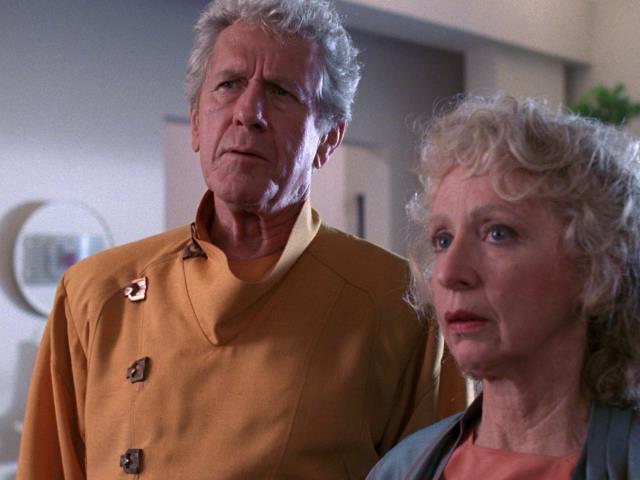
(photo from durfee.net)
I rarely include images on my blog, but Kevin Uxbridge, from the episode "The Survivors," merits one thanks to a disproportionately awesome wardrobe. Maybe it looks a little saggy now, but just imagine what he looked like in his prime. Kevin is actually a Douwd, an omnipotent being who ended up falling in love with a mortal and decided to pursue a mortal life with her. Only problem was she was murdered by aliens, and his response was to wipe out their whole species. Picard runs into Kevin and a facsimile of his dead wife, and eventually figures out what's going on. I was always impressed with the scope of this character, and so he gets to be one of the few relatively obscure characters referenced in this A-to-Z effort.
Monday, April 23, 2012
T is for The Truman Show (#395)
The Truman Show (1998) is Jim Carrey's best film, and is a truly visionary look at the concept of identity. It also happens to be an increasingly ironic look at reality TV, given that fifteen years later everyone and their mother thinks it's actually a good idea to live their life in front of a camera. Truman Burbank just happened not to choose that life, though he grew up that way, never having a clue, and most of what he's become having been shaped on an expansive studio lot, his family and acquaintances filled with actors who only sometimes care more about him than the demands imposed by executives (then again, this isn't about reality TV so much as corporate mentality). Directed by Peter Weir, written by Andrew Niccol, there's also an avalanche of excellent co-stars for Carrey to play with, including Ed Harris, Laura Linney, Natascha McElhone, Holland Taylor, Noah Emmerich, Peter Krause, Philip Baker Hall, and in one of the many supporting roles that helped him briefly achieve leading man glory, Paul Giamatti. I was already a devoted fan of Carrey before this, but The Truman Show just explodes his depth, and is not to be missed even if you never cared for him in any other film.
Star Trek bonus!
T is for T'Pol
(from Star Trek: Enterprise)
You might be mistaken to believe that T'Pol was just the next version of Seven of Nine, the token catsuit hottie. Yet even moreso than Jeri Ryan, Jolene Blalock had an infinite amount of talent and was integral from the start in the success of her Star Trek series. The first Vulcan since Spock to have real significance in the franchise, T'Pol was the rare adherent to the party line who came to understand the flaws in the system, and embraced new possibilities, even if the initial opportunities were forced on her. She originally found almost everything about humans to be repulsive, but chose to embrace logic so thoroughly that she came to find value even in the most human crewmate available, Trip Tucker (the real star of Enterprise), discovering a balance in her emotions that she never thought possible.
A-to-Z Challenge!
Sunday, April 22, 2012
#394. excerpt from Yoshimi
Here's another excerpt from Yoshimi, within forty pages of the conclusion, as things have reached their endgame and our girl is drawing ever closer to her final confrontation, within the halls of a private academy:
Ten minutes crawled by. Most of my food, and there had been very little to begin with, was still present and accounted for, and I saw Turner kiss Cat. Maybe I was more inexperienced in such matters than I thought, but it didn’t look like the first time. Maybe that made my friend a skank, I didn’t know, maybe just a good actor. At any rate, Turner got up soon after and I followed. In the hallway, there were a few other students milling about, and I awkwardly smiled at them, but never lost sight of Turner. I found myself thinking about the Scimitar again, and shuddered at the grimness of it. Maybe it was just that Turner didn’t seem worthy of such drastic measures. I actually tapped his shoulder to get his attention, and he spun around. His eyes were cloudy, like he was still thinking about Cat.
“You’ve got a lot of nerve,” he managed to say, and then sucker-punched me. “We knew what happened to him. What, did you think he was the only one you had to worry about?”
“It occurred to me,” I said, striking back. Despite his bravado, he was still distracted. Kamal suddenly appeared in the hallway, and Turner was just surprised enough to completely lower his guard. I scored another quick knockout victory. “Fancy your timing, friend-o.”
“You talk funny,” Kamal said. “Would you believe we have a detention room? Meant exactly for occasions like this, like a juvenile lockup. Not a dungeon, in case you were wondering.”
“I wouldn’t feel sorry for him if it was,” I said. “Wish I’d known earlier, though. Might have saved Corry from some potential agony. I’m still not sure these goons deserve to be caught in the crossfire. They seem kind of pathetic.”
“Most of their week is spent attending classes,” Kamal said. “Their attention has been dulled.”
“Glad mine hasn’t,” I said.
Saturday, April 21, 2012
S is for Source Code (#393)
A legitimate mind-blowing experience, Source Code (2011) seems like it's fairly straightforward, but the more you understand what's going on, you realize just how brilliant it is. All you have to do is pay attention to Jake Gyllenhaal (this is the movie that finally made me care about him), who at first seems very obviously to not be in control of his own life, for some very good reasons. And then, by the end of it, with a little help from Vera Farmiga, he proves Jeffrey Wright wrong in a very profound way. He also gets to spend a lot of time with Michelle Monaghan and repeating a lot of the same events over and over again (but again, he does a lot of this with Michelle Monaghan). From screenwriter Ben Ripley and director Duncan Jones, who also delivered Moon and happens to be the son of David Bowie. Jones shows every indication of being the most important filmmaker of his generation.
Star Trek bonus!
S is for Sisko, Benjamin Lafayette
(from Star Trek: Deep Space Nine)
What I love about Sisko so much is that he's the most nuanced of any Star Trek captain to date. You may not see it at first, because he spends most of his time fairly reserved, because he didn't after all accept the Deep Space Nine assignment willingly. In fact, you could say he really didn't want it. So at best he can come off as bemused. In the first episode, in flashbacks to his time as first officer of a ship lost in the famed Battle of Wolfe 359, Sisko comes off with more active confidence, and you can see what he could have been like in different circumstances. And once he becomes comfortable, Sisko is the most warm individual to ever fill the captain's role. You can see it anytime he interacts with his son Jake, or romancing Kassidy Yates. He can also be ruthless and cunning, as when he duels with Dukat or Eddington. He can be your best friend, as when he spends a few moments with "Old Man," Jadzia Dax. And he can be exasperated, especially when confronting his father. He's the very center of his corner of Star Trek, and Avery Brooks makes you wish the series had gotten more love. His crew would have shined on the silver screen. By the sixth season, it seemed like they were already there.
A-to-Z Challenge!
#392. Homing in on Homer
Yeah, so I've been writing away at Scouring Monk for many years, and starting back in 2010 I started having this crazy idea to split off various topics to their own blogs. A while back, I thought it would be a nice idea to chronicle my reading habits, which at that point had been streamlined into a Reading List to keep track of the many books in my personal library and the order of importance by which I would work through it. I began writing about this experience here, but last year began Hub City.
At first I was going to try and blog about each of my books, and also continue the Reading List in a fairly straightforward manner, but soon realized it would be a pretty good idea to go back and start writing reactions to the books in the List as I finished them. Lots of people spend a lot of time providing this very kind of feedback on bookstore websites like Amazon, to help others figure out what to read. Me, I decided to keep it in my own family, so to speak.
Anyway, I just finished reading The Lost Books of the Odyssey by Zachary Mason, which quickly became one of my favorite books. I've got my thoughts on it, as well as the next book on the List, and they happen to be part of a small marathon concerning books inspired by Homer's Iliad and Odyssey, which have long fascinated me.
If you care to see what kind of reader I am, have a look at Hub City.
Friday, April 20, 2012
R is for Road to Perdition (#391)
Road to Perdition (2002) is still one of the more intriguing gangster movies I've seen, mostly because its real interest is the human side, which in these films usually means you're a Corleone trying to survive attrition. Well, this time the name is Sullivan and of all people it's Tom Hanks in the lead role, and his godfather is Paul Newman. Both are excellent in the film, as are Jude Law and Daniel Craig (if it seems like Craig is in a lot of my selections, it's coincidental except for Quantum of Solace; otherwise it's a testament to his versatility and overall skill). From director Sam Mendes and featuring some of the best cinematography you're likely to ever see in film, Road to Perdition is a gem that could use a little more exposure.
Star Trek bonus!
R is for Riker, William T.
(from Star Trek: The Next Generation)
The first officer who was repeatedly offered his own command but chose to stick with his family (even though he and Deanna Troi had some pretty bad commitment issues), Riker is one of the reasons Picard's crew and Next Generation ultimately proved such a worthy follow-up to the original series. For one thing, he was in many ways a reincarnation of Kirk, and yet never came off as a carbon copy. If anything, his studied cool in most situations helped set the tone of his series almost as much as his captain. Jonathan Frakes went on to direct his castmates in two of their movies, including the excellent First Contact, and appeared in all three subsequent TV shows in one incarnation or another. This guy, in fictional and real-life form, is arguably the MVP of the modern set.
A-to-Z Challenge!
Thursday, April 19, 2012
Q is for Quantum of Solace (#390)
Quantum of Solace (2008) is effectively the first James Bond sequel, Daniel Craig's second go-around as 007, and still manages to work as a standalone experience if you want to view it that way, too, with Bond simply trying to survive a miserable set of circumstances, the death of his girlfriend, while also dueling with the latest villain. I'm not the biggest Bond enthusiast out there (mostly limited to a little bit of Connery, more Brosnan, and now two Craigs), but I am a big fan of Daniel Craig, who brings a uniquely studied ruthless intelligence to film. I also like that his Bond Girls aren't already famous, but can still keep step with the tradition. The featured ladies this time around are Olga Kurylenko (later to be featured in Neil Marshall's Centurion) and Gemma Arterton (later to be briefly ubiquitous and generally awesome). Also featured are Judi Dench, Mathieu Amalric, and Jeffrey Wright.
Star Trek bonus!
Q is for Q!
(from Star Trek: The Next Generation, Deep Space Nine, and Voyager)
"What a Q?" It's a letter of the alphabet as far as I know." The signature of John de Lancie's signature role is that you never see him coming. All-seeing and all-obnoxious, Q was the god figure taken from the pattern established in the original series to the nth degree, an imp who felt entitled and surprisingly chummy with both Captains Picard and Janeway, neither of whom were amused for one second (also, Sisko hit him; Picard never hit him!), even though clearly he was a fan favorite from the start. The best thing about Q was that he had considerable range, having managed to introduce the Borg, pose as the Sheriff of Nottingham, walk Picard through a near-death experience, and even have a philosophical debate on the merits of suicide. The fact that he was never featured in a movie baffled some fans.
A-to-Z Challenge!
Wednesday, April 18, 2012
#389. Sphere Builders, Wasteland, Batman
At Comics Reader I've concluded my look at the existing trade collections of Oni Press's Wasteland, rounding out with the fifth and sixth volumes (which were published two years apart, thanks to art issues I mention), as well as talk about some of the recent comics I've read from recent trips to Heroes & Dragons in Colorado Springs and Toys 'r' Us (where I'm glad they have comics again).
Fan Companion features thoughts on five more episodes from the sixth season of Star Trek: Voyager, including standouts "Riddles" and "The Voyager Conspiracy."
Sigild, meanwhile, has another entry in the ongoing "Star Trek '12" project, this time having a look at the legacy of the Sphere Builders from the excellent third season of Enterprise.
Additionally, Hub City recently featured some updates from my Reading List, including thoughts on the book I just finished reading and the one I just started.
And Epistles from the New Fade continues to feature new poems. Hey, it's Poetry Month. You will read this blog. You can and you will.
P is for The Proposition (#388)
The Proposition (2005) raised Westerns to a new standard. A genre that went out of fashion decades ago (died along with the Duke, is more like it), Hollywood had tried to figure out what exactly Westerns mean in the modern era, but the answer was found Down Under. Director John Hillcoat tapped musician Nick Cave to craft his vision, which pits Ray Winstone and Emily Watson against a landscape neither wants, and a clan of brothers against each other: Guy Pearce is coerced into betraying his brother Danny Huston (thus the eponymous agreement), and really, nobody wins. That's what this genre really represents. For a long time, it was portrayed as a landscape of black-and-white morality, but the frontier was settled by people simply trying to survive. Apparently the truths of frontier life are universal.
Star Trek bonus!
P is for Picard, Jean-Luc
(from Star Trek: The Next Generation)
There would be no Star Trek today if not for the gentleman captain played by Patrick Stewart. And funny enough, Star Trek would not need to have been reinvented by J.J. Abrams had it not been for the same character. Simply put, Picard was a force of nature, the total opposite of James T. Kirk, and while his series launched to dubious acceptance from existing Star Trek fans, Picard became a phenomenon unto himself. And his success was so great, Star Trek expanded and then contracted around him. The only way to recover from this phoenix was rebirth. And there is no Picard without Patrick Stewart, so long as he's still living (even Tom Hardy couldn't change this Prime Directive). So the story went back to Kirk.
A-to-Z Challenge!
Tuesday, April 17, 2012
O is for O Brother, Where Art Thou? (#387)
If George Clooney had only acted in the movies Out of Sight, Three Kings, and O Brother, Where Art Thou? (2000), he would still have made a seismic impact on film, at least in my estimation. He was plagued for years trying to establish a career for himself, before finally breaking through wit the TV series ER, but his early transition into movies was a difficult one. He encountered the same problem he'd always faced, and that's that being an actor who so closely matched the same appeal predecessors like Cary Grant first brought to the public meant that he was only going to seem like a throwback. But Clooney soon forced even his skeptics to accept that rather than being a detriment to his career, this strange appeal could be seen as a strength (even if sometimes his efforts to replicate some of the old experiences in film came back with the same lukewarm reception he knew so well), especially the older he got. O Brother is a testament to Clooney learning that lesson quickly. The Coen Brothers (I'm desperately deficient in their canon, having even missed Fargo, though I've since enjoyed No Country for Old Men, Burn After Reading, and their version of True Grit) reinterpret The Odyssey as a Southern-fried sojourn, with a celebrated soundtrack and Clooney's first performance where he truly understands his own potential. "Man of constant sorrow" no more, this clever Odysseus has since become an institution. Please remind yourself how he did it.
Star Trek bonus!
O is for O'Brien, Miles
(from Star Trek: Deep Space Nine)
Debuting in the very first episode of Next Generation, O'Brien took a long time to get a name, but actor Colm Meaney was so beloved that he became a regular and acclaimed commodity in film (just not in any Star Trek films, strangely or not), and eventually a lead actor in Deep Space Nine, where Lets-Torture-O'Brien episodes became an artform, beginning with the unlikely bond that formed between the stalwart engineer and obnoxious doctor Julian Bashir. Anyone who doesn't love O'Brien shouldn't be reading any of this, so I won't try to talk too much about him.
A-to-Z Challenge!
#386. Space Corps
Over at Sigild I've posted a short story called "Quagmire," which is actually an excerpt from an aborted novella I worked on a decade ago. But what makes it more interesting is that it was among the first fiction I actually wrote about a space opera I've been developing for almost a decade longer. This year I'll be working on the first draft of the book I've been planning since 1998, but I've got so much material for the Space Corps, "Quagmire" doesn't even deal directly with the central premise of this sprawling saga. Rather, it helps set up in a Tolkien sort of way elements that help explain how things came to be. (Never mind, but one story I just finished plotting actually explains some of the details in "Quagmire" to be lies.)
Though I posted "Quagmire" and other chapters from the novella on a personal website at the time, I've been extremely reluctant to make any of this saga public, always believing that I would become a bestselling writer either thanks directly to the book I'm finally going to write or because of something else I've written. Obviously that hasn't happened yet. It finally occurred to me that it doesn't make sense to not write something that has been so important to me, that it actually makes more sense to write it than to hold onto it. Does that make sense?
I've already written some short Space Corps material at Sigild, originally posted under the "Warship" heading, but since I'm writing some additional prologue material for the novel, I'm now going to have a whole page dedicated to the Space Corps. (Part of the reason I've been reluctant to make this stuff public is that I've tried to come up with a unifying title that I felt satisfied with, and I've gone through a lot of unsatisfying options in the meantime.)
Some of this may sound extremely silly. Hopefully you'll have the good grace to humor me.
Monday, April 16, 2012
N is for The New World (#385)
The New World (2005) retells the story of Pocahontas and John Smith from the perspective of visionary director Terrence Malick. You may actually consider it the original Avatar (if you need pop culture context). Starring Colin Farrell and Q'orianka Kilcher and featuring Christopher Plummer, Christian Bale, and David Thewlis, did I mention it's directed by Terrence Malick? If you've seen The Tree of Life, then you might know what that means. If you've seen The Tree of Life, you might still not know what that means. What it means is that you're in for an immersive, emotional experience as few filmmakers can do, all in a signature style that's unmistakable. Since Farrell is one of my favorite actors, I cannot help but support this one as one of his major performances, combining his ability to convey both soft and hard emotions, something that sets him apart from his peers. Anyway, you need to see this one.
Star Trek bonus!
N is for Nerys, Kira
(from Star Trek: Deep Space Nine)
In Bajoran culture, the first name goes last, so every time you heard "Major Kira," you were hearing her last name, not the other way around. Only people she's close to know her as Nerys (that'd be, um, Vedek Bareil, before his death, and Odo). Played by Nana Visitor because Michelle Forbes opted out of continuing in Star Trek as Ensign Ro, the first officer of station Deep Space Nine had as hard an edge to her as any character ever seen in the franchise, but that was just one of her many facets. After appearing in the first season episode "Duet," Major Kira could no longer hide as one of the show's greatest assets, though many fans didn't enjoy the Bajoran episodes, so the later Dominion War arc saw her transition into a much more pronounced relationship with Odo. It didn't help that her earlier boyfriend was turned into a cyborg at the insistence of the vile Kai Winn, not that it helped him survive...Anyway, if you want to know about Deep Space Nine, you definitely need to know Major Kira.
A-to-Z Challenge!
Sunday, April 15, 2012
#384. excerpt from Yoshimi
My current manuscript, Yoshimi, concerns an orphan who discovers the truth behind the death of her parents, and subsequently finds herself thrust along an unlikely path of vengeance.
“Anything I can do to help?” he ventured. “Nevin. Nevin Martell.”
“Well, Mr. Martell,” Ms. Wilson began, and then didn’t say anything for a while. She had obviously noticed how young he was, too, despite his demeanor, his attempted swagger. “I’m sure we can handle this. The question we both have on our minds,” she continued, indicating me inside the car, “is why you’ve been following us.”
“You noticed,” Nevin said, offering an innocent, insincere smile.
“We noticed,” she replied. “Those shades you’re wearing. They’re a signature element of a gang we’ve heard about. The Shadow Clan. Ever heard of it?”
“Can’t say that I have,” Nevin said. “Colorful name, though.”
“So are your shades,” she said. “You’re still wearing them.”
“It’s dark, I know,” Nevin said. “My choice.”
“So you say,” she said. “I’ve said we can handle it. There’s no reason for you to remain here.”
He reacted more quickly than I expected he would, but I was quicker. One kick was all it took, to the back of his head, and Nevin Martell was out cold. I took the moment to be proud of myself.
“Wipe that smile off your face and help me put him back in his car,” Ms. Wilson instructed. “We could have gotten him to talk.”
“I heard your whole conversation,” I said. “I didn’t think he was ever going to be forthcoming. I also didn’t find him very convincing.”
“On that point we agree,” she replied. “By the time he wakes up, we’ll be long gone.”
Not so much as a pat on the back, but I expected as much. She was slamming the hood back down as I was getting back into our own car. I didn’t pay attention again until we were back in civilization.
Saturday, April 14, 2012
M is for Munich (#383)
Munich (2005) is my favorite Steven Spielberg movie. A lot of people will go with E.T. or Schindler's List or Saving Private Ryan (there are certainly others to choose from), but Munich represents his most subtle filmmaking, his most mature work. Starring Eric Bana and Daniel Craig, two more of my favorite actors, it's a look at the reaction to another terrorist incident and how things quickly turn into a quagmire of moral ambiguity. The point is, everyone is forced to think about what they're doing, their motivations and roles in the events as they unfold. It doesn't hurt that on the surface Munich is a thriller with another excellent score from John Williams, or that the international cast is topnotch. It's a film where element has a purpose and it works on so many levels. For some people, anyone who failed to recognize its achievement (which was just about everyone), they didn't like the ambiguity, but that was exactly the point Spielberg was attempting to make. Maybe it's a better movie that says something definitively, but not in my book. Simply representing something, opening a dialogue (which was Spielberg's intent), is one of art's purest intents, and Munich is art all the way through. It's another film whose reputation I hope only grows in time. It doesn't hurt that a famous director made it. Eventually, succeeding generations will sift through his work and discover Munich anew.
Star Trek bonus!
M is for Mayweather, Travis
(from Star Trek: Enterprise)
Mayweather is the only recurring character to ever be featured in every episode of their Star Trek series. Everyone knew that Berman & Braga intended Enterprise to primarily feature the Big Three format of the original series, which meant that Archer, T'Pol & Tucker were always going to be the stars, with the rest of the cast filling in around them. Mayweather had a specific purpose, as did every other character, a particular vantage point to fill out, and in the first two seasons, he had a few episodes that fleshed out where exactly he came from and what it meant for him to have joined the fledgling Starfleet. The fans weren't too interested (I was), so that element of the series disappeared, and like Chakotay before him, bereft of what truly made him significant Mayweather faded ever more into the background. Played by Anthony Montgomery, he was never one of the more flashy personalities, but in the third season, he helped represent the alternative to all those MACOs that drove Reed up the wall (he did the same thing in the Mirror Universe episodes in the final season). Most of the supporting cast took a back seat in the last season, actually, so Mayweather was no exception there. But it's high time that people stop ridiculing Enterprise for its treatment of a character that was built for exactly the purpose he fulfilled. He still got more work than the ones he was patterned after (Sulu, Chekov, Uhura), after all.
A-to-Z Challenge!
Friday, April 13, 2012
L is for Lions for Lambs (#382)
You know you've done something wrong when even your target audience rebels against your film. Hollywood has a fairly conservative policy in filmmaking, but is mostly run by liberal-minded people. When a film like Lions for Lambs (2007) comes around, it shouldn't come by surprise, but this one bends almost every rule by being, essentially, a talking points drama that it ended up baffling not only its intended audience, those who theoretically were already primed to hear the War on Terror discussed into a moral quagmire, but didn't even start a conversation. Granted, audiences very quickly proved aversed to watching movies that took critical stances on current events, so it's no surprise that Lions for Lambs joined the garbage heap with little fanfare, but it was such a unique experiment, like The Vagina Monologues for the pundit set that you might have thought the reaction might have been a little different. It just goes to show that the name "Robert Redford" doesn't mean what it used to. Other big names attached include Meryl Streep (apparently a few years too early for all the ridiculous gushing praise for a career that has gotten full of itself and has now led to a historic three Best Actress honors at the Oscars) and Tom Cruise (waaay too early at this point for anyone to start admitting they still liked him), while Andrew Garfield, Derek Luke, and Michael Pena add some fresh voices to the mix. To me, this was instantly one of the more important experiments, another classic viewpoint that could be interpreted either way you want it to (and that's probably what infuriated those who wanted it only one way, close- rather than open-ended). So I've been looking to extend awareness of this curiosity.
Star Trek bonus!
L is for Locarno, Nicholas
(from Star Trek: The Next Generation)
Easily one of the more fascinating characters on Voyager was Tom Paris, who never quite had the ability to have the full arc of his story explored, given that his past was something he was trying to live down and his future would never really be resolved until the crew got home. Played by Robert Duncan McNeill, Paris became an instant surrogate for anyone who remembered "The First Duty," which featured Nicholas Locarno, who was also played by McNeill and had a similar incident that was for most people the defining moment of an inglorious Starfleet career. Paris wasn't Locarno, it should be stressed (though it'd be easier if there had ever been a definitive account of just how Paris ended up in that penal colony), but he was still one of the more intriguing characters in Star Trek, a rebel who played by his own rules and occasionally got burned because of it. Locarno was just a self-serving jerk, who expected everyone to hide the truth of a mistake that ended in tragedy, and was disappointed when it didn't work. Yeah, it would have been nice to see if anything ever came of him, but Paris quickly proved to be a more interesting variant, especially given his connection to Captain Janeway and the fact that his father was a Starfleet admiral. Circumstances helped Paris stand out, his odd association with another character played by the same actor. But don't make the mistake assuming that you know everything about him just because you saw "The First Duty." Tom Paris is not Nicholas Locarno.
A-to-Z Challenge!
Thursday, April 12, 2012
K is for Kalifornia (#381)
Kalifornia (1993) is a fascinating sociological study, first and foremost, a look at the impact of our continuing obsession with "true crime" and the clash of cultures it represents. David Duchovny, an actor who had to wait until The X-Files to truly be noticed (and who quickly sank back into semi-obscurity once it concluded) stars, teaming up with Michelle Forbes (another actor who never really got their due, mostly because she ran from her biggest role, as Ensign Ro in Star Trek) as photojournalists touring grizzly crime scenes. Things become interesting when they agree to let a couple of rednecks tag along, including the predictably unpredictable Juliette Lewis and Brad Pitt in one of his I'm-not-just-a-pretty-face roles (probably one of the more colorful performances in that regard). Morbid curiosity in violence tends to overlook the underlying causes, which probably ought to be the real goal, so that in studying it you actually enable it (goes for all those crime TV shows, too!), and that's exactly what ends up happening to the lead characters. Yes, Lewis and Pitt are horrid caricatures of white trash in this movie, but that's exactly what they need to be, because Duchovny and Forbes are unsuspecting yuppie trash, and they have no idea. White trash and yuppie trash never have any idea what they actually are. Stick them in the same room and you've got nothing but trouble. Maybe a movie like Kalifornia is intended to make that clear.
Star Trek bonus!
K is for Kirk, James Tiberius
(From Star Trek)
The new J.J. Abrams movies are ensuring that Kirk becomes the cultural icon that Star Trek fans always believed him to be, taking him out from the shadow of William Shatner and allowing Chris Pine to define him in a more universal light as the adventuring, analytical, ladies man he was always meant to be. Fearless in the face of danger and fully confident of his abilities, Kirk also became known, thanks to Shatner for believing in his own judgment sometimes to excess, ignoring the opinions of others sometimes to his own detriment, whether he realized it or not. That was made clear as a trait in Pine's first go-around, and adds new dimensions to his relationship with Spock, who is arguably the more instantly iconic character from the original set of Star Trek characters.
A-to-Z Challenge!
Wednesday, April 11, 2012
#380. Fan Companion, Wasteland, Zetar
Over at Fan Companion, I'm continuing my look at individual episodes of Star Trek: Voyager, now moving on to its sixth season, which has traditionally been viewed in a somewhat negative light (and is arguably one of the main reasons the whole franchise went into hibernation and eventual transmutation). I happy to like the season, so it'll be fun writing about it.
I've written commentaries for two additional paperback collections of Wasteland at Comics Reader. I'll be finished up with the existing collections by next week, and will be writing about Neil Gaiman's Sandman, as represented by the first annotated collection, released earlier this year.
At Sigild, I'm continuing my "Star Trek '12" fiction project, exploring every century of recorded franchise history, one significant event at a time. This time we hark back to "The Lights of Zetar," from the original series.
J is for Jackie Brown (#379)
Jackie Brown (1997) tends to get the least amount of attention from among Quentin Tarantino's fans, or film fans in general. Everyone knows how Tarantino took the movie world by storm with Reservoir Dogs and Pulp Fiction, and later with Death Proof (his contribution to Grindhouse), Kill Bill, and Inglourious Basterds, but for me, the proof in the pudding of Tarantino's incomparable love for film is Jackie Brown, which on the surface is an homage to classic blaxploitation flicks, starring a queen of the genre, no less, in Pam Grier, and if that's how you want to appreciate it, fine. You can also enjoy it as a fairly traditional Tarantino adventure with Samuel L. Jackson, Chris Tucker, and Bridget Fonda. There's also a subdued Robert De Niro to enjoy. But for me, the real star and attraction is Max Cherry, bail bondsman, played by perennially undervalued Robert Forster (who had the honor of being featured in the season of Heroes everyone decided the series had definitely lost its mojo, and was even in last year's The Descendants, but you'd hardly know it). Forster is the picture of cool maturity, and the calm center of Jackie Brown, and it's his chemistry with Grier that gives any meaning to her performance, which is purposefully minimalist. If you want to know what Tarantino is like underneath all the posturing, Jackie Brown is your best bet. He's brilliant all the way through.
Star Trek bonus!
J is for Janeway, Kathryn
(from Star Trek: Voyager)
Sometimes it seems like general appreciation for the presence of Captain Janeway stops at the fact that she was the first female lead in a Star Trek. Most of the rest from the fanboys is bitching and moaning about her command decisions, a thinly-veiled and often-disputed reaction against the right of a woman to sit in the boy's rightful place at the center of the bridge. Janeway was often conflicted and frequently made controversial decisions, as best represented by the central premise of Voyager, stranding a Starfleet crew on the other side of the galaxy and choosing to incorporate rebels into essential ship functions. Kate Mulgrew, who was admittedly a good match for Hollywood legend Katharine Hepburn, was a strong figure with enough heart to play Janeway with all the range she demanded. Janeway became one of the most complex and rewarding captains on any Star Trek.
A-to-Z Challenge!
Tuesday, April 10, 2012
#378. Wasteland, A Distant Mirror, Black Elk Speaks
Today I continued my look at Oni's Wasteland at Comics Reader, examining the second trade paperback collection and its developments for the superb comic book series.
I also put some updates at Hub City, tracking my Reading List. I've just concluded Barbara Tuchman's A Distant Mirror, and have begun Black Elk Speaks, which happens to also be one of several subjects breached in my manuscript for Ecce Homo, the book that tracks a realistic approach to Adam & Eve, and also some special looks at other religious experiences and their unlikely participants. (This is a plug for a book that is not published. Yes, it is gratuitous, but on oddly humble terms.)
Be sure to check in at Epistles from the New Fade, where new poems are written for your near-daily amusement. Today's featured a take-off on the one written by my former bookstore colleague Philip Kroagmeier, who posted a poem referencing cherry blossoms at Sword of the Ancients. Having studied Japanese poetry in college, I'm fully aware that cherry blossoms are a traditional subject of inspiration. So that's how these things sometimes happen.
I is for The Imaginarium of Doctor Parnassus (#377)
The Imaginarium of Doctor Parnassus (2009) was, for most people, that unfinished film Heath Ledger was working on when he died, months before the release of The Dark Knight, which was to cement his place in Hollywood history. Never mind that it's also a film by Terry Gilliam, which has its own notorious connotations. The fact is, it's both a film by Terry Gilliam and Heath Ledger's last movie, and is worth noting for both of these elements, and better than whatever connotations they may usher. Most critics found a hard time appreciating Ledger throughout his career, and so did audiences. His Joker was an aberration, at least to them. I knew he was something special from the moment I saw the pilot of Roar, and eagerly followed his career. Aside from Brokeback Mountain, Ledger fell into relative obscurity, a B-level star who happened to be seated at the A-level. The same can be said for Gilliam, best known as a member of Monty Python, and for delivering overachievers that only occasionally found mainstream success (The Fisher King, Twelve Monkeys). Yet both Ledger and Gilliam were to me consistently brilliant, and Imaginarium is a remarkable confluence (they'd previously worked together on Brothers Grimm). Ledger's ability to be a credible lead actor could sometimes be sabotaged by his youthful looks (no surprise, because he was on the younger side when he broke through). Imaginarium is the first time he seems to be mature enough to truly deliver a commanding presence (over this summer's new Spider-Man, Andrew Garfield, no less). It beggars so many questions about where he might have gone from there. Famously, his performance was completed by Colin Farrell, Johnny Depp, and Jude Law, each of whom appear as pure versions of themselves in said Imaginarium, which is run by Christopher Plummer, who turns out to be the real lead character, striking a bargain with the Devil for the soul of his daughter. The results are beyond brilliant. Perhaps the attention caused by circumstances was a mixed blessing, but for anyone who does see the film, there are all the more layers to enjoy about Gilliam's biggest triumph of, well, imagination. No one else could have made this film, and a quirk of fate pushed a greater emphasis on the very themes it had already set out to explore. Ledger's legacy is solidified.
Star Trek bonus!
I is for Ishka
(from Star Trek: Deep Space Nine)
Otherwise known by her son Rom as Moogie, Ishka was the polar opposite of her other offspring, Quark. Then again, they weren't as different as they might have thought. Quark never really played by the rules, either. He was as much of an outsider as his mother, who bucked all the rules of Ferengi society in pursuit of prophet. In the end, Ishka got the last laugh, but really, Quark got exactly what he wanted, too. Go back and watch Deep Space Nine and tell me differently.
A-to-Z Challenge!
Monday, April 09, 2012
H is for Hancock (#376)
Hancock (2008), if you haven't actually seen it, probably looks a lot like some other Will Smith movies you actually have seen, an obnoxious hero of some variety battling the forces of evil. Yet that's only half the movie. I happen to really enjoy Smith as an actor (even if a lot of his movies do tend to follow that pattern, i.e. Independence Day, Men in Black, Wild Wild West, I Robot, I Legend, Hitch, even his TV show Fresh Prince of Bel-Air), and his serious actor mode follows the somber example of Robin Williams. (Well, now it just sounds like I'm burying him!) Let me start over. There's a whole second level to Hancock that its previews ignored entirely. For instance, if you haven't seen it, you don't even know that Charlize Theron co-stars. Her half of the movie, how her character becomes involved in the story of Hancock, is what pushes the movie to heights rarely seen in superhero movies. The sad part is, I had an idea very similar to this six years before this film was released. Let this be a lesson to you: ideas that float in the creative ether will eventually be caught by someone else. Anyway, the concept eventually expands magnificently, and you will be rewarded tremendously (a lot of people who have seen it misinterpret this curveball; don't make that mistake). Hancock departs from the Will Smith mold, just as Smith himself was transforming his ambitions at the time into films that really began to explore his potential. Later that same year, he released his best film, Seven Pounds. So that makes it a shame that he subsequently took a break, because now we've had to wait to see what comes next. I'm game for another round of Agent J, because I love those movies, too, but he was on a roll, and there really was no telling what he could have done next.
Star Trek bonus!
H is for Hansen, Annika
(from Star Trek: Voyager)
Otherwise known as Seven of Nine, the Borg bombshell played by Jeri Ryan, so beloved that the actress became one of the few Star Trek alum to enjoy a thriving career on the scree after hanging up the (skin-tight) space suit. Seven was a fascinating character, and much like Hancock was easy to make a lot of assumptions about, and you would've been wrong in just about every one of them. Hr relationships with Janeway and The Doctor enriched both of them, but Seven herself, who was born a human and struggled to rediscover what that meant once her connection to the Collective was severed, didn't jump back into her humanity, nor did she retain every element of her former Drone personality. Like Spock and Data and even Odo before her, Seven blended the two conflicting elements of her nature for a fascinating portrait of what it means to define the self in the face of contradiction, or otherwise, what it means to be human.
A-to-Z Challenge!
Sunday, April 08, 2012
#375. excerpt from Yoshimi
This is an excerpt from my most recent manuscript, Yoshimi, about an orphan who discovers the truth behind the death of her parents and is compelled to act on it. In this scene, she has just completed one of her stages of training:
We both knew he was referring to the way the five fights had been won. Bill was conspicuously absent. “I want to thank you for taking the time to teach me. I got to talking to Jenny and Kit and they seem to believe that it’s out of character for you to accept strays like this, even at recommendation.”
“Perhaps it’s time I change my policy,” he said. “I once believed that only those I have personally selected, who have already demonstrated to me that they meet my standards, actually can. You’ve done more than that. You’ve exceeded them. For that you should be proud.”
“I wish I could explain how I do it,” I said.
“Sometimes it’s not for us to know such things,” Jim said. “You should instead be proud that others have noticed, and that you have a chance to use your gifts, even if it took a lot of misery to reach this point.”
“Thank you for saying so,” I said, bowing.
“You don’t need to bow to me, Yoshimi,” he said. “I never liked it in my students. Perhaps that’s something else I can change.”
“Don’t be so quick to initiate reforms that aren’t strictly necessary,” I said.
“It’s not for you to judge such things,” he said. “All the same, I wish you luck. The Assassins Guild is a menace I will be very happy to see eliminated. I saved Bernard and Gisberto from a life serving under it. I believe I did the same for Bill. Before you came here, Bill was the only student I thought I had truly reached. It was an intervention he said he needed, but like you, I saw him benefiting me more than I ever could him. I’m not sure he knows this. You’re good for him. He needed to step out from that little club of his in New York, embrace the world again. He brought you here so he could remind himself, I think. It killed him to sit there and watch all this time. I suspect you’ll have a hard time keeping up with him in the coming weeks.”
Saturday, April 07, 2012
G is for Gladiator (#374)
Gladiator (2000) won the Best Picture at the Oscars, but seems to have struggled to retain that level of respect ever since, and I'm not really sure why. Maybe it's because the swords-and-sandals revival (or historical epic) that it inspired did not lead to results critics were proud to have more or less chamioned, or maybe critics are just fickle. I know that star Russell Crowe and director Ridley Scott also had a somewhat rough time of it in the years that followed. Crowe starred in another est Picture winner the following year (A Beautiful Mind), and then couldn't seem to do anything right, even though he continued to do brilliant work. Scott hasn't really caught a break with anyone until this year's hotly-anticipated Prometheus, even though he's done exceptional work in the meantime on such films as Kingdom of Heaven, American Gangster, Body of Lies, and Robin Hood (working with Crowe on nearly all subsequent projects, actually). Gladiator is a work of subtle beauty, and is filled with strong performances, including the perennially underrated Joaquin Phoenix (best known recently for the identity crisis I'm Not Here, which should be no wonder), a study of motivations of the limits of the human spirit, both in triumph and ego. I suspect some people soured on it because it challenged their appreciation of Stanley Kubrick's Spartacus, almost as if admitting love for Gladiator meant that they couldn't love Kirk Douglas as a more individually iconic figure. But Gladiator, no matter the accomplishments of Kubrick elsewhere, represents better work from Scott. Great work does not need immediately identifiable material; great work creates its own attention. Gladiator did it once. It can do it again.
Star Trek bonus!
G is for Garak
(from Star Trek: Deep Space Nine)
Was he a spy, a former spy, a manipulator, an opportunist? Or was he "plain, simple" Garak, a tailor operating a shop on the sprawling Promenade on Deep Space Nine? Probably a mix of everything. That was the strength of this character, a Cardassian who gave a good name to Cardassians, a multidimensional individual who may have done things he was not proud of in the past, who lived the life of an exile, but knew well enough when he met a new friend (Julian Bashir) who would encourage his better instincts. There were plenty of bumps in the road ahead of him, but Garak proved to be one of the more fascinating characters of Deep Space Nine because you wanted to be sitting there right beside him at Quark's, enjoying a fine drink, good book, and some of the best conversation you'll ever experience. As embodied by Andrew Robinson, Garak is a quintessential Star Trek character, an outsized personality not often represented on film, who can bring life to a scene simply for being there and enjoying being there. Usually actors of this variety are confined to the stage. When there's a Star Trek on, you can be sure to find them on the screen, too.
A-to-Z Challenge!
Friday, April 06, 2012
F is for The Fall (#373)
Tarsem Singh is recently known for last year's Immortals and the first of this year's Snow White films, Mirror, Mirror, as well as historically known for The Cell, but his best film, his masterpiece, is The Fall (2008), a grand study of the power of redemption, an utterly breathtaking experience. Anyone who's seen it raves about it, and it's the reason why he's suddenly released two films in two years, far above his average, which means Hollywood has definitely seen it. Yes, Hollywood can recognize talent, too. Think of this one as one of the most brilliant superhero movies ever made, or the modern swashbuckler, the new Princess Bride (without the jokes but with all of the heart), League of Extraordinary Gentlemen the way Alan Moore might have approved. Whatever you have to tell yourself, just watch it. The Fall is worthy of its legend. You'll see why.
Star Trek bonus!
F is for Future Guy
(from Star Trek: Enterprise)
The shadowy figure at the heart of the heart of the Temporal Cold War, Future Guy manipulated Silik and the Suliban in the same way the Sphere-Builders did the Xindi in the magnificent third season of Enterprise. A recurring plot during the four seasons of the show, the TCW was another element that frustrated the fans who bothered to watch, and was blown off in the two-part opener of the final season. Yet this was the biggest missed opportunity of the early cancellation, since it was the most ambitious and consistently rewarding element of the show, demonstrating that the prequel concept had room to look far beyond anything we'd seen before. Who exactly Future Guy was remained a mystery, which now stands as a testament to the work and the puzzle the series can now be considered. (And as I said, augments that third season's significance.)
A-to-Z Challenge!
Thursday, April 05, 2012
E is for Elizabethtown (#372)
Elizabethtown is one of Cameron Crowe's portraits of a man in transition. It was released in 2005 and is probably best known for its soundtrack, since its profile did not match the popularity of, say, Jerry Maguire or Almost Famous. For me, its appeal rests in stars Orlando Bloom and Kirsten Dunst, both of whom display their magnetic appeal. Bloom is still known in 2012 for his work in the Pirates of the Caribbean and Lord of the Rings films, mostly because efforts to star in other films have largely been glossed over by the same audiences who saw him be a part of those epics. Watching him in Elizabethtown is a revelation on par with discovering that Robert Pattinson is more than just a glittery vampire. Dunst, meanwhile, may not have a more appealing performance. She's the original Zooey Deschanel, and this is the role that proves it. Anyway, this is a favorite of mine that I wish more people would give a chance. (Then again, that's a description of a lot of my favorites.)
Star Trek bonus!
E is for Evansville
(from Star Trek: Voyager)
From the episode "The 37's," Evansville is a descendant of the humans, including Amelia Earhart, kidnapped in the early 20th century, unwittingly giving birth to descendants who fought off the alien abductors and creating a society that would one day give a wicked temptation to the lost Starfleet crew trying to make it way back home. Evansville just happens to have an awesome name. It's the episode that I think is more notable, one of the more elaborate entries in the early seasons of Voyager.
A-to-Z Challenge!
Wednesday, April 04, 2012
#371. Cobra and Wasteland
I've got some new commentaries up at Comics Reader, for IDW's Cobra and Oni's Wasteland, two comic books that've been among my favorites for the last few years now. I keep expecting that their popularity will expand, but it hasn't happened yet. Cobra helped launch the "Cobra Civil War" crossover in IDW's G.I. Joe comics; Wasteland has recently gotten back into regular publishing after ironing out some issues with the art, marking 2012 a great year to jump into both of them. (Combined with Cartoon's RASL, they're what I'd recommend to anyone looking beyond The Walking Dead for comic books worth reading that don't feature superheroes, and in that regard, I'd recommend anything written by Geoff Johns or Grant Morrison.)
I've been touring some of my fellow A-to-Z Challenge, trying to find anyone who blogs like me, but I'm having difficulties, folks. A lot of those who signed up seem to be aspiring writers (not surprising, in some regards, considering the people running the challenge), and a lot of the others invested in nonfiction blogging one form or another, focusing on hobbies. I've discovered a lot of the blogs with awesome titles don't have awesome content (please disregard this opinion if you identify yourself as one of those), which is a huge disappointment. But we're still early. There may be surprises yet to be discovered. I know the point of the exercise is networking, but I'm just wondering how many of the participants will really find me, much less each other, all that intriguing. Common bonds here may begin and end with participation, other than those who already know each other.
I've been touring some of my fellow A-to-Z Challenge, trying to find anyone who blogs like me, but I'm having difficulties, folks. A lot of those who signed up seem to be aspiring writers (not surprising, in some regards, considering the people running the challenge), and a lot of the others invested in nonfiction blogging one form or another, focusing on hobbies. I've discovered a lot of the blogs with awesome titles don't have awesome content (please disregard this opinion if you identify yourself as one of those), which is a huge disappointment. But we're still early. There may be surprises yet to be discovered. I know the point of the exercise is networking, but I'm just wondering how many of the participants will really find me, much less each other, all that intriguing. Common bonds here may begin and end with participation, other than those who already know each other.
D is for The Departed (#370)
The Departed won Marty Scorsese a well-earned chunk of Oscars, but the won it most deserved was Best Actor. Simply put, this was Leonardo DiCaprio's best performance. He's been working on this for a long time, being the rare child actor to amount to a respectable adult career, for the same reasons he was able to do it in the first place, because he's comfortable in front of the camera and knows how to convey the depth of the characters he inhabits. He's got more depth in The Departed than in any other movie he's done, because in Billy he's got someone so thoroughly locked into their own bad situation he doesn't know how to deal with it (hence the periodic, inexplicable flashes of violence), trapped by an impossible goal he knows he won't come out of alive, but too committed to escape. This is DiCaprio's breakout performance, where he truly matures as an artist. It's every bit his On the Waterfront, where we meet the Leo capable of living up to the specter of Marlon Brando, a giant of the medium very few have approached (to the point where Brando was such an anomaly most critics began taking him for granted, enveloping his later career in a quagmire of disrespect, something he obviously understood). The whole cast of The Departed is electric, actually, but this is a clear-cut case of coming for the show and staying for the main attraction. You know Marty's good pal Robert De Niro? Well, there's a reason why Leo was his successor. This is it.
Star Trek bonus!
D is for Dax
(from Star Trek: Deep Space Nine)
Dax is a slug, a symbiont indigenous to the Trill homeworld, requiring a host body for interaction with the outside world. Three hosts played a key role for Benjamin Sisko, the first being Curzon, who had remarkable dealings with Klingons and became the young Sisko's mentor, and was affectionately known as "Old Man." Remarkably, Sisko got to work with the next host, too, Jadzia, once he took command of Deep Space Nine. He called her "Old Man," too, but she wasn't. Finally, circumstances also found Sisko working with Jadzia's successor, after Jadzia herself was murdered by the crazed Cardassian Dukat. Ezri was a pixie who inadvertently provided closure for most of the people who knew Jadzia, and was the first host since Curzon able to pass on Klingon dishes. A special ceremony actually allowed us to meet all of Dax's previous hosts. Some of them were more impressive than others. Odo probably found Curzon the most impressive.
A-to-Z Challenge!
Tuesday, April 03, 2012
#369. Blog Updates
Some regularly scheduled activities around the Scouring blogs:
New poem at Epistles from the New Fade, my ongoing project (until I once again hit 100).
More episodes from the fourth season of Star Trek: Voyager at Fan Companion, including thoughts on "Living Witness," which I call essential viewing. I've also got thoughts on Sunday's WrestleMania.
I got a new entry in the "Star Trek '12" project at Sigild, focusing on the Jem'Hadar from Deep Space Nine, putting their story in some context.
The final "Quarter Bin" column for some time is also up at Comics Reader, featuring thoughts on Sandman Mystery Theatre, Brightest Day, and some other discoveries in the back issue bins at Heroes & Dragons in Colorado Springs. I'll next be writing about Oni's exceptional Wasteland, covering each of its trade paperback collections.
C is for Citizen Kane (#368)
A classic both defies and clarifies context. That's what Citizen Kane did for the movies, what the genius of Orson Welles helped give the budding creative medium, the ability to look past limitations and truly give birth to an artform. Most film critics today acknowledge it as a masterpiece, yet Welles became mired in one of the most famous career tailspins in American history since Herman Melville after an inexplicable backlash marginalized his talent and downplayed his continued contributions to film. Please take note: reward those who merit it, because even if you don't, they'll still win. Reward those who don't deserve it, and you end up with Charles Foster Kane. Fair enough? If you've never seen Citizen Kane, you owe it to yourself to correct this error.
Star Trek bonus!
C is for Chakotay
(from Star Trek: Voyager)
The definition of a stoic first officer, Chakotay left Starfleet to fight for his ideals, joining the rebels known as the Maquis until fate intervened and he once more found himself serving aboard a Starfleet vessel. Portrayed by Robert Beltram, who exuded calm charisma, Chakotay was a major player in the early seasons of Voyager, but faded more into the background the less he was needed to provide the example a stranded crew on the other side of the universe needed to figure things out. It's probably no surprise that he was also at the center of the worst developments still to unfold from their prior lives, when the traitorous Seska defected to the first enemies to come across our intrepid crew.
A-to-Z Challenge!
Monday, April 02, 2012
B is for Batman Begins (#367)
Batman Begins was released in 2005, and now stands as a testament to Christopher Nolan's expanding creative abilities. At the time of its release, Nolan was known for the superb Memento, though he'd also made Insomnia and Following, the movie that launched his career. I would have seen it simply for being a Batman fan, and as a huge fan of Nolan's even at that point. I didn't expect it to be the kind of movie it actually was. Although heavily steeped in character, his vision of the Dark Knight (years before the untouchable Dark Knight) was not what I'd expected from Nolan, seeming a little too polished in the typical Hollywood veneer, a little too traditional, a little safe. I struggled with this impression for years, actually. I think I'm coming around. In many ways, its resemblance to the comic book The Long Halloween had dulled the Nolan mystique (Insomnia was adapted from someone else's material, too, but I hadn't seen the original movie, so there was no reference, only creepy Robin Williams and very sleepy Al Pacino), or so I believed. But then he made The Prestige, and The Dark Knight, and Inception. Taking myself out of my own way, I think my opinion of Batman Begins will only grow in estimation. It strength is the thing that was always obvious, that Nolan focused first on Bruce Wayne and then built everything else around him. That's what a Batman story should be about, until Batman truly emerges. In Batman Begins, we're simply not there yet. In any Christopher Nolan movie, expect to discover the main character through the unique circumstances of their life. That's what he does here.
Star Trek bonus!
B is for Bashir, Julian
(from Star Trek: Deep Space Nine)
The good doctor of the space station located at the "edge of the final frontier" was the heart and soul of the development that took Deep Space Nine from its early rough edges to the grandiosity that it attained over seven seasons. He grew up more literally than Sisko's kid, and never is that more apparent than in the metamorphosis of his relationships with Miles O'Brien and Garak, the "plain, simple" Cardassian tailor. Portrayed by Alexander Siddig, who has gone off to a well-deserved career in the movies, Bashir is one of the great characters of Star Trek.
A-to-Z Challenge!
Sunday, April 01, 2012
A is for Alexander (#366)
Alexander is my favorite movie. It's from director Oliver Stone and stars Colin Farrell, who is my favorite actor. Released in 2004, it was generally panned by critics and received a lukewarm reception from audiences (except on the international scene). Some of Farrell's brilliant co-stars include Angelina Jolie, Val Kilmer, Sir Anthony Hopkins, and Rosario Dawson. One of the reasons I love the movie so much is that its cast in impeccable. I also love it for its grand sweep, its deep understanding of character and motivation, and the score by Vangelis. I love everything about it. Another cut was released in 2005, to try and make it easier to follow, and then a third in 2007, which is probably the most comprehensive and best one available. Despite its general reputation, I have maintained Alexander as my favorite film since my first viewing. I don't expect this to change, even though I've seen many great films since.
Star Trek bonus!
A is for Archer, Jonathan
(from Star Trek: Enterprise)
Jonathan Archer was the captain of the Enterprise, and was portrayed by Scott Bakula, who was sometimes accused of overacting (but that's a tradition that began with Shatner, so don't sweat it). His father helped further develop the warp engine created by Zephram Cochrane, but Jonathan was the one to see the dream become reality. He often struggled with Vulcans, but it was his diplomatic abilities despite his worst tendencies that helped form the foundation of the United Federation of Planets.
A-to-Z Challenge!
Wednesday, March 28, 2012
#365. Survivor: One World thoughts
It's perhaps not a well-documented fact here at Scouring Monk, but I've been watching Survivor since Rich Hatch and me both agreed in the first episode that he was going to win.
My sister shares my obsession, and we've been watching previous seasons in our typical marathon sessions. That's helped me get my groove back in trying to figure out who has the best odds to win. That being said, Survivor: One World is now officially Troyzan and Kim's season to lose. If they don't win, then we'll probably learn in the next few episodes who will be able to dethrone them (next week's preview suggests some of that will be attempted soon).
But I really don't think it'll work. Again, this season of Survivor will be won by either Troyzan or Kim. Only so often do the people who find hidden immunity idols bungle their good fortune. These two won't pull a James. The fact that they both have one only serves to testify the strength of their game. Some people stumble into these things. These two know exactly what they're doing.
#364. Blog Updates, Bluewater, Yoshimi
#364.
I've got a new poem up at Epistles from the New Fade as well as a bonus "Quarter Bin" column at Comics Reader, focusing on Robin, which I took the measure of sharing on Facebook, hoping for a little extra readership, y'know, to justify writing this kind of stuff on the Interweb when there doesn't otherwise seem much purpose without, y'know, significant readership.
But sanity is not defined by the perception of others.
I should also note that I've delivered a second comic book script to Bluewater Studios, publisher of the Wrath of the Titans comics that helped inspire the second Clash of the Titans film. Bluewater is a company I've tried getting published with in the past, with a short story accepted in an in-limbo Legend of Isis anthology. Thanks to financial concerns in the modern economy, a lot of things changed from the time it was accepted to the present. Bluewater started focusing its attention on pop biographies, for one thing, to help stand out from the pack. That's what I've been submitting to them, one on Neil Gaiman and the new one on Russian billionaire Mikhail Prokhorov. If these get published, they might be the foot in the door I've been looking for.
Examiner.com keeps asking me to contribute more material, but there's so little readership, or interest in what I write for them, that there's very little point to "gaining experience" with them unless I truly feel motivated. Last year I was in a somewhat better position to go see movies and write reviews for them, but I can't justify the same thing in 2012. So if you wanted an explanation for my lack of activity, Examiner, that's it.
I'm still waiting to hear back from Hall Bros. Entertainment on the Yoshimi manuscript. I have to admit that I'm a little concerned that A.C. Hall has once again done a soft revolution on me, and decided against continuing commitments to his extrapersonal literary endeavors, just like what happened with Dead Letter Quarterly nearly five years ago. When I keep reading Facebook updates about how busy and fulfilled he feels at work, and what he's doing with his own projects (and it's scary enough that 75% of all the things HBE has published is either by A.C or his brother), rather than how he's finally getting through all the Untold Tales of the Past submissions that the brothers were deluged with last fall, I can't help but wonder. The catch this time is that he's got a contract with me that states if we don't play, he still has to pay. I don't know if I'm just being paranoid, but this is my literary future, and I'm justified in being a little paranoid. A lot of things have fallen apart on me. I would really like this to not be one of them.
Yeah, we'll see.
Tuesday, March 27, 2012
#363. Poems, Star Trek, Comics
#363.
Once again, I've got my weekly activity across the blogs...
Epistles from the New Fade continues to feature new poems daily, all attempting to elucidate my perspective of the modern world.
Fan Companion continues its look at the fourth season of Star Trek: Voyager, with looks at five more episodes, including "The Killing Game" and "Vis a Vis."
Comics Reader has a new "Quarter Bin" column up, looking at more work from Jeph Loeb, Grant Morrison, and Geoff Johns, as well as a review of Green Lantern #7, also from Johns.
Finally, Sigild has another "Star Trek '12" entry, this time looking at Klingons and Kahless the Unforgettable, as well as the conclusion to "Warship."
Hope something therein is worth reading!
Monday, March 26, 2012
#362. Girl with the Dragon Tattoo
#362.
I'm doing the A-Z Challenge in April with movies (which may not surprise those who've visited Fan Companion). Just thought you'd like to know, picked the line-up from my personal DVD collection, repeating the first four letters at the end of the month.
I picked up David Fincher's Girl with the Dragon Tattoo today, one of the movies from the end of 2011 that I didn't get a chance to see in theaters, and the one I most regretted missing. I think Stieg Larrson's Millennium Trilogy is one of the more important cultural touchstones of, well, the new millennium, whose impact is only beginning. You can take your Hunger Games. I'll take my Lisbeth Salander.
Saturday, March 24, 2012
#361. Poetry
#361.
Poets hate each other.
I don't know how else to say that. (Please continue reading my regular entries at Epistles from the New Fade.) The truth is, that's the only conclusion I can reach.
When I attended the University of Maine, I didn't start out as someone who was all that interested in poetry. I had attended one year at Mercyhurst College, and started a poetry project after a field trip to Boston (which was ironic, because heading up to Eric, PA was the first time I'd left the New England area, and here I took a trip to...New England), but hadn't really considered any further association with the literary form. Yet one thing led to another, and this English major (eventual hugely beneficial holder of a degree) and I took one poetry class, and then another, and I sort of became a member of the poetry scene on campus. (Emphasis on "sort of.")
The New Writing Series launched on campus around this point (you can do the research on that if you'd like), and very curiously, seemed receptive to just about everyone the director of the program could reach except the two major, active poets who were actually members of the faculty. I didn't really consider how weird that was at the time, possibly because one of them was good friends and collaborator with the director.
In hindsight, after he sorted of skirted any real effort in helping me get a foot in the door of the wider scene upon my graduation, I guess it was kind of appropriate. When I say I was a part of the scene, and when I say "sort of," I mean that the "scene" disintegrated at the first stiff breeze. I didn't expect that. I thought that it was going to last longer than a season. But it didn't.
And so that helps me reach my conclusion. Poets don't like each other, not in the modern age, anyway. I've been doing this blog for a long time, and have now launched five poetry blogs. Most people don't read other people's blogs anyway, not unless they think they can somehow benefit from it. But it's a little weird to keep running into that. I just assumed after many years of writing poems there would be a smidgen of interest, and yet, there isn't. And so, I conclude, with mock sincerity, that poets don't like each other. They hate each other, in fact.
How else to put it? There is no poetry scene because no modern poet is remotely interested in actually saying anything, or acknowledging that anyone might actually have something to say. There has been such an extreme reaction, like rock music, to the expected and trying to do anything but (while many, many poets do exactly that) that everyone suffers when no one wants to try and reach out...
Am I being a little drastic here? Probably. But drastic is good. Drastic is passion. Poetry ought to have passion. If it doesn't, what can possibly be the point? Just to detail every little expected part of human experience? Poetry ought to be about the unexpected, everything everyone knows but can't put into words. Not just the exact way the sunlight hits the windowsill...
Okay, I'm done. Please read my poems. Or not. Probably not. But it'll still be there.
Wednesday, March 21, 2012
#360. Free Looks at Comics
#360.
Since I started writing about comic books starting in 2006 at Paperback Reader (now definitively departed), I've had the occasional opportunity to read material I have not needed to buy. (Among the early ones were Drew Melbourne's ArchEnemies and Night Trippers, which remains the only physical work that has been sent to me.)
Happily, I discovered that my Comics Reader blog has allowed me to continue this, which is a fair bit beyond what I expected from this venture. Last year I was able to review Dear Creature, which I later saw stocked at Barnes & Noble, and now I've had a look at Sensory Distortion thanks to my adventures on Facebook. Anyone who has visited Comics Reader knows that I typically read superhero comics, but I can appreciate good storytelling no matter how it's told (cheap plug for Hub City, here), and Sensory Distortion is good visual storytelling.
Did I mention how cool it is to get free looks at stuff?
Tuesday, March 20, 2012
#359. Poems, Star Trek, Reading List, Comics
#359.
More new content!
New poem at Epistles from the New Fade, for those interested. Small little nugget of a thought, in as close to what most people think of when they think of poetry as I usually get.
Thoughts on five more episodes from Star Trek: Voyager's fourth season at Fan Companion, with notables including "Mortal Coil" and "Message in a Bottle."
New "Star Trek '12" entry up at Sigild, with a look at elements from the Original Series episode "Arena" (the one with the Gorn), which featured another of those god-like species that seemed to appear in every other episode. This story features my interpretation of the Metrons.
I've also got updates on my Reading List at Hub City, including thoughts on the book I just finished and the one I just started.
Be sure also to check out the latest "Quarter Bin" at Comics Reader, where I talk about Superman/Batman, the Challengers of the Unknown, Cerebus, and some obscure property known as Star Trek.
Monday, March 19, 2012
#358. Epistles from the New Fade
#358.
I just launched my fifth poem blog cycle, Epistles from the New Fade, continuing the web idylls I've been working on since 2007. The concept is simple enough: to write a new poem as close to one a day as possible until I reach a hundred. This will be the first time that I attempt each one to fit a single theme, which is the New Fade.
The New Fade, you ask? It's a concept I've worked on for almost a decade (I've helpfully tagged in each of the previous four blogs, Terror of Knowing, We'll See, Fall In Their Place, and Modern Woe, poems that have "New Fade" in the title, though it's referenced in others as well, and obviously ones that are not publicly available, including the first one).
The idea is that we live in times that are in a constant state of flux, but the results are more a quagmire than a revelation, so that to understand it at all, and very few people do, you need to examine it in ways that might not seem obvious (but then, the critical eye is what I believe poetry is for).
Poetry itself is in a curious state. It used to be huge. It isn't anymore. In many ways, poetry itself is a fascinating subject for the New Fade, since like almost everything else it's fallen victim to the strange mix of perfect socialism we enjoy that is nonetheless subject to some of the most insidious totalitarianism that history has ever known. If you can understand that statement, you might understand the New Fade already.
But for everyone else, that's what I'll be trying to write about.
Wednesday, March 14, 2012
#357. Comics, Fan Companion, Star Trek '12
#357.
I've got an onslaught of material over at Comics Reader, so here's your guide:
First, a new Quarter Bin column, my regular look at older comics, this time dealing with Martian Manhunter and work from creators Jim Krueger and Mark Waid, only one of whom should wish that I was talking about comics they did with Alex Ross.
Then I've got a ton of reviews for new comics: RASL, Aquaman, Demon Knights, Quatermain, Justice League, The Twelve, Nightwing, Shinku, and The Stand, plus a look at a few preview books I got my hands on from Heroes and Dragons, but that one's on top, so if you just visit Comics Reader, already, you'll see that one just fine.
I've also got five more episodes analyses for the fourth season of Star Trek: Voyager up at Fan Companion, so definitely check that out.
Finally, I've got more Star Trek at Sigild. With the latest entry in the "Star Trek '12" project, I try to put a little perspective on one of the most sensational elements of Voyager, the Vidiians, who famously suffered the horendous Phage and attacked the crew on multiple occasions. Perspective is what "Star Trek '12" is all about. Hopefully that's coming across.
Tuesday, March 13, 2012
#356. John Carter
#356.
I've got a review of John Carter up at Examiner. It's one of those movies I was compelled to go see even though I had no particular interest in it, and found out there was good reason: not only is it a good movie, but an incredibly intellectually relevant one, too.
The last time that happened was Source Code. I'm sensing a pattern.
I don't mention in the review, but another good reason to see John Carter is the fact that it seems like a direct extension of the Star Wars prequels, like the next logical step in the movie-going experience, especially if you're one of those older Star Wars fans who couldn't bring yourself to like them. There are knowing nods to Avatar and Dune, but clearly it's Star Wars, and especially the prequels, that is the most relevant experience, beyond Source Code, The Adjustment Bureau, and the Matrix trilogy. You'll notice that with the latter films, it becomes a lot harder to find an appreciative audience the more thought is put into the story.
It's one of those movies that kind of changes everything, makes you a fan of something that has long existed but you weren't really aware of, had no idea why you should appreciate it. I guess I'm not surprised that it's underperforming at the box office, but as I suggest in the review, I hope it finds the audience it deserves, eventually.
I also want to mention how it also brings up an interesting parallel with Superman, with the Fortress of Solitude, an element of the Man of Steel's mythology that has had an inordinate presence in the movies as compared to its overall significance in the comics. When will a writer figure out how to make it as important to Superman and Krypton's legacy as what can be seen in John Carter?
Friday, March 09, 2012
#355. Honesty
#355.
Honesty begins in the classroom.
Unfortunately, I believe that honesty is the last thing you learn in the classroom. I'm talking here about intellectual honesty, the stuff that's not measured by how well you do on a test, or how well you can remember specific points in a book that you are then directed to write about. Intellectual honesty leads to critical thinking ability. And I'm not sure how much of that we've got going on.
You can read any random movie review, and from an objective standout notice almost immediately that the thing the movie critic is reacting against is almost never the movie itself, but whatever the critic had been thinking about, irregardless of the experience they actually had watching the movie. It's because they're reacting to elements that don't necessarily combine to the movie experience. They harp on general observations, but cannot for the life of them tell you what a movie is actually worth. Critical consensus has no business being so different from the typical audience reaction.
The same goes for how people read, how people write, and the disparity of good literature and good writers being shunned in favor of the easy fix, like reading is a drug. I'm not sure that critical thinking is taken into account in this equation. If it makes you think, then it had better have a lot of whiz bang elements, too, but it can't make you think too much! I don't know. That's just some of what I've been thinking...
#354. Sigild, Publishers
#354.
I just posted a new story at Sigild, my latest effort to try and do a Star Wars (the way I write Star Trek) as I think is actually worthwhile, writing from the perspective of what we know, rather than dumping irrelevant trivial adventures that don't mean anything to the powerful story we already know (because anything else, what does it matter to Star Wars that couldn't have been done in someone else's creation?).
And I've been thinking at how ridiculous an age we live in. Reading is at such a curious phase right now. Bookstores are struggling to remain relevant, partly because there are people who are absolutely convinced that everything digital is not only the future, but our present. This means not only that there are people reading existing literature digitally, but that a lot of aspiring writers are writing to that market, convinced that this is their best way at exposure and success.
Except it seems to me that many of those writers are only reading other writers like them who are getting their things published (the new Internet boom, I suppose) in this manner, so that they're only reading what should at best be considered highly questionable literary material, and I don't say this to demean these writers, but at my basic experience that 99% of writers are not good writers, who write because they like writing and not because they should actually be writing.
Traditional publishers know this. They know this so well that they've actually taken to sabotaging themselves, because they have no idea how to handle the volume of submissions they receive in a reasonable manner. There are a great many more books published each year than there are films released. (And that's just one reason why the average film is better than the average book, because film is the dominant medium of the storyteller in the 21st century.) This would be fine if publishers knew how to market their products, but they don't, and critics who believe their opinions actually matter apparently don't realize that the majority of existing readers prefer the easiest possibles reads, mostly because they're the easiest possible selections. They don't have to dig into the mass tangle of reviews that only sometimes crescendo on a single book, and even then mass audiences only really come together when someone other than a critic recommends one.
So this means that all those writers writing for the digital forum who read each other, believing that they're supporting the medium and boasting about their success are only hurting themselves and the medium they're trying to support. The more they read mediocre work the more they write mediocre work, because they cannot differentiate between their unreasonable expectations and the best possible uses of literature. Again, I do not advocate censuring popular literature so much as support the idea that the best of all possible worlds celebrate real merit over ambition and easy sales.
But what do I know?
Wednesday, March 07, 2012
#353. Tim Sale & Jeph Loeb, Star Trek '12, Seven Thunders
#353.
Some new material up at both Comics Reader and Sigild.
The former has a new "Quarter Bin" column, exploring some thoughts on the dynamic duo of Jeph Loeb and Tim Sale via some of their Marvel work together, specifically Daredevil: Yellow, Hulk: Gray, and Spider-Man: Blue. I've written about them at the comics blog before, mostly obsessing over their forgotten first masterpiece, The Challengers of the Unknown Must Die!, so yeah, they're another recurring feature, along with my continuing thoughts on Grant Morrison, among other favorites. I've got another five weeks of "Quarter Bin," and then I'll be spending some time on Oni's excellent Wasteland, covering each of its trade paperback collections, and also IDW's Cobra, another buried treasure of the modern comics landscape.
The latter includes a new "Star Trek '12" entry as well as the first installment of a new project, "new" in the sense that I've rarely made public material I've been working on for two decades (since middle school!), that happens to tie in with Seven Thunders, the next book I'll be writing and the one I've worked on since 1998. You can understand that it means a great deal to me. This particular, initial installment references "an ancient institution whose origins were shrouded in legend," among other things, which is actually a cryptic reference to the only other public material for this sci-fi epic, which I published on a previous web presence. (If you scour the archives of Scouring Monk, you could find it!)
Tuesday, March 06, 2012
#352. Star Trek Fan Companion Returns
#352.
I'm now reclaiming Fan Companion as an active member of my blog family, digging back into Star Trek.
More specifically, I'm writing some individual commentaries for episodes of seasons that readers previously indicated were more provocative from the early summaries of my franchise thoughts back in 2010 (as indicated by level of actual readership). My whole purpose for the Fan Companion in the first place was to try and suggest that it's not as hard as some fans like to suggest to like Star Trek in all of its forms. Some fans, for instance, suggest that Voyager, for instance, or Enterprise, or even the critically-beloved Deep Space Nine, is by definition inferior to the original series or Next Generation. Their main ammunition was the diminishing returns in viewership from the peak of the franchise (circa 1994), which they took to prove that later shows and films just weren't as good as earlier ones.
Of course, in 2012 you could make the argument that no Star Trek was really popular until the 2009 film. That's beside the point!
I'm simply trying to make the whole process less ambiguous. With the new episode commentaries, I'm trying to discuss the success rate by four categories:
1) Franchise, or if you need to be a fan of Star Trek in general to enjoy it;
2) Series, or if you need to be a fan of that particular series;
3) Essential, or if you can enjoy it above and beyond specific loyalties;
4) Character, or if the episode centers on someone who helps it succeed just on that level.
An episode can win distinction with any one category, or several, or best of all, all four. My humble opinion is that any episode that accomplishes that is worth watching whether or not you're skeptical about my opinions.
Subscribe to:
Posts (Atom)
LinkWithin
